Pest Control near Me for Rats: How to Choose a Local Pro
You hear scratching in the attic at 2 a.m., find droppings behind the pantry, or spot a rat bolt across your garage floor. Your first move is probably a search for pest control near me rats , and now you're staring at a list of companies with no clear way to tell who actually knows rodents versus who just sprays for ants and calls it a day. That gap matters more than most homeowners realize until they've paid for a treatment that didn't work.
Choosing the right rat control company comes down to a few specific things: licensed rodent technicians , exclusion work (not just bait stations), and a company that inspects your property before quoting a price. Rats need sealed entry points and removed food sources, not a one-time trap drop, so the pro you hire needs to treat the whole problem, not just the symptom.
This article walks through exactly what separates a real rodent specialist from a generic exterminator, the questions to ask before you sign anything, and the red flags that signal a company will waste your money. If you're in the Sacramento area, we'll also cover what local, family-owned providers like Defender offer that national chains typically don't.
Why professional help beats DIY rat traps
Why store-bought traps fail against rat colonies
Snap traps and glue boards catch the rat that's already bold enough to wander into your kitchen, but they do nothing about the dozen or so still breeding inside your wall void, which is why it helps to compare all the methods for getting rid of rats before you settle on one. Rats reproduce fast, a single female can produce up to six litters a year with a dozen pups each, so DIY trapping just thins the population while the colony rebuilds behind your drywall. You might feel like you're winning because you're catching rats, but you're really just treating a symptom while the actual infestation keeps growing where you can't see it.
Catching a rat with a trap doesn't mean you've solved a rat problem, it means you've met one member of a much bigger household.
The hidden cost of a delayed response
Every week you spend cycling through hardware store traps is a week rats spend chewing through wiring, insulation, and structural wood. That's not an exaggeration; the National Fire Protection Association and several utility companies have linked rodent-damaged wiring to residential electrical fires. Structural damage from gnawing and nesting also builds up quietly, since rats prefer hidden spaces like attics and crawlspaces where you won't notice the cost until it's already expensive. Delaying a call to a licensed exterminator because you want to try one more trap almost always ends up costing more in repairs than it saves in service fees.
What a licensed rodent technician does differently
Professionals don't start with bait, they start with an inspection that maps every entry point, feeding site, and nesting area on your property. That's the real difference between sealing a home against rats for good, meaning physically closing gaps as small as a quarter-inch with rodent-proof materials, and simply scattering traps and hoping for the best. Technicians also read rat behavior for you: rub marks, droppings, and gnaw patterns tell them where the population lives and roughly how big it is, information most homeowners searching for pest control near me rats simply aren't trained to interpret on their own.
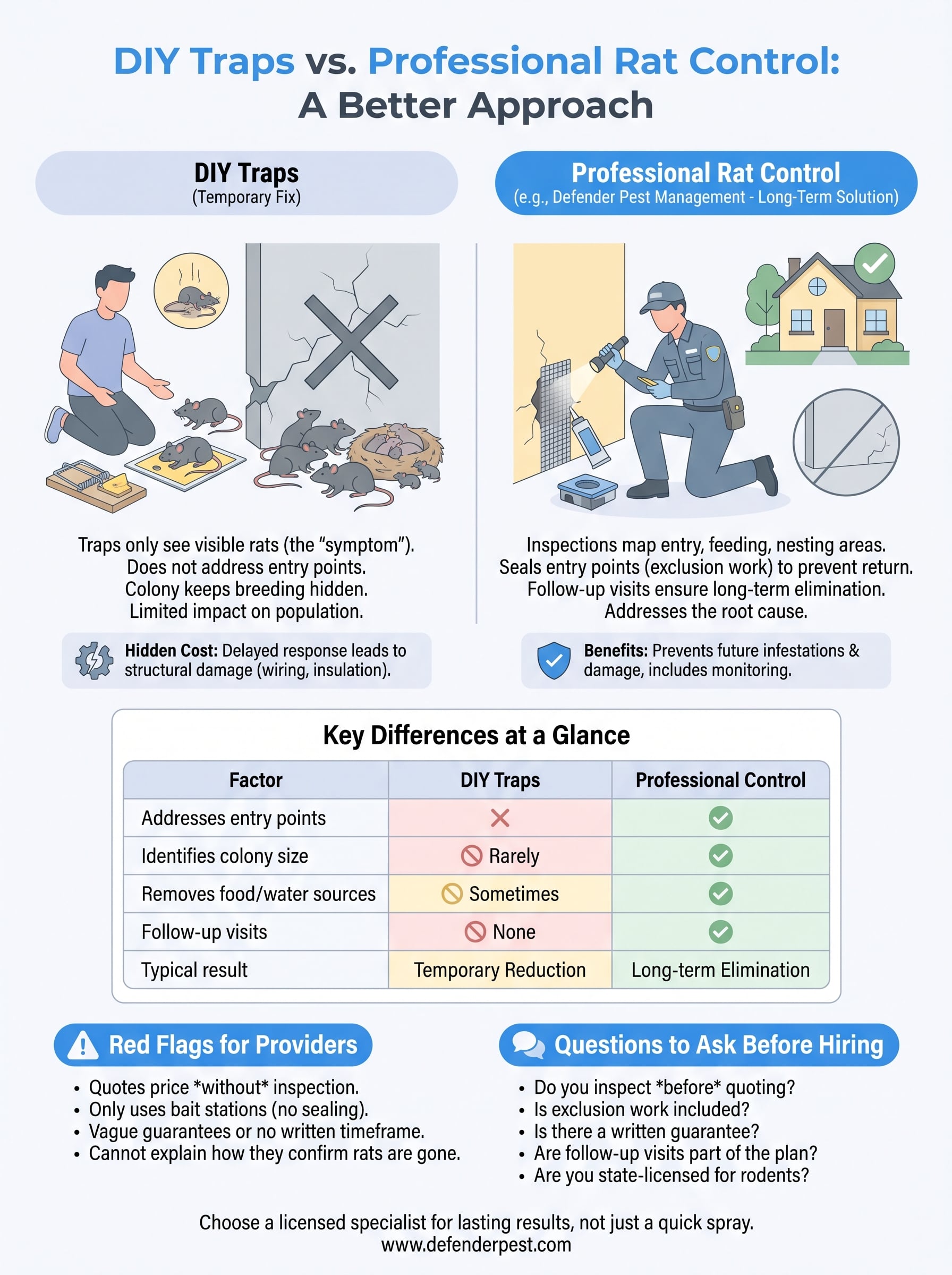
Here's how the two approaches typically compare:
| Factor | DIY Traps | Professional Rat Control |
|---|---|---|
| Addresses entry points | No | Yes, seals gaps and access points |
| Identifies colony size | Rarely | Yes, through inspection and monitoring |
| Removes food/water sources | Sometimes | Always, part of the treatment plan |
| Follow-up visits | None | Scheduled monitoring included |
| Typical result | Temporary reduction | Long-term elimination |
Laid out this way, the pattern is hard to miss: traps deal with the animals you happen to see, while a full rat removal plan and what it costs deals with the reasons rats picked your property in the first place. That's why so many homeowners who try DIY first end up calling a professional anyway, just weeks later and with a larger, more expensive problem. Going straight to a company like Defender Termite & Pest Management skips that detour and saves you both time and repair costs.
Signs you need a rat exterminator now
Rats leave a trail long before you ever see one scurry across a room, and knowing what to look for can save you weeks of wondering. Most homeowners wait for a live sighting before searching for rat control near me , but by then the infestation is usually well established. Recognizing the early warning signs gets you a technician on-site before the colony grows past what a single treatment can handle.
Sounds, smells, and droppings that confirm activity
Scratching in the walls or ceiling at night, especially right after sunset, is one of the clearest signs of nocturnal rodent activity. Add a persistent, musky odor near baseboards or vents, along with dark, pellet-shaped droppings near food storage or under sinks, and you're looking at more than a one-off visitor. Grease marks along baseboards and gnaw marks on wood, wiring, or plastic containers round out the list of signs a trained eye picks up immediately during an inspection, and they also help you tell rats apart from mice before treatment starts.
Seeing one rat in daylight almost always means there's a much larger, nocturnal population you haven't spotted yet.
Why a daytime sighting is a red flag, not a fluke
Rats are naturally nocturnal, so spotting one moving around during the day usually means the nest is overcrowded and competition for food has pushed weaker individuals out into the open. That's not a small problem you can wait on, it's a signal that the colony behind your walls has already outgrown its hiding spots. Waiting even a few more weeks at this stage typically means dealing with double or triple the population by the time you finally call for help.
Quick checklist: when to call a professional
If you notice two or more of these signs, it's time to bring in a licensed technician rather than reach for another box of traps:
- Scratching or scurrying sounds in walls, attics, or crawlspaces
- Fresh droppings near pantries, cabinets, or garages
- Gnaw marks on wires, wood, or stored food packaging
- A strong, musky smell in enclosed spaces
- Grease trails or rub marks along walls and baseboards
- A live rat spotted during daylight hours
Homeowners who act on even one or two of these signs typically resolve the issue faster and cheaper than those who wait for undeniable proof, since early rat control almost always costs less than repairing the damage a mature colony leaves behind.
How to choose the right local pest control company
Not every exterminator who shows up in a search for pest control near me rats actually specializes in rodents. Many general pest companies treat rats the same way they treat ants or spiders, with a quick spray and a few bait boxes, which explains why so many homeowners end up calling a second company after the first one fails. Picking the right provider takes a little research upfront, but it saves you from paying twice for the same problem, and a short list of vetting questions covers most of what you need to know.
Look for licensing and rodent-specific experience
Start by confirming the company holds a current state pest control license and ask directly how much of their work involves rodents versus insects. A technician who handles rats every week will spot entry points and nesting patterns that someone who mostly sprays for spiders will miss. Local, family-owned companies that have served the same region for years, like Defender's Sacramento rat and rodent control team, tend to have this kind of concentrated experience because repeat customers and referrals depend on it.
A license tells you a company is legal to operate, but rodent-specific experience is what actually tells you they can solve your problem.
Check reviews for rat-specific results
General star ratings only tell you so much. Search reviews for the words "rats" or "rodents" specifically, and pay attention to whether customers mention exclusion work, follow-up visits, or lasting results rather than just a friendly technician. A pattern of reviews describing repeat visits for the same rat problem is a warning sign, not proof of good customer service.
Compare quotes with a checklist, not just a price
The cheapest quote is rarely the best value once you factor in callbacks and repairs. Before choosing a local exterminator , compare providers against this short list:
- Do they inspect the property before quoting a price?
- Is exclusion (sealing entry points) included, or billed separately?
- Do they offer a written guarantee with a defined timeframe?
- Are follow-up visits part of the plan or an extra charge?
- Can they explain, in plain terms, how they'll confirm the rats are gone?
A company that answers all five clearly is almost always a safer bet than one offering the lowest upfront number with vague details attached.
What to expect during a professional rat treatment
Once you've hired a company, the process should feel methodical, not like a quick spray-and-go visit. A real rat treatment plan moves through distinct phases, each building on what the last one found, and a technician who skips straight to bait stations without inspecting first is cutting corners you're paying to avoid.
The initial inspection and assessment
Expect the technician to walk your property inside and out, checking the attic, crawlspace, garage, and foundation line for entry points, droppings, and nesting material. They'll ask about noises you've heard, when you hear them, and where you've spotted droppings, since that history helps them map the colony before they touch a single trap. A thorough rodent inspection usually takes 30 to 60 minutes depending on the size of the property, and you should get a written summary of what they found, not just a verbal recap.
A treatment plan built on a real inspection will always outperform one built on guesswork, no matter how many traps get placed.
Exclusion, baiting, and sealing entry points
After the inspection, the technician seals gaps around pipes, vents, rooflines, and foundation cracks with rodent-proof materials like steel wool, hardware cloth, or metal flashing, since even a quarter-inch gap is enough for a rat to squeeze through. Bait stations and traps go in strategic spots identified during the walkthrough, not scattered randomly around the property. This combination of exclusion and baiting is what separates a real rat extermination service from a company that just drops traps and leaves, though what sealing work typically costs varies with the size and condition of the home.
A typical service visit generally includes:
- Sealing identified entry points with durable materials
- Placing tamper-resistant bait stations or snap traps in high-activity zones
- Removing accessible food and nesting material where possible
- Documenting bait station locations for future reference
Follow-up visits and monitoring
One visit rarely finishes the job, since rats already inside need time to feed on bait or get trapped, and technicians need to confirm activity has actually stopped. Most reputable providers schedule a follow-up within one to two weeks to check bait stations, adjust trap placement, and look for new activity. Defender's approach to rodent control builds this monitoring phase into the service from the start, so you're not paying extra just to find out whether the first treatment worked.
Questions to ask before you hire an exterminator
Before you sign a contract, a short phone call can tell you more about a company than any website review page. Asking the right questions upfront weeds out the operations that treat rat extermination as an afterthought to their general pest business, and it gives you a clear record to point back to if the treatment doesn't hold up.
Questions about the treatment plan itself
Good technicians expect these questions and answer them without hesitation, since they've explained this process hundreds of times before. A company that gets vague or defensive when you ask about specifics is telling you something important about how they operate.
- Will you inspect the property before quoting a price, or is this a flat-rate estimate?
- What method will you use to identify entry points, and will you seal them as part of the service?
- How many rats or how large a colony do you estimate based on the signs I've described?
- Will you use bait stations, traps, or both, and where will they be placed?
- How many follow-up visits are included before the job is considered finished?
If a company can't explain how they'll confirm the rats are actually gone, they don't have a real plan, just a service they hope works.
Questions about guarantees, pricing, and licensing
Once you've covered the technical side, shift to the business side. This is where licensed exterminator claims and vague guarantees either hold up or fall apart under a direct question.
- Are you licensed by the state, and can you provide that license number you can verify with California's licensing board?
- Is there a written guarantee, and what exactly does it cover?
- What happens if rats return within the guarantee period? Is the follow-up free?
- Is exclusion work (sealing gaps) included in the price, or billed as an add-on?
- Do you offer emergency service if activity worsens between scheduled visits?
Run through this list with any provider that shows up when you search pest control near me rats , and compare their answers side by side rather than just their quotes. Defender's team walks Sacramento homeowners through these exact points before starting a rodent inspection, since a homeowner who understands the plan is far more likely to trust the results and stick with the follow-up visits that make the treatment stick. A company willing to answer every question clearly, in plain language, is almost always the one that treats your rat problem like a real infestation instead of a quick service call.
Making the right call for your home
Rats don't fix themselves, and every week you spend testing store-bought traps is another week they spend chewing wires and building nests deeper into your walls. The fastest path to a real solution is hiring a licensed rodent technician who inspects first, seals entry points, and follows up until the activity actually stops. Skip the companies that quote a price over the phone without seeing your property, and skip the ones that get vague when you ask about guarantees.
Running a search for pest control near me rats is the easy part. Choosing the right provider is what actually determines whether this is the last time you deal with rodents or just the first of several expensive callbacks. If you want a deeper look at how to find the right rat exterminator near you, including pricing ranges and warning signs, that guide walks through it, and Defender Termite & Pest Management can put a technician on-site in the Sacramento area for an inspection and a straight answer about what it'll take to clear your home for good.