Rodent Control Professional in Philadelphia: 9 Checks to Run
The best rodent control professional in Philadelphia is a licensed, insured company that inspects before it quotes, seals the entry points, and puts its method, price, and guarantee in writing. Row-house owners should weigh exclusion skill most heavily. Landlords and restaurant managers should weigh service records and documentation. Everyone should walk away from a company that quotes by phone and offers only bait.
Every company says it does all of this. Search results give you dozens of names, star ratings that are hard to compare, and quotes that cover different work. Meanwhile the mice or rats keep moving in. You need a way to separate a real professional from a bait-and-leave operation before you hand over any money.
We are Defender Termite & Pest Management, a family-owned company in Sacramento that has handled rodent work since 1999. We cannot service Philadelphia, so this is not a pitch. It is the nine-point check we would want any homeowner to run on us, covering licensing, insurance, inspections, sealing, safety, pricing, guarantees, reviews, and local knowledge.
When a rodent control professional beats DIY
Signs the problem is bigger than a few traps
Hiring a rodent control professional makes sense once you see rodents more than once, hear them in the walls, or cannot find where they get in. One mouse in a garage is a fair DIY job. Repeat activity means a food source, a nesting spot, and an open entry point already exist. These signs point to that situation:

- Droppings in more than one room, or fresh droppings after you have trapped
- Scratching in walls or ceilings at night
- Gnawed wiring, insulation, or food packaging
- Grease smears along baseboards and pipes
- Rats or mice moving around in daylight, which often means a crowded nest
- Pets that fixate on a wall or corner
What a professional does that DIY rarely does
Rodents are hard to beat because they hide, breed fast, and return through the same gaps. Store-bought traps deal with the animals you can see. A professional deals with how they got in and what keeps them there , which is why DIY efforts so often stall after one quiet week.
A trap catches a rodent. A professional stops the next one from getting in.
So is professional help worth it for mice? Yes, when sightings repeat or you cannot find the entry point. Mice fit through gaps about a quarter inch wide and rats through roughly half an inch, so a trained eye spots openings you walk past every day. Rodents also contaminate food and surfaces and chew wiring, so waiting has a real price . For a single mouse and a known gap, a few snap traps and a patch may be all you need.
How to use the nine checks below
Call at least three companies and run each one through the same nine checks. Checks 1 and 2 are pass or fail , because a company without a license or insurance should not be in your home. Checks 3 through 7 separate a good company from an average one. Checks 8 and 9 break ties between finalists.
Keep notes in one place so you compare like with like. Quotes that look far apart are usually covering different scopes of work , and the notes will show you where.
1. Pennsylvania license and applicator certification
Why it matters
A licensed professional has met your state's training and legal requirements for handling pesticides, including rodenticides. In Pennsylvania, the Department of Agriculture regulates pesticide businesses and the applicators who work for them. The EPA's advice on hiring a rodent control professional starts the same way: ask to see the company's license. That one question screens out operators who skip the rules.
If a company cannot show you a license, the conversation is over.
Next, understand who holds what. A larger company may send a technician who works under a certified applicator, which is normal. What you need to know is who holds the certification and who supervises the work in your home.
How to check it
Verify before the technician enters your home, not after the invoice arrives. The EPA suggests calling your state pesticide regulatory agency if you have concerns, and in Pennsylvania that means the Department of Agriculture. Five minutes of checking costs far less than a failed job with no one accountable.
- Ask for the business license number and the name of the supervising certified applicator.
- Ask the technician to show their certification or registration on arrival.
- Confirm with the state agency that the license is current and matches the company name.
- Write the license number into your service agreement.
Warning signs
Be wary of vague claims. "We're fully certified" without a number is not an answer, and a license under a different name than the one on the invoice needs an explanation. Door-to-door crews with no local office are another red flag , because you will have nobody to find if the work fails.
Also refuse any offer to leave rodenticide for you to place yourself. That skips the training and oversight that licensing exists to provide, and it puts pets and children at risk in your home.
2. Liability insurance and bonding
Why it matters
Rodent work happens in attics, crawl spaces, basements, and behind appliances, and things get damaged there. A professional should carry general liability insurance for harm to your property and workers' compensation for injuries to its own employees. The EPA also tells you to make sure employees are bonded, which protects you if an employee steals from you.
Insurance turns a mistake in your attic into the company's bill, not yours.
Without coverage, a technician who falls through a ceiling or cuts a wire can leave you in a dispute with your own homeowner's insurer. For landlords and businesses, the exposure is larger, because a claim can involve tenants, customers, or employees. Ask about coverage even when the job seems small.
How to check it
A verbal "yes, we're insured" proves nothing. Ask for a certificate of insurance and ask that it be sent directly by the insurer or broker, not handed over as a photocopy. A real company can do this the same day.
- Confirm the policy covers pest control work specifically
- Check that the coverage dates include your service date
- Look for both general liability and workers' compensation
- Ask whether employees are bonded
- Ask what happens if a technician damages property, and who handles the claim
Warning signs
Pay attention to hesitation. A company that says it is covered but cannot produce a certificate, or sends one that has already expired , is telling you something. Solo operators who subcontract the actual work to someone else deserve extra questions, because the coverage may not travel with the subcontractor.
Also be cautious when the price is far below every other quote. Skipping insurance is one of the quiet ways a low bid gets low, and you carry that risk once the technician is inside your walls.
3. A full inspection before any quote
Why it matters
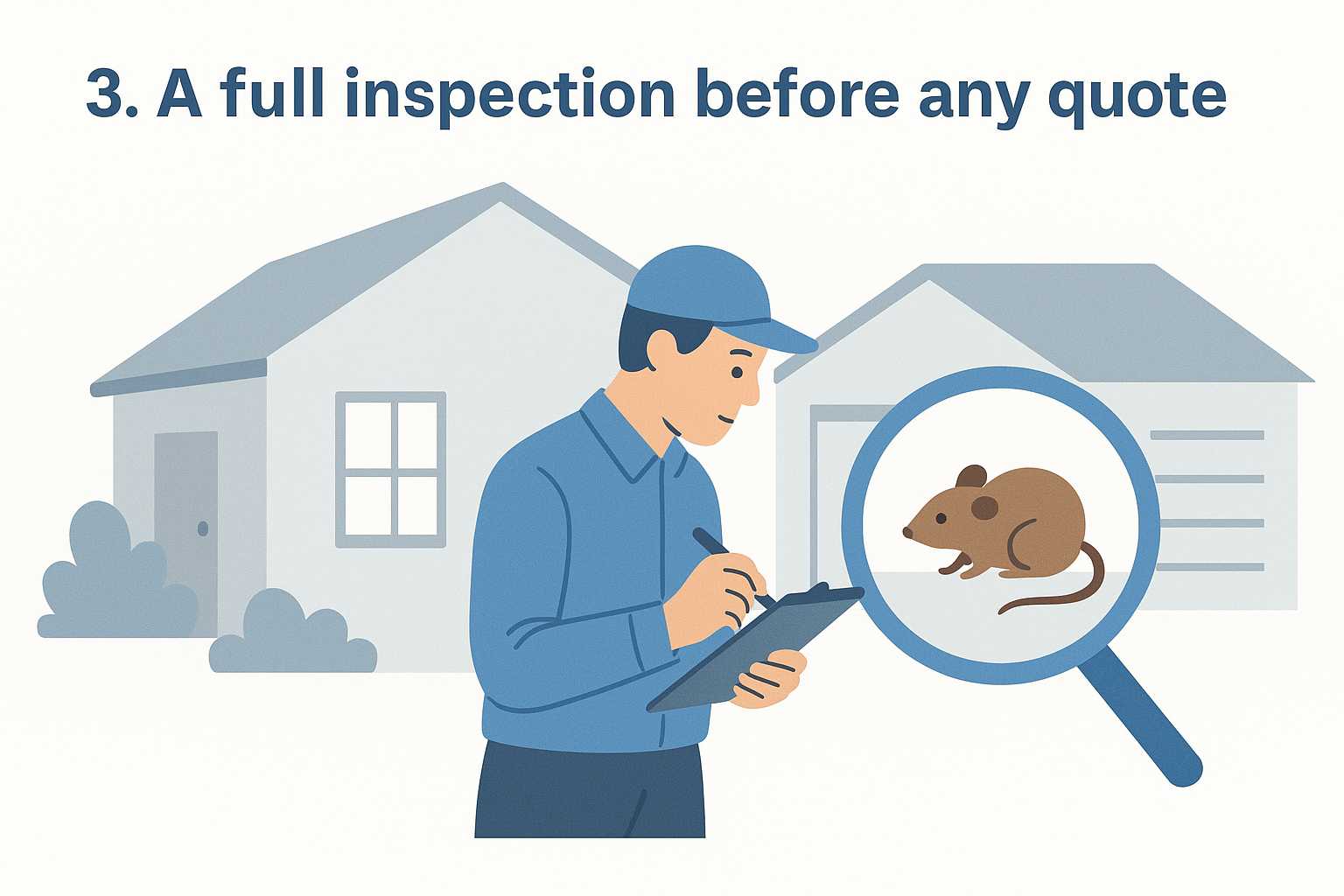
A proper inspection is where real rodent control begins, because it identifies the species, the entry points, the nesting areas, and the food source. Norway rats, roof rats, and mice behave differently, nest in different places, and need different tools. A quote written without an inspection is a guess about all four.
A price given before an inspection is a price for work nobody has defined.
Expect the inspector to start outside, then move through the basement, attic, kitchen, garage, and any sheds. They should look for droppings, grease marks, gnaw marks, burrows, and runways along walls and pipes. A thorough inspection also covers why the rodents came: food, water, clutter, and open gaps.
How to check it
Ask what the inspection includes and what you will receive afterward. A professional should explain findings in plain language and show you evidence, ideally with photos. Then they should lay out a recommended sequence of steps, not a single product.
A useful inspection report contains:
- The rodent species identified, and how they know
- Entry points found, with locations
- Evidence of activity, such as droppings and gnawing
- Conditions that attract rodents, such as food, water, and clutter
- The recommended steps, in order, with the reasoning
Warning signs
Phone quotes are the biggest one. A company that names a price after a two-minute call has not seen your building and will change the number later or skip the hard parts. Another is a walk-through that never reaches the attic, crawl space, or basement, where most activity hides.
Be careful with a "free inspection" that ends in pressure to sign the same day. A professional who knows the problem does not need to rush your decision , and a written report lets you compare companies calmly.
4. Exclusion work that seals entry points
Why it matters
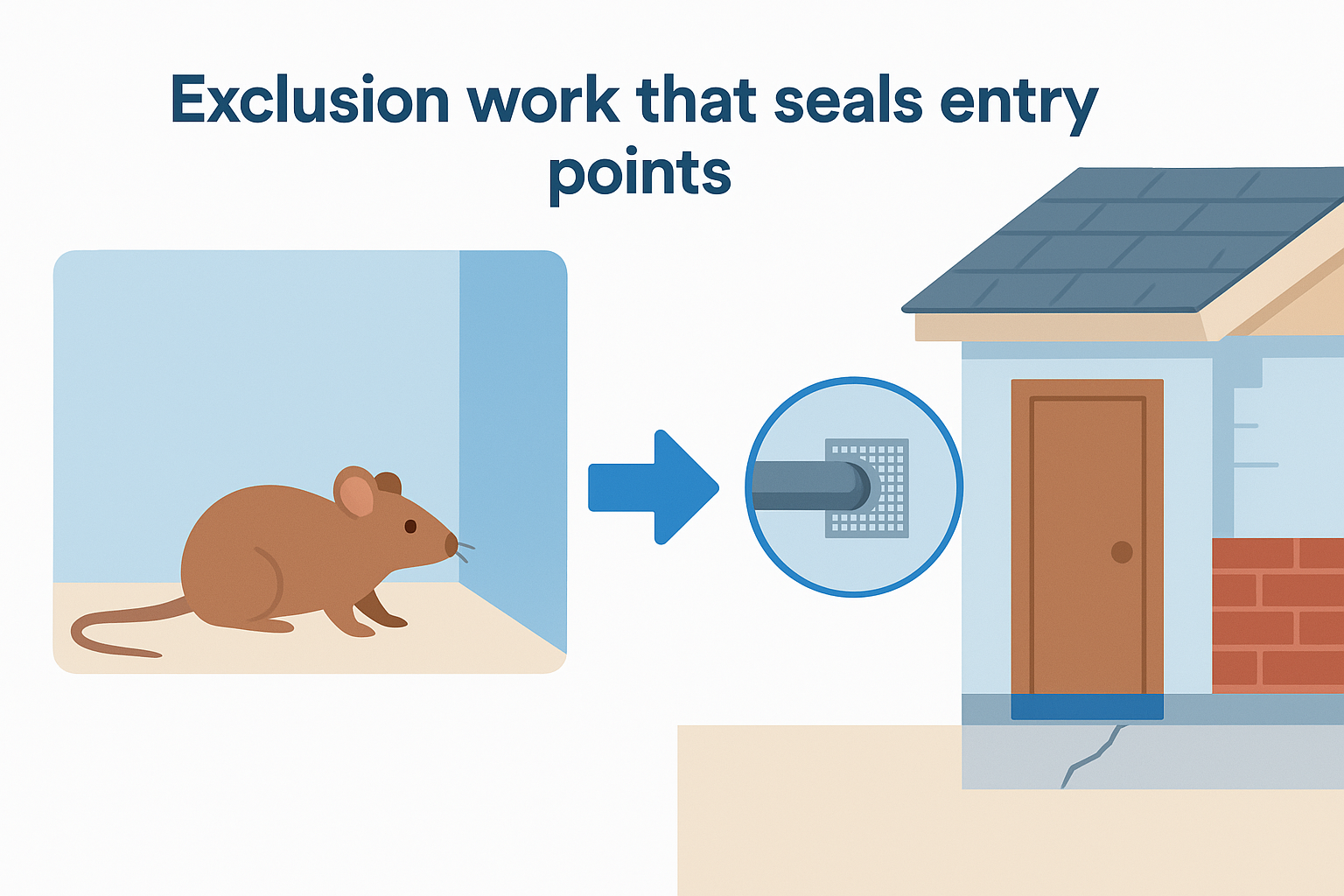
Exclusion means closing the gaps rodents use to get in, and it is the step that stops a problem from coming back. Mice need only about a quarter inch and rats about half an inch, so gaps around pipes, vents, rooflines, foundation seams, and garage doors all count. Trapping without sealing just clears the room for the next group.
Trapping without sealing only clears the room for the next group.
We see this from the repair side too. Defender pairs pest work with construction-grade wood repair, so we are used to rodent damage to fascia, sill plates, and soffits, where the repair is the exclusion . Rodents chew soft materials, so durable fixes matter more than quick ones.
How to check it
Ask which materials the company uses, whether the quote includes sealing, and whether it repairs openings or only recommends repairs. The table shows what a durable fix typically looks like for common entry points.
| Entry point | Durable fix |
|---|---|
| Utility pipe and cable openings | Metal mesh or sheet metal collar, sealed in place |
| Gaps under garage and exterior doors | New door sweeps and a rodent-resistant threshold |
| Vents and soffits | Hardware cloth or heavy screening |
| Foundation cracks | Masonry or cement-based patch |
| Roofline and eave gaps | Metal flashing and wood repair |
Also ask for before-and-after photos. A technician who is proud of the sealing work will be glad to show it.
Warning signs
Be skeptical of any plan that is bait-only , with no mention of entry points. Monthly bait visits that never end are a business model, not a solution, because the gaps stay open. Another sign is a plan that relies on expanding foam or plain caulk alone, which rodents chew through.
A vague promise to "seal up what we find" with no line item in the quote is also worth questioning. If exclusion is not written down, it may not happen .
5. Treatment methods that are safe for your household
Why it matters
Method matters because rodenticides can harm more than rodents. Pets, children, and wildlife can be poisoned by eating bait directly, or by eating poisoned rodents. The EPA publishes guidance on rodenticide risks, and a good professional will explain what they plan to use and why it is safe in your setting.
The right treatment plan names every product, every location, and every reason.
Many professionals lead with snap traps, sealing, and tamper-resistant bait stations placed along travel routes, using bait only where it is needed. That approach reduces risk and gets better results, because the plan targets how rodents actually move through your building.
How to check it
Ask for specifics, and expect real answers. A professional who has done this for years can explain the plan in two minutes and will not be annoyed by safety questions. Pet owners and parents should ask these before signing:
- Which products will you use, and where will you place them?
- Are bait stations tamper-resistant and locked?
- How will you find and remove dead rodents, including any in walls?
- Can I see the product label or safety data sheet?
- What do I need to do with pets, food, and children during treatment?
Dead rodents in wall voids can cause odor, so a good technician will explain how they handle that possibility up front.
Warning signs
A company that will not name its products is hiding something. So is one that scatters loose bait in open areas, or proposes a single spray as the solution to rodents. Neither addresses where the animals live or travel.
Heavy reliance on glue boards is another concern. They are considered inhumane and often catch non-target animals such as lizards or birds. If a technician's answer to everything is "we'll put out more bait," keep looking.
6. A written quote with clear scope and pricing
Why it matters
Cost is a legitimate part of your decision, but a bare number tells you little. Rodent jobs vary with species, building size, number of entry points, and whether structural repair is needed. That is why reputable companies quote after an inspection and itemize the work . We leave dollar figures out here on purpose, because an invented average would mislead you.
Compare what each quote includes before you compare what it costs.
Expect a quote to cover the inspection, sealing, treatment, follow-up visits, and any repairs. A cheaper quote that leaves out sealing or follow-ups usually costs more once the rodents return . Scope is what you are really buying.
How to check it
Ask each company for a written quote and line them up side by side. These are the factors that move the price, and each should be visible in the document:
| Cost factor | Why it changes the price |
|---|---|
| Species and infestation size | Rats and larger colonies need more visits and equipment |
| Number and type of entry points | More gaps and harder materials mean more sealing labor |
| Building size and access | Attics, crawl spaces, and shared walls add time |
| Structural repair | Damaged wood, insulation, or masonry adds a separate cost |
| Follow-up visits | A longer monitoring period costs more but catches problems |
| Residential or commercial | Businesses may need documentation and recurring service |
Warning signs
Watch for flat prices quoted without seeing the property, large upfront payments before any work, and "special price, good today only" pressure. Be cautious about per-visit bait plans with no defined end point , because they let the bill run while the entry points stay open.
Also ask what is not included. A low quote with a long list of add-on charges is not a low quote. The honest company tells you early what could raise the total, such as hidden damage found in a wall.
7. A guarantee with real follow-up visits
Why it matters
Rodent work is not done when the technician drives away. A good guarantee says what is covered, for how long, and what triggers a free return visit. Rodents can find a missed gap weeks later, so follow-up visits are where problems get caught early instead of becoming a second infestation.
A guarantee you cannot read is a guarantee you do not have.
A common structure is an initial service, then scheduled check visits to inspect traps and stations, adjust the plan, and confirm activity has stopped. Sealing and repair work may carry its own warranty on the repair itself. Ask which parts of your job carry which promises.
How to check it
Get the guarantee in writing and read it before you pay. Ask how quickly the company responds if activity returns, since rodents do not keep business hours. Defender offers 24/7 emergency service for exactly this reason, and response time is worth asking about everywhere.
- How long does the guarantee last, and what does it cover?
- What voids it?
- Are return visits free during the guarantee period?
- Who pays if rodents find a new entry point?
- For businesses, will you provide service reports and monitoring records?
Warning signs
"Satisfaction guaranteed" with nothing on paper is marketing. So is a guarantee voided by vague conditions like "if conditions change." Be careful with long contracts for a one-time problem, because you may end up locked into recurring charges you do not need.
If a company is reluctant to put its guarantee in the contract, treat that as the answer. A promise made only out loud does not survive a disagreement.
8. Reviews that hold up to scrutiny
Why it matters
Reviews show how a company behaves when something goes wrong, which a license cannot. There is no single best rat exterminator in Philadelphia for everyone, because the best fit depends on your building type, budget, and whether you need residential or commercial service. The company that passes the other checks and has a consistent record is the one to call.
Read the middle reviews first. They show how a company handles trouble.
Look for reviews that describe rodent work specifically . A company with hundreds of reviews about lawn spraying tells you little about how it handles a rat in a basement wall.
How to check it
Check several places, such as the company's Google Business Profile, Yelp, and Better Business Bureau listing, and compare what you find. Then read with a purpose. Specific details are more useful than stars, and patterns across reviews matter more than any single one.
- Read the three-star and one-star reviews, then the owner's replies
- Look for specifics: technician names, what was done, whether rodents came back
- Check the dates and spread, since steady reviews over years beat a sudden burst
- Ask for references, especially for commercial work
- Ask neighbors with a similar building type who they used
Warning signs
A burst of near-identical five-star reviews in a short period is suspicious. So is a rating built entirely on other services when you need rodent work. Reviews posted to a national brand page may not describe the local branch that will actually serve you.
Be wary of a company that has no reviews anywhere and no references to offer, or that operates under several business names. Defensive or hostile owner replies to criticism show how a complaint about your job would go.
9. Philadelphia building and neighborhood know-how
Why it matters

Philadelphia buildings create rodent problems that differ from suburban houses. Attached row homes share walls and rooflines, so activity passes between neighbors. Older masonry and basements have gaps, and alleys and trash set-out give rats food. A rodent control professional who works in your area recognizes these patterns and plans for them.
Shared walls mean a rodent problem is rarely one household's problem.
The rat most often seen around city streets, alleys, and basements is the Norway rat, while roof rats climb and favor attics and upper spaces. The city also has its own reporting channels . Philadelphia's Department of Public Health handles rat reports for residences and public parks, while activity around food businesses is directed to the Office of Food Protection. Check the city's current process before you file.
How to check it
Ask how many row homes or similar buildings the company works on, and how it handles shared walls. For commercial rodent control, ask about documentation that supports health inspections.
- Do you inspect party walls, basement drains, and rear alleys?
- Can you coordinate with my landlord or neighbors if activity crosses units?
- Do you have a local office and technicians who live in the area?
- For a restaurant or shop, do you provide service logs and reports?
Warning signs
Be cautious of a script that sounds identical no matter what building you have. A company that never mentions party walls , drains, or exterior harborage around a row house may not understand the problem it is quoting.
Other signs include no local address you can verify, no plan for coordinating with neighbors or a landlord, and technicians dispatched from far away with no local accountability . Local knowledge is the difference between sealing your side and solving the problem.
Choosing with confidence
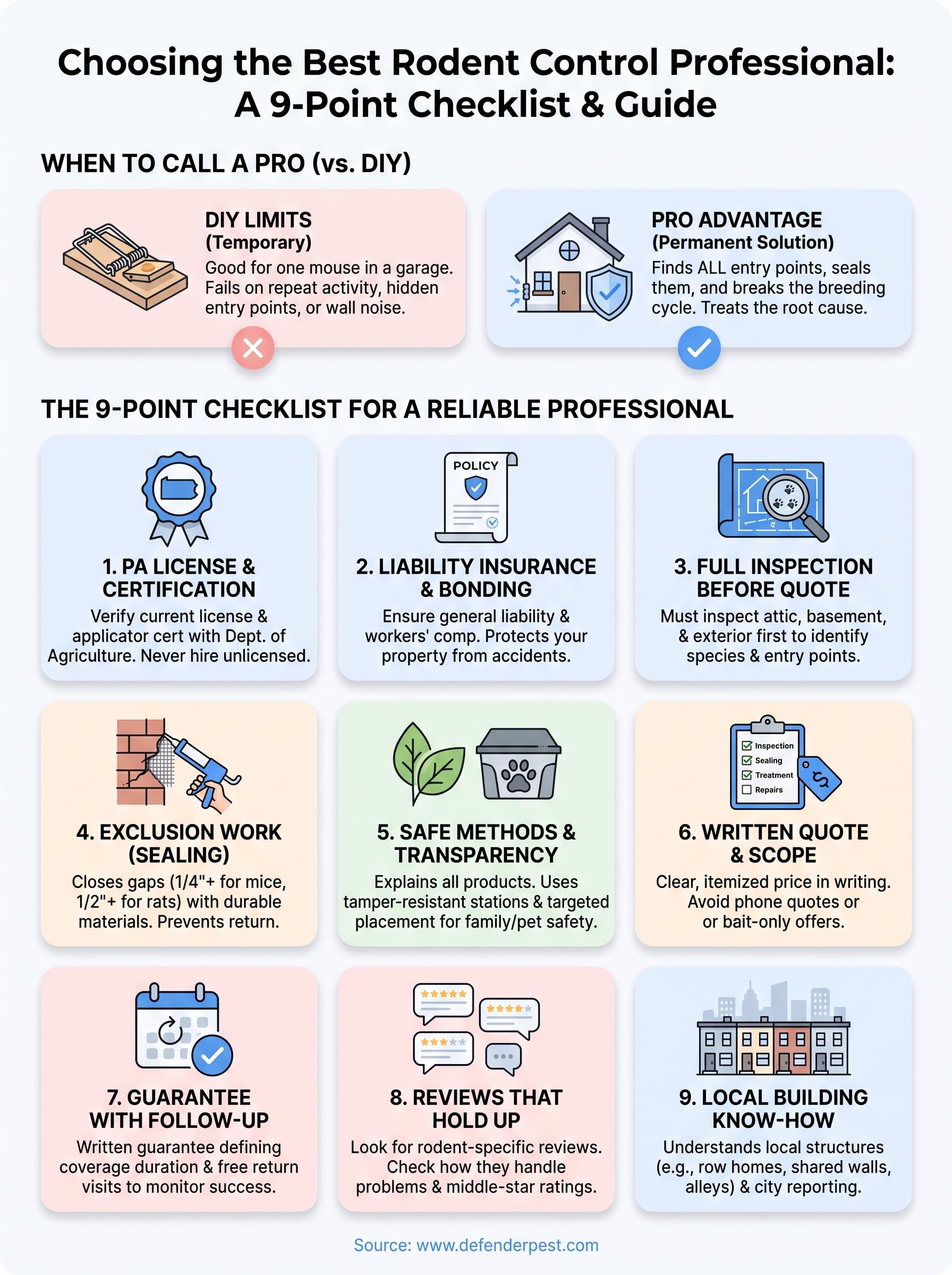
The nine checks come down to one idea. A good rodent control professional proves who they are, inspects before pricing, seals what they find, explains what they use, and stands behind the work in writing. Licensing and insurance are pass or fail. Inspection, sealing, safety, pricing, and guarantee separate strong companies from average ones. Reviews and local knowledge settle the tie.
Run the same checklist on every company you call and the right choice becomes clear, usually within a few phone calls. You do not need to find the one perfect name. You need a company that passes every check and puts it on paper.
We cannot help in Philadelphia, but if you are in the Sacramento area and need the same standard of work, you can request a rodent control estimate from Defender and we will inspect first, seal what we find, and put the plan in writing.