Rat and Rodent Control: How to Choose a Pro
You've heard the scratching in the attic at 2 a.m., found droppings behind the pantry, or noticed a gnawed wire in the garage. At that point, DIY traps and store-bought bait stop being enough, and you start searching for rat and rodent control that actually works. The problem is that Sacramento has no shortage of pest companies claiming they can handle it, and picking the wrong one means paying twice: once for a treatment that fails, and again for the actual fix.
This guide answers the question homeowners and property managers ask us every week: how do you tell a legitimate rodent control professional from someone who's just going to set a few snap traps and disappear? We'll walk through the licensing and inspection standards that separate real exterminators from door-to-door operators, plus the exclusion work (sealing entry points, not just killing what's already inside) that determines whether rodents come back in six months.
By the end, you'll know what questions to ask, what a fair quote looks like, and why a company that also handles structural repair, like ours here at Defender, often catches damage that pure pest-control outfits miss entirely.
Why hiring a rodent control professional makes sense
Rats breed fast. A single female Norway rat can produce six litters a year, with up to a dozen pups each time, which means the two rodents you spotted last month can turn into a colony of forty before you've even ordered a second box of traps. Store-bought bait stations work on the rats brave enough to walk into them, but they do nothing about the ones hiding in your attic insulation or the nest under your shed. That's the gap professional rodent control services are built to close: they don't just kill what's visible, they map the whole infestation, using a combination of sealing, sanitation, trapping, and baiting methods instead of one tactic.
Growing colonies also cause damage you can't see from the kitchen. Rats gnaw constantly to keep their incisors from overgrowing, and they'll chew through wiring insulation, PVC pipe, and wood framing without hesitation. The National Pest Management Association has linked rodent gnawing to a measurable share of house fires nationwide, since chewed wiring is a known ignition source. Structural damage from rodents often stays hidden behind drywall until a contractor (or a termite inspector) opens the wall for an unrelated reason, which is why attic rodent proofing and insulation restoration matters as much as the trapping.
A few dead rats in a trap doesn't mean the problem is solved, it means you've thinned the herd while the survivors keep breeding.
Health risks matter just as much as property damage. Rodents carry hantavirus, leptospirosis, and salmonella, and their droppings can trigger asthma symptoms when disturbed during cleanup. Licensed pest professionals know how to handle contaminated insulation and droppings safely, using PPE and containment methods that most homeowners skip entirely. The Centers for Disease Control specifically warns against sweeping or vacuuming rodent droppings dry, since it aerosolizes the pathogens; a trained technician sprays a disinfectant first, then removes material safely.
Experience also shortens the timeline. A technician who's inspected hundreds of Sacramento attics recognizes a rat runway, a gnaw mark pattern, or a grease trail along a joist in seconds, where a homeowner might spend weeks guessing. Local expertise matters here too: rats in older Sacramento neighborhoods often enter through foundation vents and roof lines that look nothing like the entry points common in newer Elk Grove or Roseville construction. Getting someone who's worked your specific area saves you from a generic treatment plan that ignores how your house is actually built.
Finally, professional treatment comes with a plan for prevention, not just extermination. A pro seals entry points, sets bait stations in a monitored pattern, and schedules a follow-up inspection, so you're not back to square one after the first cold snap sends rats looking for shelter again.
Step 1. Confirm you have a rat or rodent problem
Before you call anyone, spend a day confirming what you're actually dealing with. Not every scratching noise means rat infestation , and plenty of Sacramento homeowners have paid for a full treatment plan when the real culprit was a squirrel in the eaves or a one-time mouse that wandered in during a cold snap. A quick self-check saves you from over-treating a minor issue or, worse, underestimating a serious one.
Signs your rodent problem is real
Walk your attic, garage, and exterior foundation line looking for these specific clues:
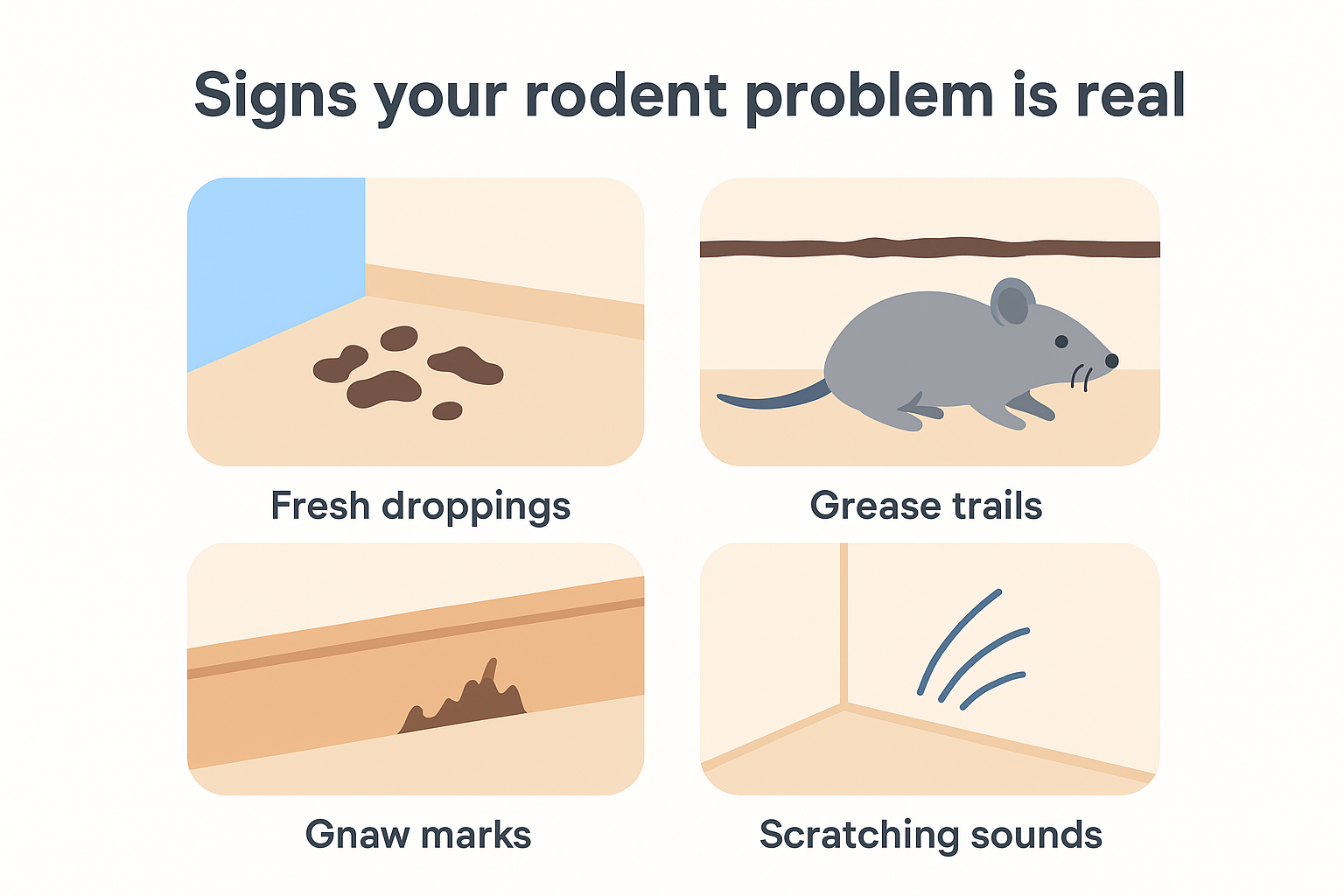
- Fresh droppings , dark and moist near food sources or nesting areas (older droppings turn gray and crumbly)
- Grease trails along baseboards or joists, left by oily fur brushing the same path night after night
- Gnaw marks on wood, wiring insulation, or plastic piping
- Scratching sounds at night, especially in walls or the attic
- Nesting material , shredded insulation, fabric, or paper balled up in corners
Mice or rats? Why the distinction matters
Identifying the species changes the treatment plan. Roof rats climb and nest high, Norway rats burrow near foundations, and house mice squeeze through gaps as small as a dime, so learning how to identify rats or mice in your house fast pays off before anyone quotes you. Guessing wrong means bait stations placed in the wrong spots and entry points left unsealed.
The species you're dealing with determines where a technician looks first, guess wrong and you'll be treating the wrong half of the house.
If you've spotted two or more of these signs, it's time to move past DIY and start comparing local rodent control companies , which is exactly what step two covers.
Step 2. Build a shortlist of local rodent control companies
Once you've confirmed an active infestation, resist the urge to hire the first name that pops up in a search. Sacramento has dozens of pest companies, but not all of them specialize in rodent exclusion work , and some subcontract the actual labor to whoever's available that week, so it helps to know how to choose pest control and rodent control services before you dial. Building a shortlist of three or four candidates gives you room to compare instead of settling out of desperation at 2 a.m. when you hear scratching again, and a side-by-side look at the best rodent control service options near you speeds that up.
Where to look
Start with sources that reflect real customer experience rather than paid placement:
- Google Business Profile reviews , filtered for recent posts (last 6 to 12 months) since ownership and technicians can change
- Neighborhood platforms like Nextdoor, where locals mention which companies actually solved their problem versus which ones just sold a service contract
- Referrals from your real estate agent or property manager , especially if you're near an older Sacramento neighborhood where entry points are common knowledge
- State licensing lookup through the California Structural Pest Control Board, which lets you verify a company's license status before you ever pick up the phone
What to filter for
Narrow your list to companies that explicitly mention rodent control as a specialty, not just a line item buried under general pest services. A company that only lists ants and spiders on its homepage probably treats rats as an afterthought.
A company's homepage tells you what they're good at selling, not what they're good at solving, check licensing and reviews before you trust the pitch.
Aim for three to four names before moving to the next step, where you'll start asking each one how they actually inspect and treat a property, not just how fast they can show up.
Step 3. Compare inspection and treatment approaches
Call each company on your shortlist and ask how they run a rodent inspection , not just how much it costs. A thorough technician walks the attic, crawl space, foundation line, and roof perimeter looking for entry points, not just the room where you found droppings. If the person on the phone can't describe what happens during an inspection, that's a red flag before you've even scheduled a visit.
Questions to ask every company
Use this list on every call so you're comparing apples to apples:
- Do you inspect the full exterior, including roofline and foundation vents, or just the area I report?
- Do you offer rodent exclusion (sealing entry points) or only bait and trap placement?
- What bait or trap types do you use, and are they safe around pets and kids?
- How many follow-up visits are included after the initial treatment?
- Do you provide a written inspection report with photos?
Why exclusion work separates real pros from trap-and-go operators
Baiting alone kills rodents already inside, but it does nothing to stop the next wave from squeezing through a gap under the eaves. A company that includes entry point sealing , using steel wool, hardware cloth, or sealant on gaps as small as a quarter inch, is treating the actual cause. One that only sets traps is treating the symptom.
Bait kills what's already inside, exclusion stops the next one from getting in, and only one of those actually ends the problem.
Compare the answers you get against a simple checklist: full-property inspection, documented entry points, exclusion materials specified by name, and a written report you can keep for future reference or a real estate disclosure. Companies that hesitate on any of these points usually cut corners somewhere else too.
Step 4. Check pricing, guarantees, and credentials
Once you've narrowed your list based on inspection quality, the last filter is money and paperwork. A fair rodent control quote in the Sacramento area typically covers the initial inspection, trap or bait placement, and at least one follow-up visit within 30 days, so it's worth knowing how rat removal works and what it costs before you compare numbers. If a quote seems unusually low, ask what's excluded, since exclusion work and attic cleanup often get tacked on as separate line items later, and average sealing prices run from a few hundred to well over a thousand dollars.
What a written estimate should include
Before you sign anything, make sure the estimate spells out these specifics in writing:
- Scope of work , including which areas of the property get treated and sealed
- Materials used , such as bait station type or exclusion hardware
- Number of follow-up visits included in the base price
- Warranty or guarantee terms , including what voids coverage
- Total cost , with no vague "starting at" pricing
Guarantees worth asking about
Guarantees separate companies confident in their work from ones hoping you won't call back. Ask whether the guarantee covers a return visit at no charge if rodents reappear within a set window, commonly 30 to 90 days, and whether that guarantee extends to new entry points the technician missed the first time.
A guarantee with a real time window and no fine print about "new activity" tells you the company stands behind its own exclusion work.
Verify credentials before you sign
Don't take a technician's word for licensing. Every legitimate operator in California carries a license from the Structural Pest Control Board, and you can confirm it in under a minute through the board's contact and licensing information. Insist on proof of liability insurance too, since attic and crawl space work carries real risk of property damage. Rodent control companies that hesitate to share license numbers or insurance certificates usually have a reason, and it's rarely a good one.
Finding the right team for a rodent-free home
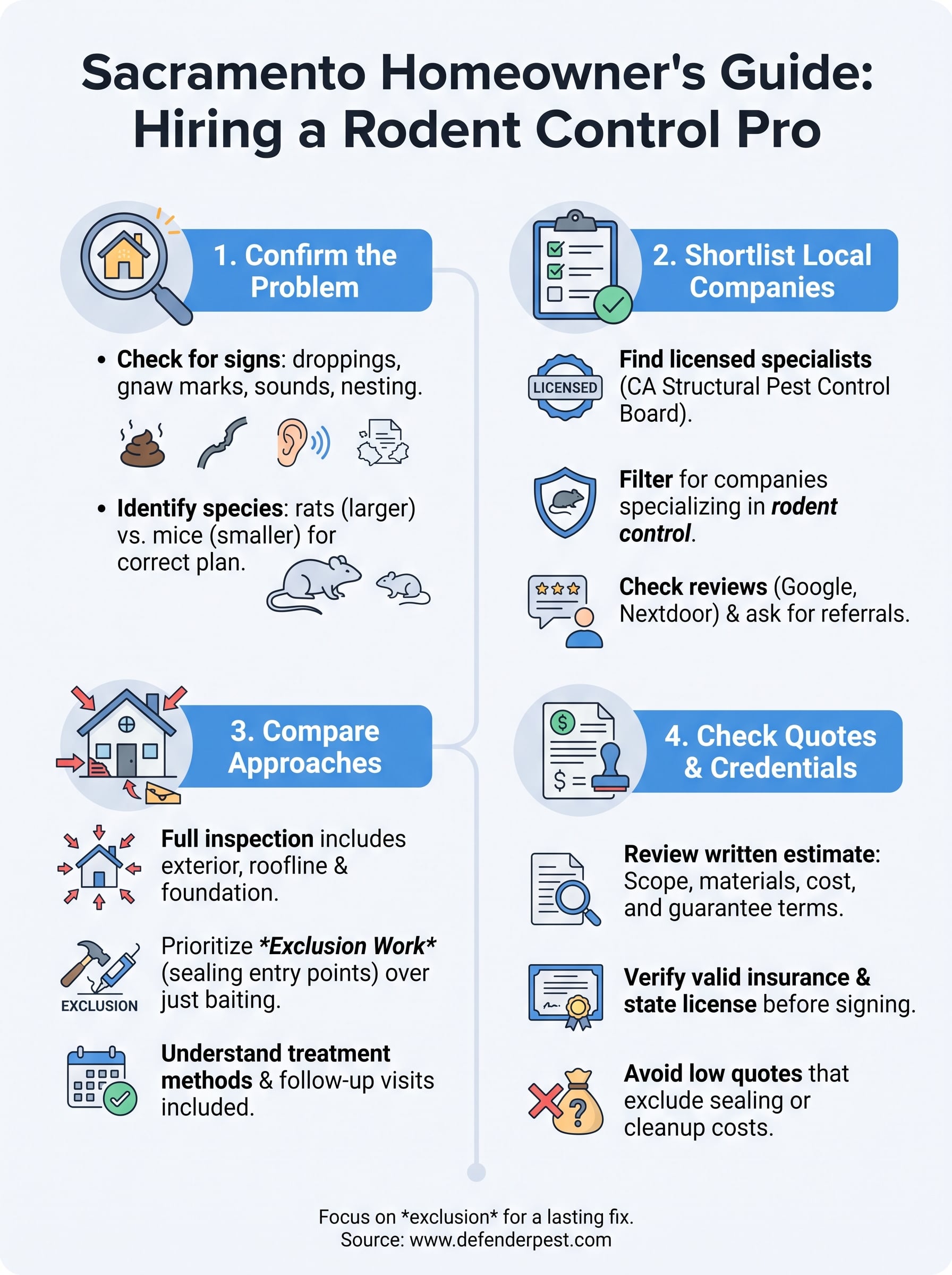
A rodent problem doesn't fix itself, and the wrong hire just delays the real solution while rats keep breeding in your attic. Confirming the infestation, shortlisting licensed companies, comparing inspection depth, and checking guarantees in writing gives you a repeatable process instead of a gamble on whoever answers the phone first. Exclusion work is the detail that separates a lasting fix from a temporary one, so don't let any company skip it.
Getting your rat and rodent control right the first time saves you money, protects your home's wiring and framing, and lets you stop listening for scratching at 2 a.m. If you're in the Sacramento area and want a team that inspects thoroughly, seals entry points, and can even repair the wood damage rats leave behind, request a quote for rat and rodent control in Sacramento from Defender Termite & Pest Management and get a straight answer about what your property actually needs.