How to Choose Pest Control and Rodent Control Services
You hear scratching in the attic at 2 a.m., or you spot droppings behind the pantry, and suddenly you're searching for help fast. Choosing pest control and rodent control services under pressure is tough, especially when every company website promises the same thing: fast response, guaranteed results, fair pricing. Sacramento homeowners deal with this constantly, from ants in the kitchen to rats nesting in the garage.
If you're typing " rat removal services near me " into your phone right now, you need a way to tell the real professionals apart from the ones who'll take your money and leave the problem half-solved. That means knowing what licensing to check, what a fair quote actually looks like, and which red flags signal a company that cuts corners.
This guide walks through exactly how to vet a pest and rodent control company, from verifying credentials to comparing treatment plans , so you can hire with confidence instead of guessing. We'll also cover what separates a one-time exterminator visit from a company built for long-term prevention, something we've handled in the Sacramento area since 1999.
What pest and rodent control services actually cover
Most homeowners assume "pest control" is one service, but it's actually a bundle of different specialties that require different tools, chemicals, and expertise. Understanding this upfront helps you ask the right questions and avoid paying for a generic treatment when you actually need something specific, like rodent exclusion or a termite inspection tied to a real estate sale. Pest control and rodent control often get lumped together in marketing, but the methods behind them are distinct enough that some companies specialize in one and outsource the other.
Residential and commercial pest control
Residential treatments usually target ants, spiders, cockroaches, and seasonal invaders like wasps or silverfish. A standard visit includes an inspection, exterior perimeter treatment, and interior spot treatment in kitchens, bathrooms, and entry points. Commercial accounts work differently. Restaurants, warehouses, and multi-unit properties need documented compliance programs that satisfy health inspectors, which means scheduled visits, service logs, and sometimes bait station mapping. If you manage a business, ask whether the provider offers commercial pest control programs built around regulatory paperwork, not just spray-and-go visits.
Termite inspections and structural protection
Termites cause damage that homeowners insurance typically won't cover, so this category deserves its own line item in your research. A proper termite service includes a visual inspection, moisture readings in crawl spaces, and a written report, often required for home sales in California. Some companies stop there and hand you a list of contractors for repairs. Others, like Defender, combine termite inspections and structural wood repair under one roof, so you're not coordinating between an exterminator and a separate carpenter after the damage is found.
Termite damage repair and termite elimination are two different jobs, and the strongest providers handle both without a subcontractor in between.
Rodent control and exclusion work
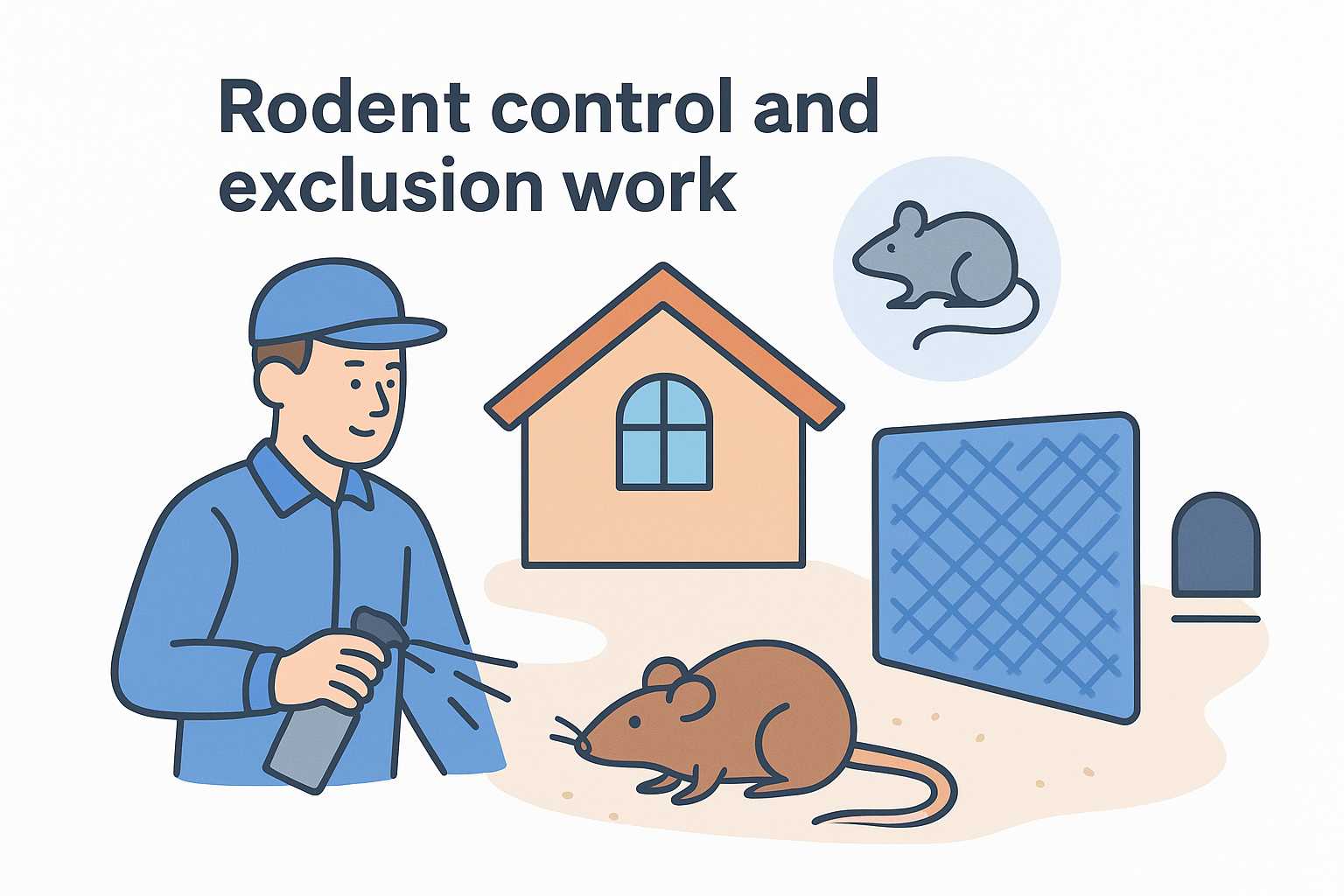
Rodent control is its own discipline because rats and mice don't respond to the same baits or barriers as insects. Effective service includes trapping, sanitation guidance, and rodent exclusion work, meaning physical repairs to vents, foundation gaps, and roofline entry points where rodents get in. If a company only sets traps without sealing entry points, you'll be calling them back within months. This is exactly why searches for rat removal services near me often lead people to Sacramento rodent control services rather than general pest packages.
Lawn care and emergency service
Outdoor spaces need attention too. Grubs, chinch bugs, and other lawn-damaging insects can wreck landscaping fast, and lawn insect control services are a separate treatment track from indoor pest work. On top of that, infestations don't wait for business hours, so confirm whether a provider offers 24/7 emergency response for situations like a wasp nest near a doorway or a sudden rodent breach.
| Service Type | What It Covers | Typical Trigger |
|---|---|---|
| Residential pest control | Ants, spiders, roaches, seasonal insects | Ongoing prevention or active sighting |
| Commercial pest control | Compliance documentation, scheduled visits | Health code requirements |
| Termite services | Inspection, detection, elimination, wood repair | Real estate sale or visible damage |
| Rodent control | Trapping, exclusion, sanitation advice | Scratching noises, droppings |
| Lawn care insect control | Grub and chinch bug treatment | Dying or damaged turf |
| Emergency service | Same-day or after-hours response | Sudden infestation or nest |
Knowing which category your problem falls into makes the next step, actually diagnosing the issue, much faster.
Step 1. Identify your pest or rodent problem
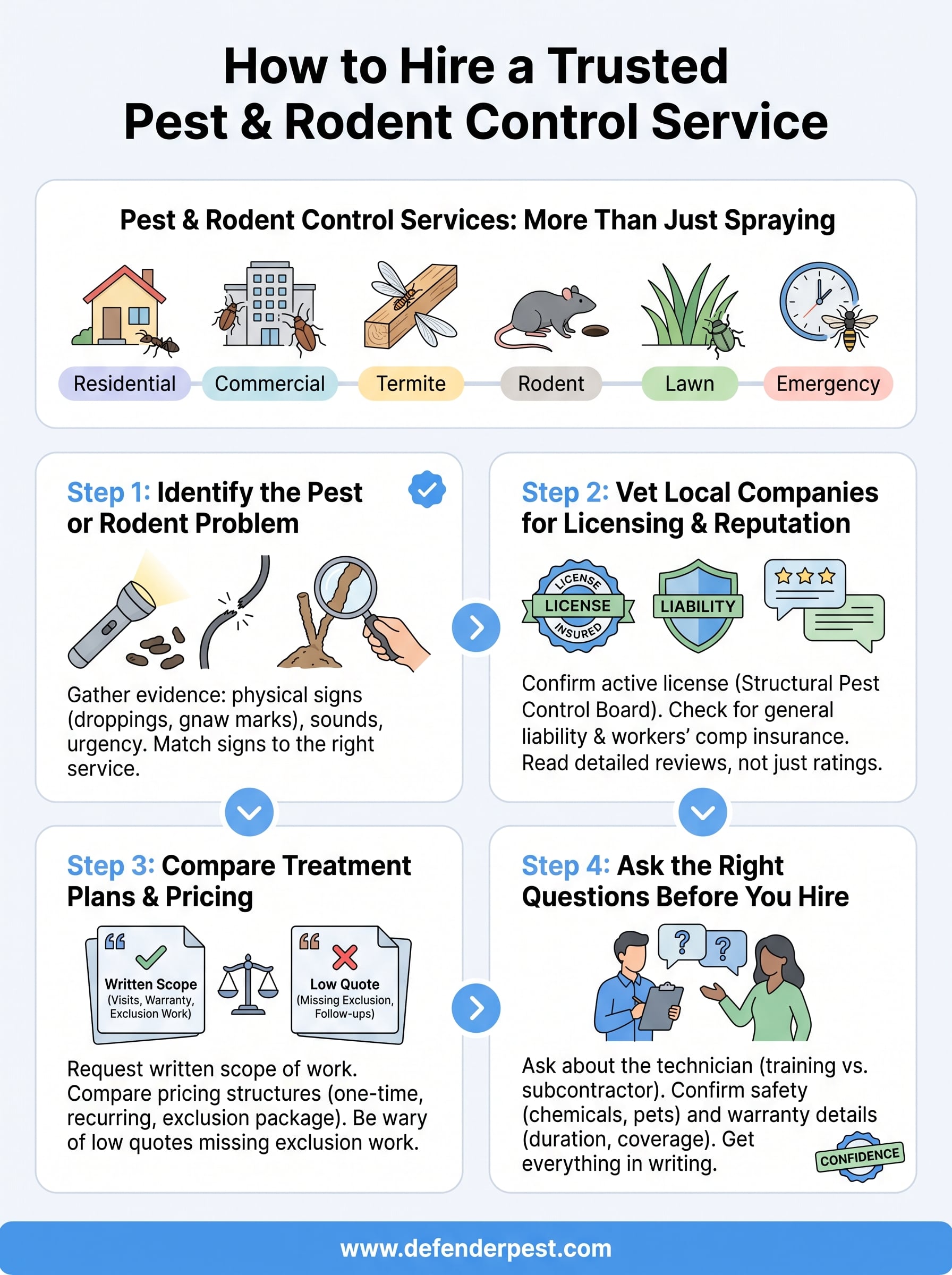
Before you call anyone, spend ten minutes gathering evidence. Correctly identifying the pest determines everything downstream: which company you need, what treatment they'll recommend, and roughly what it should cost. Guessing wrong here means paying for a general pest visit when you actually have a rodent exclusion problem, or vice versa.
Look for the physical signs
Grab a flashlight and check the usual trouble spots: attic corners, under sinks, along baseboards, and the garage. Droppings, gnaw marks, and grease trails along walls point to rodents, and there are quick ways to tell whether you have rats or mice. Discarded wings near windowsills or mud tubes along your foundation point to termites. Live sightings of ants, roaches, or spiders during the day, especially in large numbers, usually mean an established colony rather than a stray invader.

Match the signs to the right service
Once you've spotted evidence, match it against a shortlist so you know what to ask for when you call:
- Scratching sounds at night, droppings, chewed wiring : rodent control and exclusion
- Mud tubes, hollow-sounding wood, discarded wings : termite inspection
- Visible ants, roaches, or spiders indoors : home pest control in Sacramento
- Dying patches of lawn despite normal watering : lawn care insect control
- Wasp nests, sudden infestations, bites overnight : emergency pest service
Matching the right symptom to the right service saves you from paying for a treatment that was never designed to solve your actual problem.
Consider the scope and urgency
Think about how widespread the issue is and how fast it's moving. A single ant trail in the kitchen is different from droppings in three separate rooms, which usually signals an established rodent population rather than a single mouse passing through. Urgency matters too. Structural pests like termites rarely require same-day action, since the damage accumulates slowly, but a rodent breach near food storage or a wasp nest by your front door often does. Sacramento's climate adds another wrinkle: dry summers push rodents and ants indoors searching for water, while wet winters bring termite swarms out of hiding, so the season itself can hint at what you're dealing with.
Document what you find with a few photos and notes on location before you call anyone. It speeds up the phone consultation and helps the company send a technician equipped for the actual job instead of a generic first visit that ends with a second appointment.
Step 2. Vet local companies for licensing and reputation
Once you know what you're dealing with, narrow your list to companies that can actually prove they're qualified. Licensing and insurance aren't paperwork formalities, they're your protection if a technician damages your property or misapplies a chemical. Skipping this step is how homeowners end up with unlicensed operators running door-to-door scams after storms or termite swarm season.
Confirm the license is active
Every pest control company operating in California needs a license from the Structural Pest Control Board, and you can verify a company's license number on the board's public lookup tool in under a minute. Ask for the license number directly if it's not posted on the website, check it against the Structural Pest Control Board's licensing records, and be wary of anyone who hesitates to provide it. Also confirm the company carries general liability and workers' compensation insurance , since you don't want to be liable for an injury that happens on your property during treatment.
A company that can't produce a license number on request isn't one you should let inside your home.
Read reviews for patterns, not star ratings
Star averages tell you almost nothing on their own. Read the actual text of recent reviews, especially the ones mentioning rat removal services near me , follow-up visits, or how the company handled a problem that came back, and compare them against what finding a trusted rat exterminator should look like. Look for specifics: did the technician explain the treatment plan, show up on time, seal entry points instead of just setting traps? A handful of detailed, recent reviews matter more than hundreds of generic five-star ratings.
Check for real local roots
Some outfits that dominate search results are national franchises with rotating technicians and call centers hundreds of miles away. A company that's been serving the same region for decades, like Defender has in Sacramento since 1999, tends to know local pest pressures, from valley ant species to termite swarm timing, better than a national brand cycling through new hires. Ask how long the company has operated locally and whether the same team handles follow-up visits, since continuity matters when a rodent problem needs a second look weeks after the first treatment.
With licensing and reputation confirmed, you're ready to compare what each company actually charges and what that price includes.
Step 3. Compare treatment plans and pricing
Once you've confirmed a company is licensed and reputable, the real comparison starts with what they'll actually do and what it costs. Treatment plans vary widely between companies even for the same pest, so a low quote isn't automatically a good deal if it skips exclusion work or follow-up visits. Get at least two or three written quotes before you commit, know what pest control service typically costs, and make sure each one spells out the scope, not just a flat number.
Request a written scope of work
A phone estimate isn't enough when you're dealing with rodents or termites. Ask for a written proposal that lists the treatment method, number of visits included, and what happens if the pest returns before the warranty period ends. For rodent jobs specifically, confirm whether exclusion repairs are part of the quoted price or billed separately, and learn what rodent exclusion costs, since sealing entry points is often the difference between a permanent fix and a repeat call in six weeks.
Compare pricing structures side by side
Pest control pricing typically falls into a few common models. Knowing which one you're being quoted helps you compare apples to apples:
| Pricing Model | How It Works | Best For |
|---|---|---|
| One-time treatment | Single visit, flat fee | Isolated ant or wasp problem |
| Recurring service plan | Monthly or quarterly visits, contract-based | Ongoing prevention |
| Rodent exclusion package | Trapping plus physical repairs, often with a warranty | Confirmed rat or mouse infestation |
| Termite treatment bundle | Inspection, elimination, and structural repair combined | Real estate sales or active damage |
Watch for red flags in low quotes
A quote significantly below every other estimate usually means something's missing, often exclusion work, a warranty, or follow-up visits. Ask directly what's excluded before you assume you found a bargain.
The cheapest quote almost never includes the exclusion work that actually keeps rodents from coming back.
Also ask how the company handles a treatment that doesn't work the first time. A solid provider stands behind the job with a written warranty period rather than charging you again for a repeat visit. If you're ready to see how a transparent quote looks in practice, request an online estimate and compare it against whatever else you've collected so far.
Step 4. Ask the right questions before you hire
Before you sign anything, get on the phone and run through the key questions to ask a Sacramento pest control company, the kind a scripted salesperson can't dodge. A short phone call reveals more about a company's competence than any website ever will, especially when you ask about specifics like chemical safety around pets or what happens if rats come back after the first visit. Companies that specialize in pest control and rodent control should be able to answer these without stalling or reading from a brochure.
Ask about the technician and the process
Find out who's actually showing up. Is it an employee with ongoing training, or a subcontractor the company doesn't fully vet? Ask what the technician will do on the first visit versus what requires a follow-up, and whether they'll show you the entry points or damage they find rather than just handing you an invoice.
Ask about safety and guarantees
Get a straight answer on chemical safety if you have kids, pets, or a garden near the treatment area. Also nail down the warranty terms in writing: how long does it last, what does it cover, and is a return visit free if the pest comes back within that window?
If a company can't tell you exactly what their warranty covers, assume it covers almost nothing.
Questions to run through before you hire
Keep this list handy during your calls:
- What's your license number, and can I verify it myself?
- How many visits are included, and what triggers a follow-up?
- Is exclusion work (sealing entry points) included in rodent jobs?
- What's your warranty period, and what voids it?
- Do you handle termite damage repair in-house, or subcontract it?
- Are you available for emergencies outside normal business hours?
- Can I get the quote in writing before scheduling?
Specific answers matter more than confident tone. A company that hesitates on license numbers or warranty details is giving you information too, just not the kind you want. Track the answers from each company on a simple sheet so you can compare them side by side once every call is done. Two or three thorough conversations at this stage will save you from a callback in six weeks when the same rats show up in the same spot.
Protecting your home for the long term
Hiring the right company isn't a one-time transaction, it's the start of keeping your home protected season after season. Rodent and pest problems rarely stay solved after a single visit if entry points go unsealed or follow-up visits get skipped, so the vetting work you just did pays off long after the first treatment. Sacramento's mix of dry summers and wet winters means new pressure shows up every few months, from ants chasing water indoors to termite swarms after the rain, which is exactly why a provider with local history matters more than a flashy website.
Go back through your notes, licenses verified, quotes compared, questions answered, and pick the company that gave you straight answers instead of the lowest number. If you're still weighing options, get a free quote from Defender and see how a Sacramento-based team since 1999 handles pest control and rodent control differently than the rest.