Carpenter Ant Extermination Cost: Prices & Factors (2026)
Carpenter ants don't eat wood, they excavate it. They hollow out structural beams, wall studs, and door frames to build their nests, and the damage they leave behind can rival what termites do. If you've spotted large black ants trailing through your kitchen or noticed small piles of sawdust near baseboards, you're probably already wondering what carpenter ant extermination cost looks like and whether it's worth calling a professional. The short answer: it almost always is.
Most homeowners in the Sacramento area can expect to pay somewhere between $250 and $1,500 for professional carpenter ant treatment, but that range depends on several factors, the size of the colony, how deep the infestation goes, the treatment method used, and whether there's structural damage that needs repair. At Defender Termite & Pest Management, we've handled carpenter ant problems across Greater Sacramento since 1999, and we've seen jobs on every end of that spectrum. Our dual expertise in pest elimination and structural wood repair means we can address both the infestation and the damage it caused.
This guide breaks down current 2026 pricing, explains the factors that push costs up or down, and helps you understand exactly what you're paying for when you hire a pest control professional.
What carpenter ant extermination costs in 2026
Understanding carpenter ant extermination cost starts with knowing that no two jobs are identical. Pest control companies price their services based on the size of the infestation, the number of treatment access points, and the methods they deploy. Most Sacramento-area homeowners pay between $250 and $1,500 for professional treatment, but jobs involving structural damage or multiple active colonies can push well beyond that upper number.
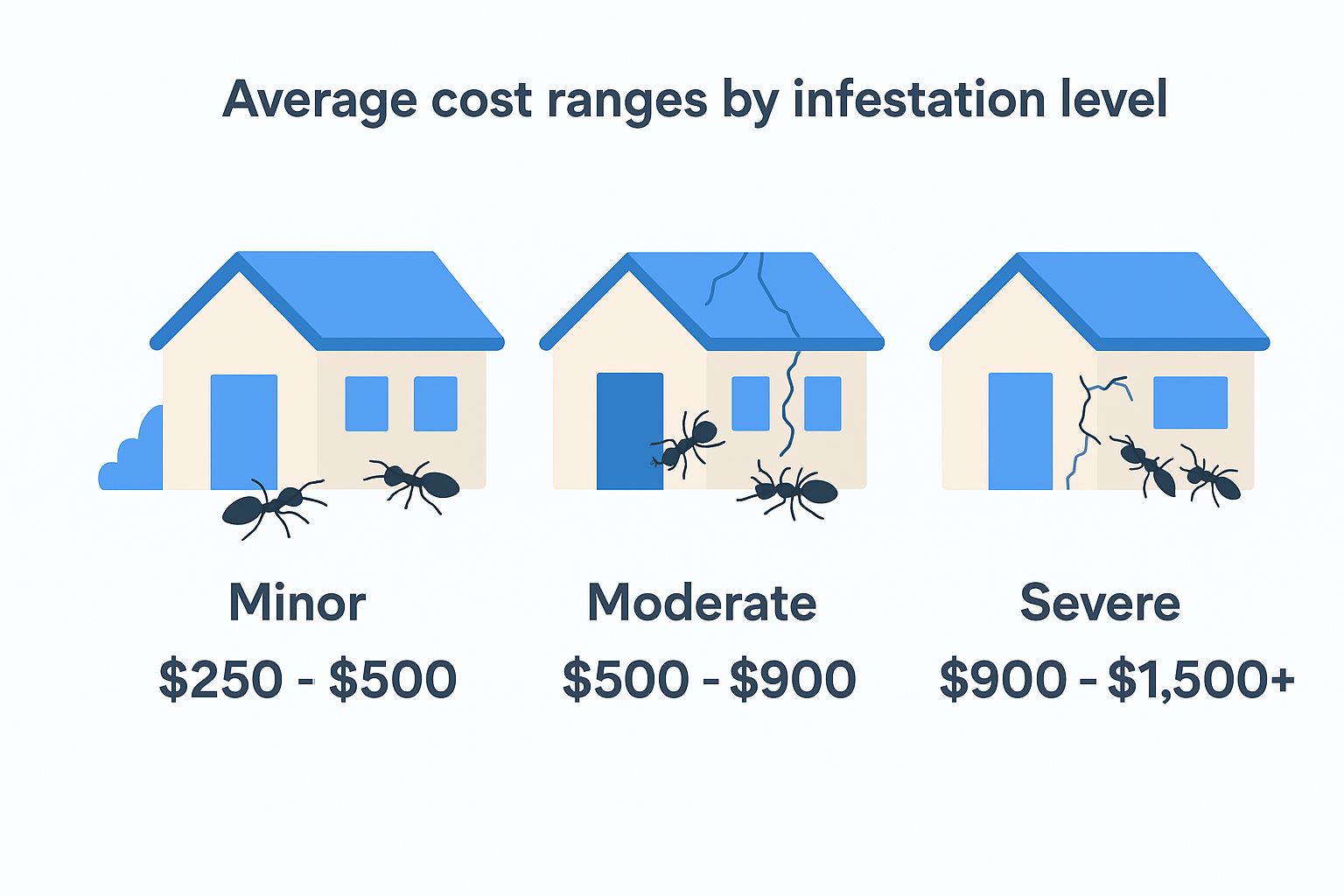
Average cost ranges by infestation level
The severity of your infestation is the single biggest pricing variable. A minor problem caught early, where ants are still confined to one area, costs far less to resolve than a colony that has spread through multiple wall voids or across several sections of your home's framing.
| Infestation Level | Typical Cost Range | What It Usually Includes |
|---|---|---|
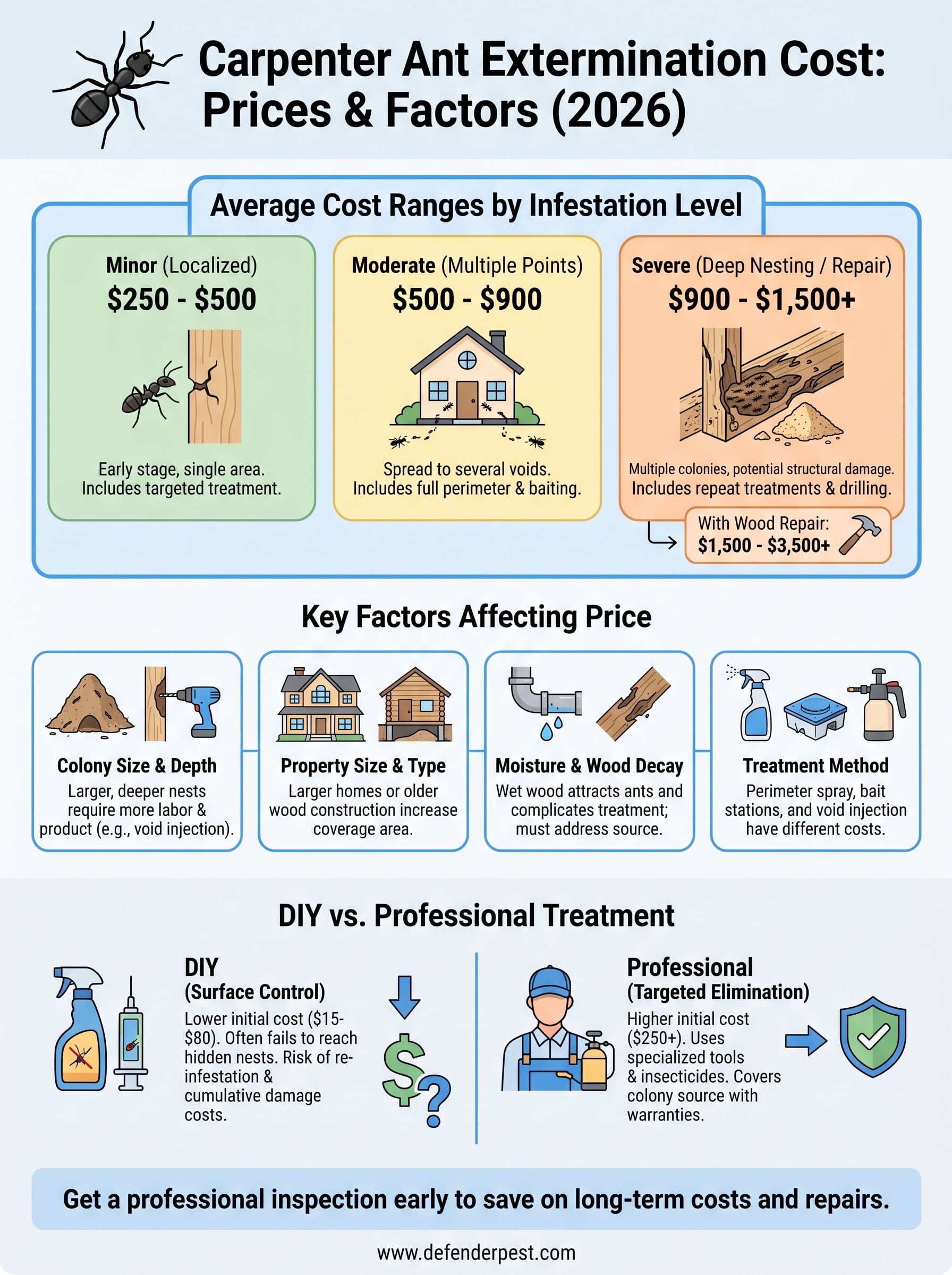
| Minor (early-stage, localized) | $250 - $500 | Single treatment, targeted baiting or perimeter spray |
| Moderate (multiple entry points) | $500 - $900 | Full perimeter treatment, bait stations, follow-up visit |
| Severe (multiple colonies or nesting sites) | $900 - $1,500+ | Repeated treatments, drilling and injection, extended warranty |
| With structural wood repair | $1,500 - $3,500+ | All of the above plus carpentry and repair work |
Acting quickly when you spot the first signs saves you real money. Carpenter ants cause progressive structural damage , meaning the longer a colony stays active inside your walls, the more gallery tunnels they excavate and the more your repair costs grow alongside your treatment costs.
The cheapest time to treat a carpenter ant infestation is before it spreads - waiting almost always costs you more in both treatment fees and structural repairs.
What a one-time treatment vs. an ongoing plan costs
One-time treatments are the most common starting point, and they work well when you catch the infestation before it fully establishes. Expect to pay $300 to $700 for a standalone service call in most Sacramento neighborhoods, which typically includes an inspection, treatment application, and a short-term guarantee, usually 30 to 90 days depending on the company.
Ongoing pest control plans run cheaper on a per-visit basis and make practical sense if your property is prone to re-infestation. Homes near wooded areas, creek beds, or properties with older wood siding face a higher recurring risk than properties in fully urban settings. Annual plans that include quarterly visits and carpenter ant coverage generally cost $350 to $700 per year , depending on your property's square footage and service tier.
Before you sign up for any recurring plan, ask whether it explicitly covers carpenter ants and other wood-destroying insects . Some general pest plans exclude them by default, treating them as a separate line item. Getting that detail in writing before you commit protects you from surprise charges later when you actually need the service.
Some companies also charge a separate inspection fee of $75 to $150 before quoting a treatment price, while others fold that cost into the overall job total. When you request quotes from multiple providers, ask upfront which pricing structure they use. That one question helps you compare bids accurately rather than mistaking a low treatment quote that excludes the inspection for a genuinely better deal.
What affects the total price
Several variables determine where your carpenter ant extermination cost lands within that $250 to $1,500 range. Understanding these factors before you call a pest control company helps you anticipate what the technician will assess during an inspection and why certain jobs cost significantly more than others. These factors rarely exist in isolation, and they interact in ways that can either keep your bill manageable or push it considerably higher.
Colony size and nesting depth
The bigger and older the colony, the harder it is to eliminate. Mature carpenter ant colonies can contain thousands of workers, and they often split into satellite nests connected by foraging trails throughout your home. A small, young colony confined to a single entry point takes far less time and product to treat than one that has spread into multiple wall cavities across several seasons.
Nesting depth adds its own cost pressure. When ants nest deep inside structural wood or within insulated wall voids, technicians need to drill and inject product directly into the gallery system rather than relying on surface applications. That additional labor and access work raises your total.
The harder a nest is to reach, the more you will pay in both labor and materials.
Property size and construction type
Larger properties require more product and more time , which drives up the base price. A home over 2,500 square feet with multiple exterior walls, an attached garage, or a wood deck gives carpenter ants more potential nesting sites and gives a technician more ground to cover and treat.
Your home's construction materials also shape the final price . Older homes with wood siding, wood fascia boards, or crawl spaces with exposed wooden beams present more access challenges and more potential nesting locations than newer builds with concrete foundations and fiber cement exteriors.
Moisture damage and wood decay
Carpenter ants strongly prefer wet or decaying wood because it is far easier to excavate than sound timber. If your property has moisture problems from leaky pipes, poor drainage, or aging roofing, you have already created an ideal environment for them. Treating the infestation without addressing the underlying moisture source means re-infestation becomes likely, and that adds future treatment costs on top of what you pay today. Common moisture sources that raise your risk include:
- Leaking pipe fittings under sinks or in crawl spaces
- Clogged gutters that push water against wood fascia
- Poor grading that directs runoff toward your foundation
- Aging roof flashing that lets water penetrate attic framing
What treatments cost and what you get
Knowing the type of treatment a technician recommends helps you understand exactly what you are paying for and why one quote might differ from another. Each method targets carpenter ants differently, and the application technique directly influences how much labor is involved, how many site visits you will need, and what follow-up looks like.
Perimeter and liquid spray treatments
Liquid spray treatments applied around your home's exterior are the most common first-line approach for carpenter ant problems. A technician applies a liquid insecticide along your foundation, around entry points, and across wood-to-ground contact zones. This method typically runs $200 to $500 as a standalone service and works best when the infestation is still localized to outdoor foraging rather than active indoor nesting. You will usually get a 30 to 60-day retreatment guarantee with this type of application.
For interior situations, technicians may also apply a liquid residual inside wall voids or along baseboards near nesting activity. That additional interior work adds time and, accordingly, adds cost to your total bill.
Bait stations and void injection
Bait stations offer a slower but highly effective approach. Worker ants carry the bait back to the colony, which eventually poisons the queen and collapses the nest from the inside. Bait-based programs typically cost $300 to $600 and are often paired with a follow-up inspection after 30 days to confirm colony activity is declining.
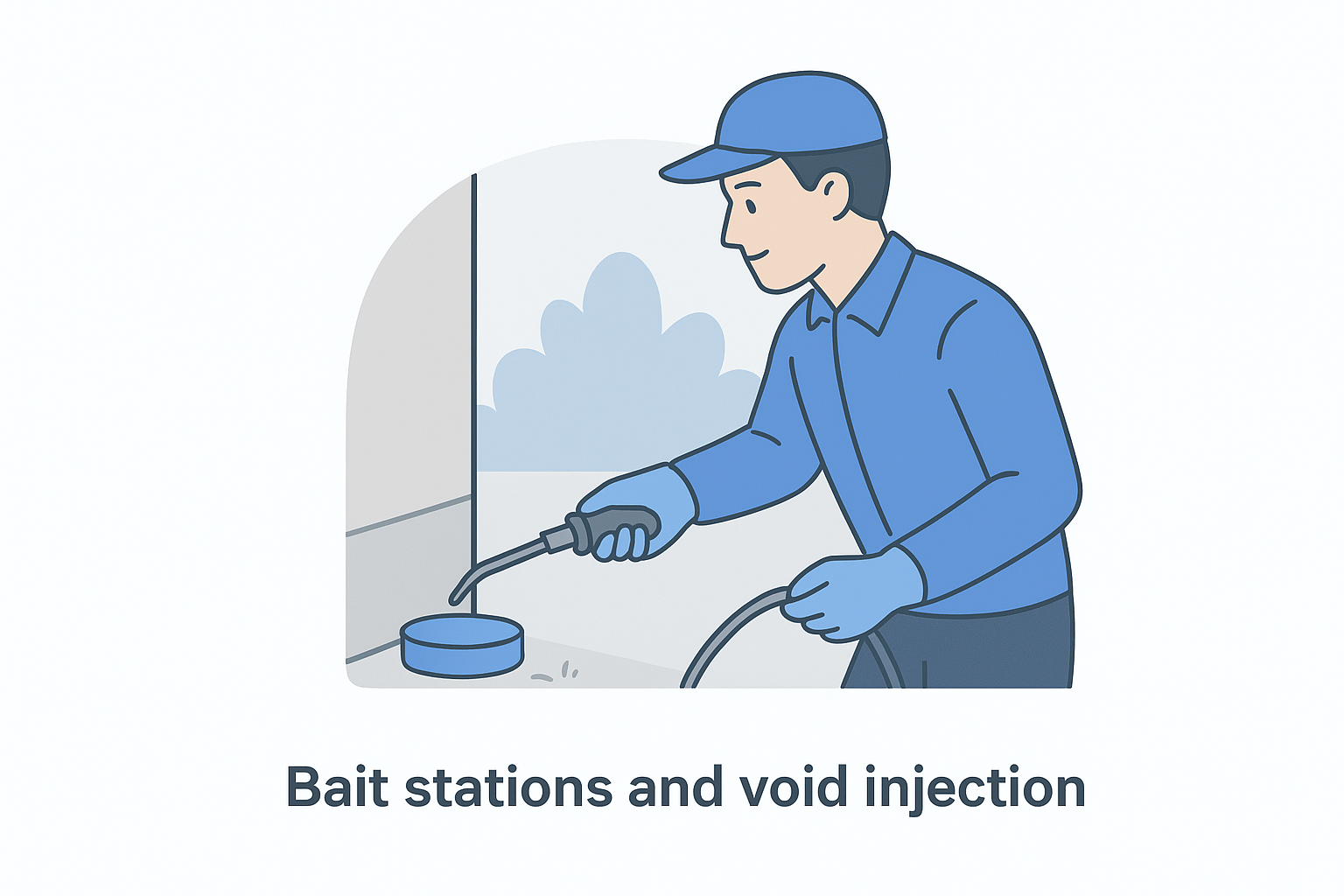
Void injection with insecticide dust is the most targeted method available when nests sit deep inside wall cavities or structural framing. Technicians drill small access holes, inject boric acid or pyrethroid dust directly into the gallery tunnels, and seal the holes after treatment. This technique is labor-intensive, which is why it often raises your carpenter ant extermination cost by $150 to $300 compared to surface-only methods. The tradeoff is direct contact with the colony rather than waiting for ants to encounter a perimeter barrier.
Void injection costs more upfront but often produces faster colony elimination than bait or perimeter spray alone, which can reduce the number of follow-up treatments you need.
What a service warranty covers
Treatment warranties vary widely between companies, and understanding what yours covers before work begins prevents disputes later. Most single-treatment guarantees cover re-treatment at no charge if activity returns within 30 to 90 days. Longer warranties, sometimes extending to one year, typically come with ongoing plans rather than one-time service calls. Always ask whether the warranty covers interior nest sites, not just perimeter reapplications.
DIY vs professional treatment costs and risks
Many homeowners consider handling carpenter ants on their own before calling a pest control company. Store-bought sprays and baits are far cheaper upfront than a professional service call, but the comparison is not that straightforward once you factor in what DIY products can and cannot do against an established colony.
What DIY products actually cost
Over-the-counter carpenter ant treatments range from $15 to $80 depending on the product type. Perimeter sprays run around $15 to $25 per bottle, while bait gels or granule stations sit in the $20 to $50 range at most hardware stores. If you treat repeatedly across several months without resolving the infestation, those costs accumulate quickly.
The core problem with most consumer-grade products is surface reach . They work well against ants you can see foraging along baseboards or countertops, but they rarely penetrate deep enough to contact a colony nested inside wall framing or structural wood . You can eliminate foragers indefinitely while the queen and workers continue expanding the nest behind your walls, and the infestation grows larger and more expensive to address the longer it continues.
DIY products control visible ants, but they rarely eliminate the colony at its source, which means you end up paying for repeated treatments rather than a permanent fix.
Why professional treatment is usually worth the price difference
A licensed technician brings commercial-grade insecticides, void injection equipment, and inspection tools that are not available at a hardware store. They can locate satellite nests , identify moisture sources drawing the colony in, and apply product directly where the ants are nesting rather than only where they are foraging.
When you compare carpenter ant extermination cost between DIY and professional routes, the honest calculation includes every product purchase, every failed treatment cycle, and any structural repair costs that grow while an unresolved infestation continues doing damage. Homeowners who spend a full season on DIY attempts before calling a professional often pay more in total than they would have paid for professional treatment from the start. For an active infestation inside your home's structure, professional intervention is almost always the more cost-effective path.
How to get an accurate quote in Sacramento
Getting an accurate quote takes more than a quick phone call with a vague description of what you spotted. Pest control pricing in Sacramento varies between providers, and the detail you share upfront determines how realistic the estimate is before a technician arrives at your property.
What to tell the company before the inspection
When you call, describe where you noticed activity , how long it has been going on, and whether you found sawdust piles or soft spots in any wood. That information helps the company give you a realistic price range before they even schedule a visit. Companies that quote a firm price without asking any of these questions are almost certainly offering a placeholder number rather than a genuine estimate.
You should also ask whether the inspection carries its own fee. Some Sacramento-area providers charge $75 to $150 for the inspection visit , while others apply that cost toward your treatment total if you move forward. Knowing this before you book lets you compare multiple bids on equal terms rather than mistaking a low treatment quote for the best overall deal.
Questions to ask before you commit
The inspection visit is your best opportunity to gather the information you need before making a decision. Bring a short list of questions so you leave with a complete picture of what you are paying for and what the service actually covers.
- Does the quote include follow-up visits if activity returns within the guarantee period?
- What treatment method do you plan to use, and why?
- Does the warranty cover interior nesting sites , or only perimeter reapplication?
- Are moisture source corrections part of the recommendation, or billed separately?
Getting clear answers to these questions in writing before work starts protects you from unexpected charges and gives you a reliable basis for comparing the true carpenter ant extermination cost across multiple bids.
Why local experience matters in Sacramento
Sacramento's climate, with hot dry summers and wet winters, creates seasonal patterns in carpenter ant activity that a locally experienced company recognizes and accounts for in their treatment approach. A provider who understands these regional patterns will time treatments more effectively and recommend follow-up visits when colonies are most vulnerable, not just on a generic service calendar that ignores local conditions.
Wrap-up and next steps
Carpenter ant extermination cost ranges from $250 for a localized early-stage treatment to well over $1,500 when the infestation has spread into structural wood or multiple wall voids. The factors that matter most are colony size, nesting depth, property type, and whether moisture damage is present . Every week you delay gives the colony more time to expand and gives you a larger repair bill alongside your treatment cost.
Professional treatment almost always costs less overall than repeated DIY attempts followed by a professional call. If you spot large black ants, sawdust piles, or soft spots in wood around your Sacramento-area home, get a professional inspection before the problem grows.
Defender Termite & Pest Management has handled carpenter ant problems across Greater Sacramento since 1999, and our dual expertise in pest elimination and wood repair means you get a complete solution. Request a quote from Defender Termite & Pest Management and find out exactly what you are dealing with before the damage compounds.