How To Treat Drywood Termites: Tenting Vs. Spot Methods
Drywood termites don't need soil or moisture to destroy your home. They burrow directly into wood framing, furniture, and structural supports, eating from the inside out. By the time you notice frass piles or hollow-sounding walls, the colony has likely been feeding for months, sometimes years. Knowing how to treat drywood termites starts with understanding that not every infestation calls for the same approach, and choosing the wrong method can cost you time and money while the damage spreads.
The two main paths are whole-structure fumigation (tenting) and localized spot treatments. Each has clear advantages depending on the size, location, and severity of the infestation. Fumigation wipes out every colony in the structure. Spot treatments target isolated areas without displacing your household. The right choice depends on your specific situation , and sometimes a combination of both is what gets the job done.
At Defender Termite & Pest Management, we've been handling drywood termite infestations across the Greater Sacramento area since 1999. Our team doesn't just eliminate termites, we also repair the structural wood damage they leave behind, so you're not stuck coordinating between multiple contractors. This guide breaks down your treatment options, explains when tenting makes sense versus spot methods , and helps you make an informed decision about protecting your property.
What drywood termites are and how they spread
Drywood termites (primarily Cryptotermes and Incisitermes species) are wood-destroying insects that live entirely inside dry wood , requiring no contact with soil or a moisture source to survive. Unlike subterranean termites, they form smaller colonies, typically a few hundred to a few thousand individuals , and they work slowly but steadily. That slow pace is part of what makes them dangerous: you may go years without any visible clue while they hollow out the wood framing inside your walls, floors, or furniture. By the time you notice a problem, the structural damage is often significant.
How drywood termites differ from subterranean termites
Understanding the difference between these two species matters because it directly changes how you treat drywood termites and which methods actually work. Subterranean termites build mud tubes and need access to soil for moisture, so treating the soil around your structure is a standard part of eliminating them. Drywood termites live entirely inside the wood they consume, which means soil treatments do nothing against them. You need to treat the wood itself, either in one targeted spot or throughout the entire structure, depending on how widespread the infestation is.
| Feature | Drywood Termites | Subterranean Termites |
|---|---|---|
| Moisture need | Low, no soil contact needed | High, require soil access |
| Colony size | Small (hundreds to a few thousand) | Large (up to hundreds of thousands) |
| Mud tubes present | No | Yes |
| Primary warning sign | Frass pellets, hollow wood | Mud tubes, swarms near soil |
| Main treatment approach | Wood-focused: spot treatment or fumigation | Soil treatments, bait systems |
How they enter your home
Drywood termites get into structures through unfinished or exposed wood surfaces , including attic vents, roof eaves, window frames, and door trim. Swarmers, the winged reproductive members of a mature colony, fly out during warm months to locate new nesting sites. In Northern California, swarm season typically runs from late summer into early fall , which is when most homeowners first spot them clustered near light sources or windowsills. A swarmer needs only a small crack or patch of unfinished wood to start a new colony inside your home.
Once a swarmer pairs up and burrows into wood, the new colony grows in complete silence for months or years before producing any visible signs.
How infestations spread within a structure
Spread happens through two routes: natural swarming between structures and the movement of infested wood. Used furniture, wood pallets, picture frames, and antiques are frequent carriers. If you bring a piece of infested wood indoors without inspecting it, you can introduce a brand new colony with zero outdoor exposure. Drywood termites also spread within a structure over time as colonies mature and swarmers move from one section of framing to another. This is why identifying every active colony matters as much as treating the one you already found.
Step 1. Confirm you have drywood termites
Before you choose a treatment method, you need to verify that drywood termites are actually the problem. Misidentifying the pest wastes money on ineffective treatments and gives the real infestation more time to spread. Grab a flashlight and a flathead screwdriver and inspect wood surfaces in your attic, crawlspace, garage, and around window and door frames before you do anything else.
Physical signs to look for
The most reliable indicator is frass , the small pellet-shaped droppings drywood termites push out of kick-out holes in wood. These pellets are six-sided, hard, and range from tan to dark brown. You will often find small piles on windowsills, shelves, or floors directly beneath infested wood. Hollow-sounding wood is another strong signal: tap a beam or wall stud with your screwdriver handle, and a dull, papery thud instead of a solid knock tells you termites have been feeding inside.
- Frass piles : Small ridged pellets near baseboards, windowsills, or furniture legs
- Kick-out holes : Pinhole-sized openings in wood where termites push out frass
- Hollow wood : Dull thud when tapped, possible surface blistering or collapse under pressure
- Swarmers or shed wings : Discarded wings near light fixtures or windowsills during late summer and fall
Finding frass is the most reliable DIY indicator that drywood termites are currently active, not just remnants of an old infestation.
Ruling out other wood-destroying pests
Wood-boring beetles produce damage that looks similar at first glance, but their frass is coarser and contains visible wood shavings rather than the smooth, uniform pellets drywood termites leave behind. Carpenter ants are another common mix-up: they excavate wood rather than eat it, so you'll find larger ragged galleries with no frass nearby. If you're still unsure after your inspection, a licensed termite inspector can probe the wood and use acoustic detection tools or borescope cameras to locate active galleries and confirm which pest you're dealing with before you commit to any treatment plan for how to treat drywood termites.
Step 2. Decide if you need tenting
Whole-structure fumigation is the most thorough method for how to treat drywood termites, but it is not always the right call. Your decision comes down to three factors: how many locations show active infestation , how accessible those areas are, and whether you can confirm the full extent of the damage through inspection.
When tenting is the right call
Fumigation makes sense when the infestation has spread across multiple areas of your home that you cannot directly access or treat with a localized method. If your inspector finds active colonies in three or more separate locations, in inaccessible attic framing, inside wall cavities, or deep within structural beams, spot treatments will leave surviving colonies behind. Tenting fills the entire structure with sulfuryl fluoride gas , which penetrates every piece of wood regardless of where the termites are hiding. You will need to vacate your home, including pets and plants, for two to three days while the treatment runs. This disruption is significant, but it is the only reliable way to eliminate a widespread infestation in one treatment cycle.
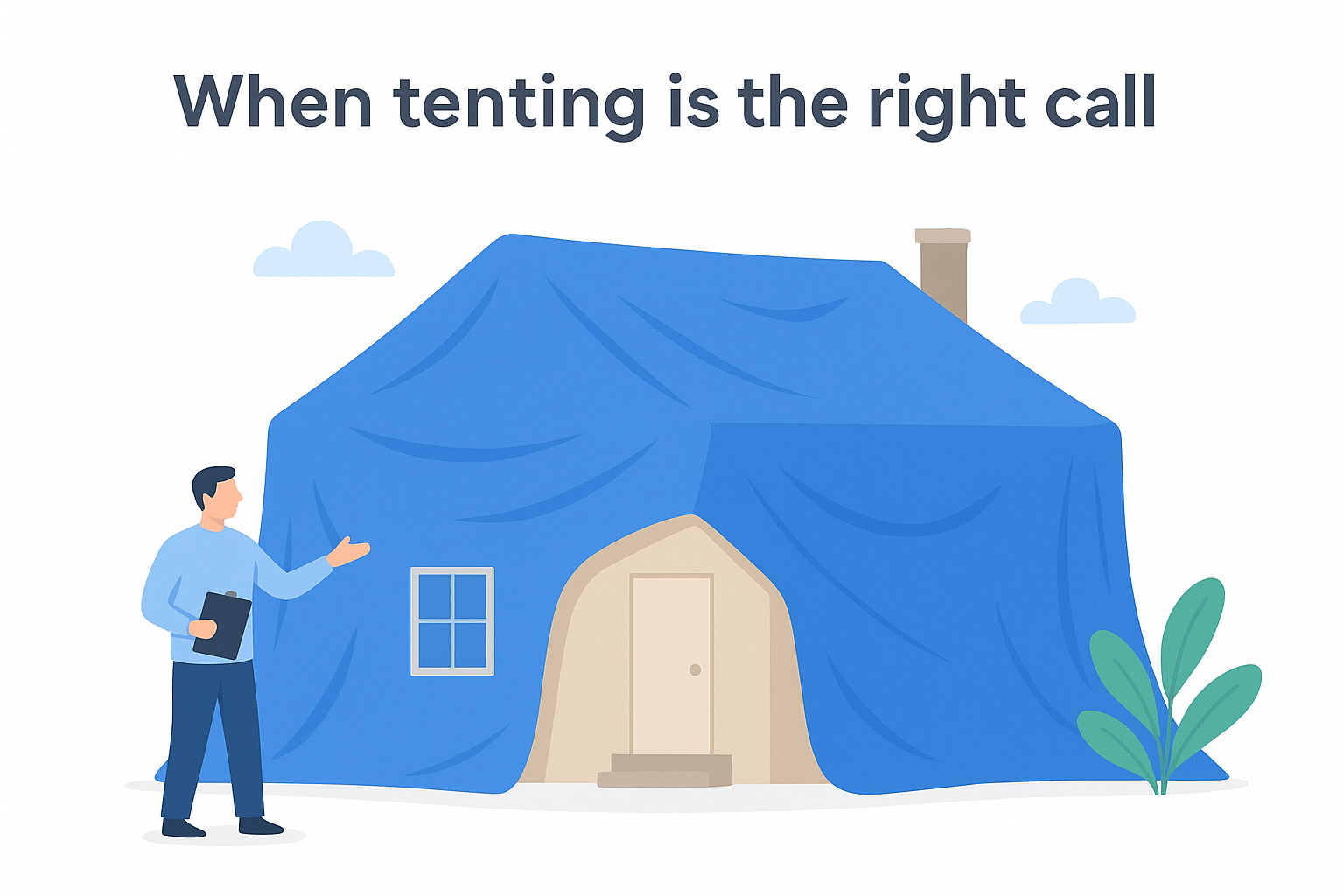
If your inspector cannot rule out infestation in areas they cannot physically access, tenting removes the guesswork entirely.
- Active colonies in three or more separate locations
- Infestation inside wall framing or other inaccessible structural areas
- A large home or commercial building where spot-treating every zone is not practical
- A real estate transaction requiring a clear pest inspection report before closing
When spot treatment is enough
Spot treatment is a reasonable choice when your inspector can confirm the infestation is limited to one or two clearly defined areas that are directly accessible. A good example would be a single infested window frame, a piece of furniture, or an exposed attic rafter where you can see the full extent of the damage. In those situations, localized treatments like foam injection, orange oil, or heat treatment eliminate the colony without requiring you to leave your home. The key requirement is that your inspector can actually verify the infestation has not spread beyond what is visible.
Step 3. Treat without tenting when it makes sense
When your inspection confirms a limited, accessible infestation , spot treatments let you eliminate drywood termites without vacating your home. The key word here is "accessible": you need to physically reach the infested wood , either directly or through a drilled entry point. If you cannot access the gallery, the treatment cannot reach the termites, and the colony survives.
Foam injection and liquid termiticide
Foam injection is one of the most reliable localized methods for how to treat drywood termites. A pest technician drills small holes into the infested wood, injects termiticide foam directly into the galleries, then plugs the holes. The foam expands to fill irregular cavities, contacting termites that a liquid spray would never reach. Borate-based products like Boracare or Timbor penetrate wood fibers, kill termites on contact, and leave a residual barrier that blocks reinfestation in that section of wood.
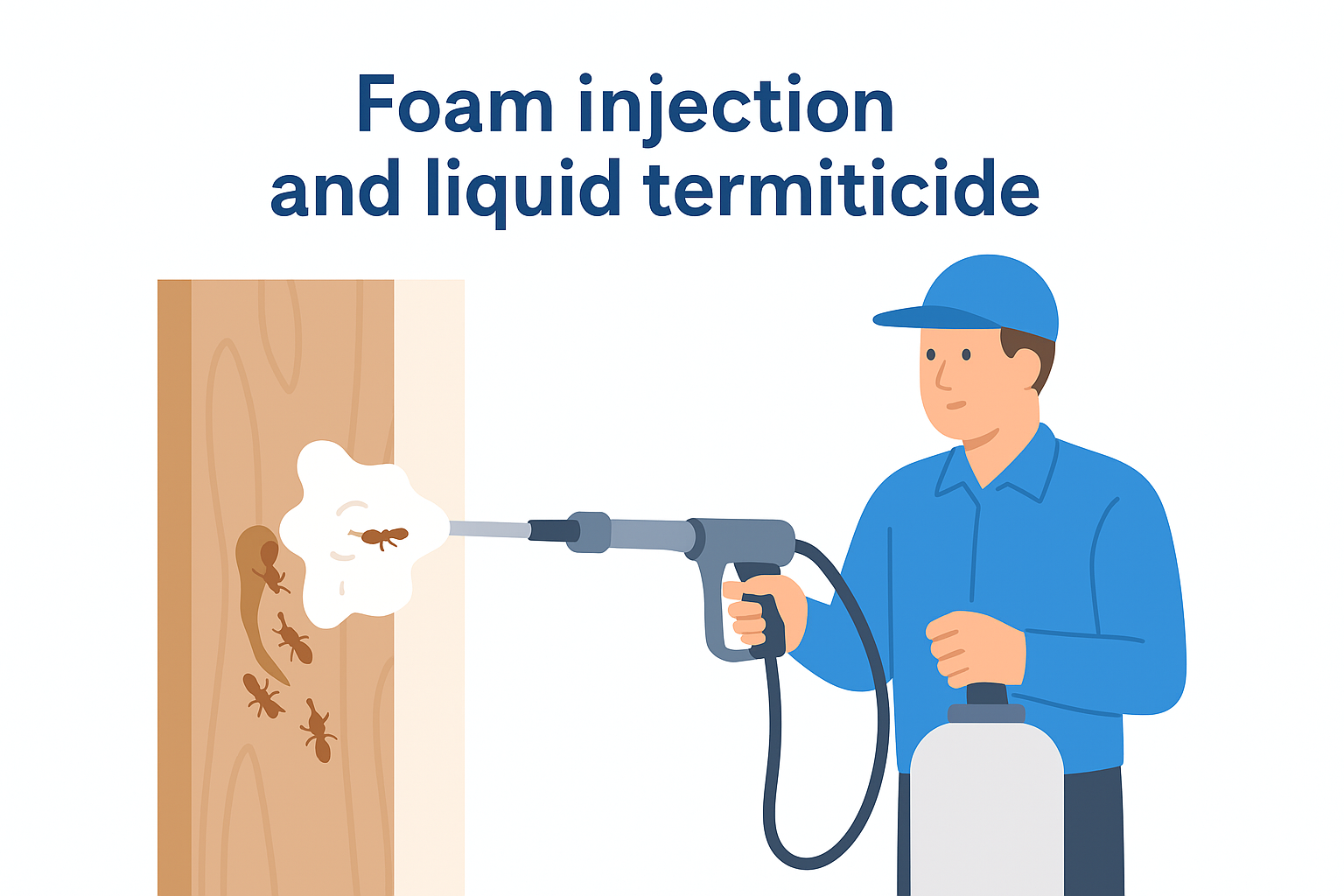
Foam injection works well in these specific locations:
- Exposed attic rafters where you can see and confirm the full extent of damage
- Window frames, door trim, and baseboards with visible frass and kick-out holes
- Furniture or wood structural members accessible from a crawlspace
Foam injection only produces reliable results when you can confirm the infestation has not spread beyond the area you are treating.
Heat treatment
Localized heat treatment raises the temperature inside infested wood to above 120 degrees Fahrenheit, which kills termites at every life stage including eggs. A technician applies targeted heating equipment to bring specific structural members or rooms to lethal temperature without treating the entire structure.
This method works for wall voids, flooring sections, or furniture where chemical penetration is impractical. It leaves no chemical residue, which makes it a useful option for interior spaces with food preparation surfaces or sensitive materials nearby.
Orange oil as a limited spot option
Orange oil (d-limonene) kills drywood termites on direct contact by breaking down their exoskeletons. The main limitation is penetration depth : orange oil does not travel far through dense wood, so it only produces consistent results in early-stage, shallow infestations. Treat it as a supplemental tool for a single furniture piece or small exposed wood section, not as a primary solution for anything deeper inside your structure.
Step 4. Prevent return and fix damage
Eliminating the active colony is only half the job. Without sealing entry points and addressing the structural damage termites leave behind, you are setting up conditions for the same problem to return within a few years. The steps in this stage protect the investment you just made in treatment and keep your home from becoming a repeated target.
Seal entry points and treat exposed wood
Drywood termites re-enter through the same routes they used originally: unfinished wood surfaces, attic vents, eave gaps, and wood-to-exterior joints around windows and doors. Walk the perimeter of your home and paint or seal any raw wood that faces the exterior. Apply a borate-based wood preservative like Boracare to attic framing and other interior wood surfaces that are not painted or finished. This creates a long-term residual barrier that kills termites before they can establish a new colony.
- Caulk gaps around window frames, door trim, and utility penetrations
- Screen attic vents with fine mesh (1/16 inch or smaller openings)
- Apply exterior wood sealant or paint to any exposed fascia, eaves, or siding
- Inspect and seal gaps where electrical conduit or plumbing enters exterior walls
Treating exposed wood with a borate preservative after fumigation is one of the most cost-effective long-term steps you can take against drywood termites.
Repair structural wood damage
Termite galleries weaken wood from the inside , and leaving damaged structural members in place creates both a safety risk and a ready-made nesting site for any future infestation. A qualified inspector can probe the wood to identify which members have lost structural integrity. Sections with significant hollowing or surface collapse need full replacement, not patching with wood filler. Working with a company that handles both pest control and wood repair keeps the entire process under one team, so the people doing the repairs already know exactly which sections to remove and what structural standards apply.
Knowing how to treat drywood termites does not end with the chemical treatment. Getting the wood repairs done correctly closes the loop on the entire process and leaves you with a structure that is protected and structurally sound.
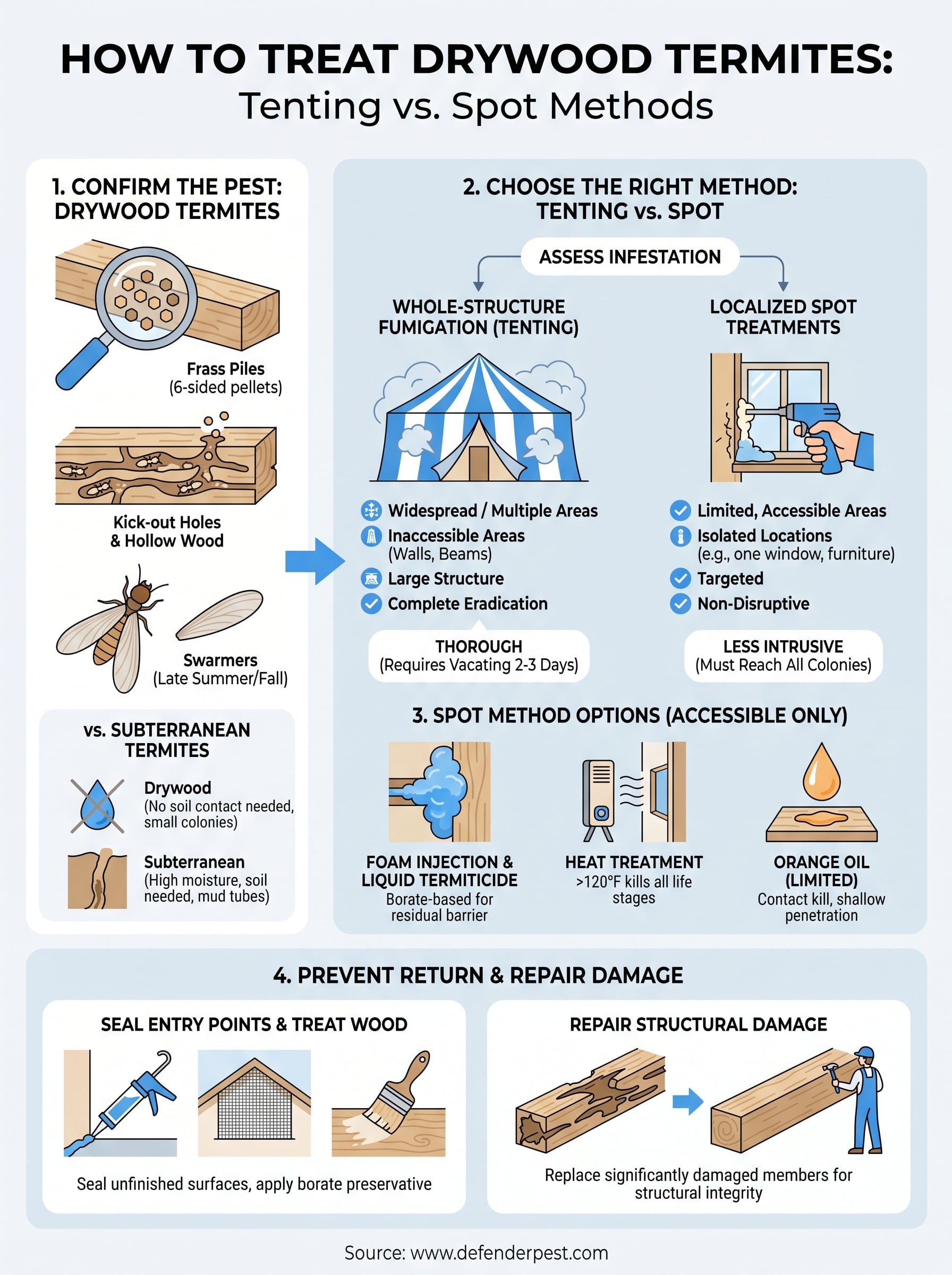
What to do next
You now have a clear framework for how to treat drywood termites , from confirming the pest to choosing between tenting and spot methods, sealing entry points, and repairing structural damage. The biggest mistake most homeowners make is waiting too long after spotting the first signs. Frass piles and hollow wood do not disappear on their own , and a colony left untreated for another season only makes the damage worse and the treatment more expensive.
Start by doing a thorough inspection of your attic, crawlspace, and window frames this week. If you find frass pellets or suspect active galleries, get a professional assessment before committing to any treatment method . The wrong approach wastes money and leaves surviving colonies behind. Defender Termite & Pest Management has handled drywood termite infestations across the Sacramento area since 1999, and our team covers both treatment and wood repair. Request a termite inspection today and get a clear picture of what you are dealing with.