How Long Does Termite Treatment Last? Factors & Timelines
You just paid for a termite treatment, so naturally, you want to know how long does termite treatment last before you need to think about it again. It's a fair question, and the answer isn't as simple as a single number. Treatment longevity depends on the method used , the conditions around your property, and how well the treatment was applied in the first place.
At Defender Termite & Pest Management, we've been treating homes and businesses across the Greater Sacramento area since 1999. Over that time, we've seen firsthand how different treatments hold up, and what causes some to fail earlier than expected. Liquid soil barriers, bait stations, and direct wood treatments all come with different timelines, and each one has trade-offs worth understanding before you commit.
This article breaks down the realistic lifespan of each major treatment type , the factors that shorten or extend their effectiveness, and how to know when it's time for re-treatment. Whether you're dealing with an active infestation or planning ahead, this will help you make a more informed decision about protecting your property long-term.
Why termite treatment timelines matter
Knowing how long does termite treatment last is not just useful information. When treatments wear off, termites return without announcing themselves. By the time you spot visible damage, they've often been active for months. Understanding your treatment timeline gives you a concrete window to schedule inspections and plan re-treatments before the far more expensive scenario of structural damage becomes your reality.
The cost of letting a treatment lapse
When a termite barrier or bait system stops working, your property sits unprotected without any visible warning. Subterranean termites, the most destructive species in Northern California, build colonies with hundreds of thousands of workers. They consume wood continuously, which means a lapsed treatment window gives a new colony time to establish well before you notice any change.
A single subterranean termite colony can cause thousands of dollars in structural damage within a year if left untreated.
Retreating on a schedule costs far less than structural repairs. Wood replacement, framing work, and the labor to access damaged areas add up fast. The repair bill almost always exceeds what proactive re-treatment would have cost , and that gap widens the longer a lapsed barrier goes unnoticed. Tracking your treatment date is the most straightforward way to stay ahead of this outcome.
Why Sacramento's climate affects how long protection lasts
Northern California's climate directly affects how long termite treatments hold up. Sacramento's hot summers and wet winters put stress on soil treatments in particular. Liquid termiticide barriers break down faster under high soil moisture and temperature swings , both of which accelerate chemical degradation in the soil around your foundation.
Termites remain active throughout the year in Sacramento , unlike in colder climates where colony pressure slows seasonally. Your property faces continuous risk, not a seasonal one. A treatment that holds for five years in a cooler, drier region may underperform here, especially if you run irrigation near the foundation. That added moisture speeds up barrier breakdown and gives new colonies a better chance to exploit gaps before your next inspection cycle.
How tracking your treatment history helps
Keeping a simple record of when your treatment was applied and which method was used takes minimal effort but pays off over time. Many homeowners assume that no visible termites means the treatment is still working. That assumption is risky because termites operate entirely out of sight , inside walls, below floors, and within foundation timbers where a surface-level look reveals nothing.
A clear record lets you schedule a follow-up before your barrier expires, giving your pest professional time to apply re-treatment before new colony pressure builds . That shift from reactive to proactive is where most of the long-term savings come from.
How long each termite treatment lasts
Different methods protect your home for very different lengths of time, and matching that timeline to your specific situation is what makes the difference between staying protected and leaving gaps. The question of how long does termite treatment last comes down to which product was applied, how thoroughly it was installed, and what conditions it faces after application. Knowing the typical range for each method helps you plan inspections and re-treatments before your protection runs out.
Liquid soil barriers
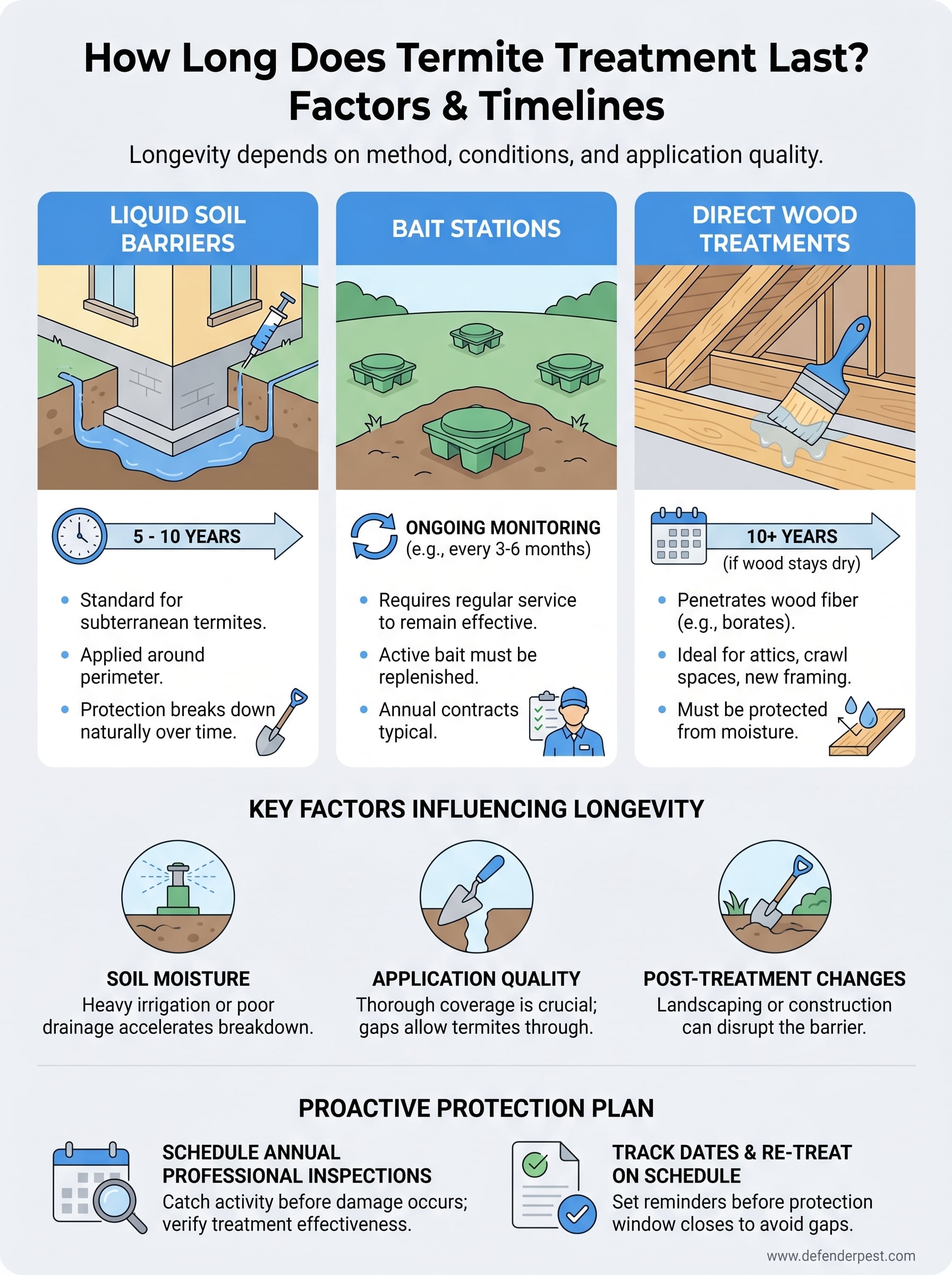
Liquid termiticide barriers applied to the soil around your foundation typically last five to ten years under normal conditions. Products based on fipronil set the standard here, with most manufacturers reporting about five years of reliable protection when the treatment is applied correctly and the soil stays undisturbed. Re-grading, heavy irrigation, or deep digging near the foundation can shorten that window significantly by breaking up or diluting the treated zone before the chemical naturally degrades.
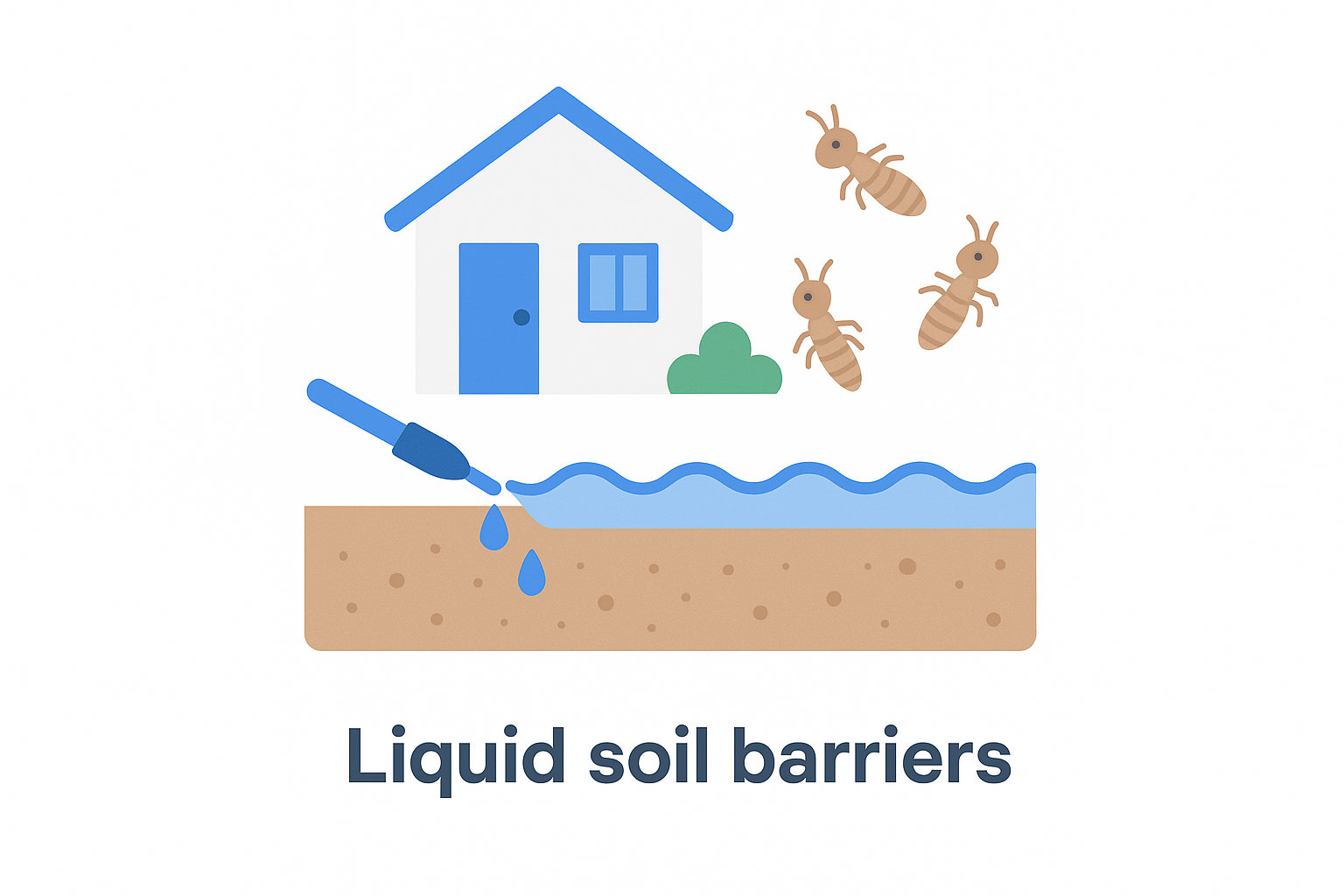
A professionally applied liquid barrier is currently the longest-lasting single-application option available for subterranean termite control.
Bait stations
Bait station systems work differently because they depend on ongoing monitoring and maintenance rather than a one-time application. The stations themselves stay in the ground indefinitely, but the active bait inside needs to be checked and replenished on a regular schedule, typically every three to six months. The system only delivers results as long as the service continues , which is why most bait programs are structured as annual contracts rather than standalone treatments.
Direct wood treatments
Direct wood treatments, including borates applied to exposed framing or structural lumber, last ten or more years when the treated wood stays dry. Borate solutions penetrate deep into the wood fiber and remain effective as long as moisture does not flush the chemical out over time. Attics, crawl spaces, and new construction framing are ideal candidates for this method because the wood in those areas typically stays protected from rain and humidity, preserving the treatment for the long term.
What changes how long termite treatment lasts
Even a well-applied treatment can wear out ahead of schedule if the conditions around your property work against it. Several variables, from soil chemistry to post-treatment construction activity, play a direct role in how quickly protection degrades. Understanding what shortens or extends your protection window helps you manage your property more effectively and avoid gaps that give termites an opening.
Soil conditions and moisture levels
Soil moisture is one of the biggest factors that affects how quickly a liquid termiticide barrier breaks down. Heavy irrigation near your foundation, poor drainage, or rain that pools against the house all push water into the treated soil and accelerate chemical degradation. The more water that moves through the treatment zone , the faster the barrier loses its concentration below the threshold needed to stop termites.
Keeping sprinkler heads pointed away from your foundation and maintaining clean drainage channels extends the life of your liquid barrier treatment significantly.
Quality of the original application
How thoroughly the initial treatment was applied matters as much as the product itself. A barrier with gaps, missed spots, or uneven depth gives termites a direct route around the protection. Proper application requires complete coverage around the entire perimeter of the structure, including hard-to-access areas like under concrete slabs, around pipes, and near expansion joints.
Choosing an experienced pest professional rather than the cheapest bid you find directly affects how long does termite treatment last in practice. Cutting corners during application means re-treating sooner, which costs more in total than getting it done right the first time.
Changes to your property after treatment
Any significant disturbance to the soil after treatment can break up the barrier and expose your foundation to termites. Landscaping projects, added plumbing, in-ground features, or even deep aeration of garden beds near the house can disrupt the treated zone. Notify your pest professional before undertaking any digging or grading work so they can assess whether a partial re-treatment is needed to close the gaps you create.
How to tell if treatment is still working
Most homeowners have no way to visually confirm that a termite treatment is still doing its job, because effective protection looks exactly the same as no protection at all from the outside. Rather than guessing, you can use a combination of inspection habits, record-keeping, and professional verification to stay confident that your home is actually covered.
Signs that your protection may have lapsed
Knowing how long does termite treatment last for your specific method is the clearest starting point. If your liquid barrier was applied more than five years ago and you have no record of a follow-up inspection, the protection may already be below effective concentration. Physical signs worth watching for include mud tubes along your foundation walls, hollow-sounding wood when you knock on baseboards, and small piles of frass, which is a sawdust-like material that drywood termites push out of their galleries.
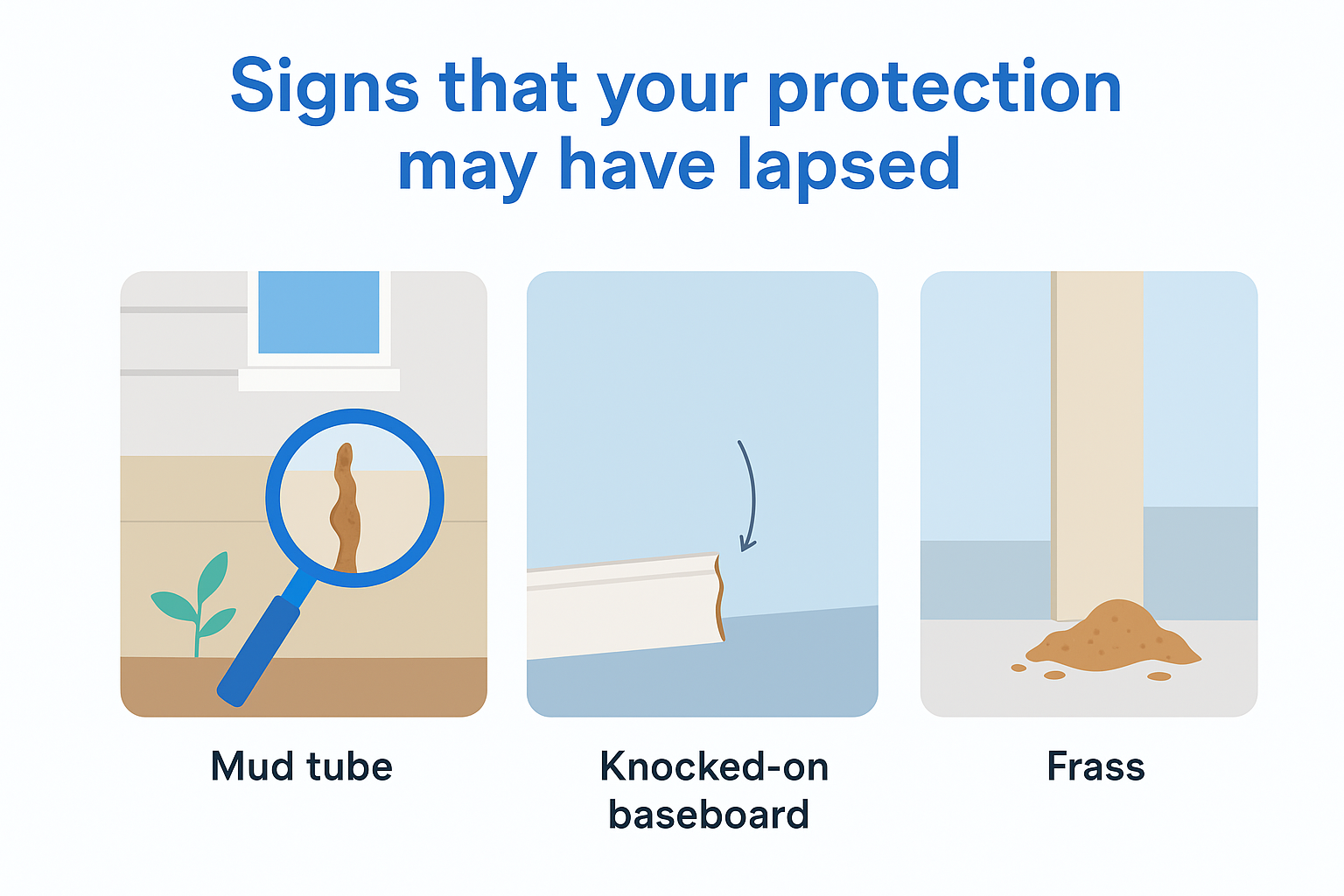
Finding mud tubes on your foundation is a reliable indicator that subterranean termites are actively foraging near your home, regardless of when treatment was last applied.
Blistered or bubbling paint on wood surfaces, sagging floors, and doors or windows that suddenly stick can also point to termite activity inside the structure. These symptoms often appear only after significant damage has already occurred , so treating them as early warning signs rather than confirmation of an active infestation gives you a better chance to respond quickly.
What a professional inspection confirms
A licensed termite inspector can assess your property in ways that a walk-around simply cannot match. Professionals use probing tools, moisture meters, and trained visual assessment to identify active termite pressure and check whether your existing treatment still shows signs of effectiveness in the soil or wood. Scheduling an inspection every one to two years , even when you see no visible warning signs, closes the gap between what you can observe on the surface and what may be happening inside your walls and beneath your floors.
How to choose a treatment and re-treatment plan
Choosing the right termite treatment starts with understanding your property's specific risk factors rather than defaulting to whatever is cheapest or most familiar. Your home's construction type, soil conditions, and history of termite activity all point toward which method will hold up longest and give you the best return on what you spend. A professional assessment before any treatment is applied gives you the clearest picture of which option actually fits your situation.
Match the method to your risk level
Properties with active or historical subterranean termite pressure are generally the best candidates for liquid soil barriers because they deliver broad, continuous protection around the full perimeter. If you're managing a larger property or one with multiple structures, bait station programs offer flexibility because technicians can monitor and adjust the system over time as colony pressure shifts. Drywood termite problems in attics or crawl spaces respond better to direct wood treatments, particularly borates, which stay effective for a decade or more when the wood stays dry.
Pairing a liquid barrier with annual bait station monitoring gives you two independent layers of protection and a faster alert if termite activity breaks through.
Build a re-treatment schedule you'll actually follow
Understanding how long does termite treatment last for your chosen method is the first step toward building a schedule that keeps you protected without gaps. Write down the application date, the product used, and the expected effective window. Set a calendar reminder at least six months before that window closes so you have time to arrange a professional inspection rather than scrambling at the last minute.
Re-treatment schedules work best when they're tied to annual inspections from a licensed professional who can spot early pressure before a new colony establishes itself. Consistent monitoring costs a fraction of what a single structural repair runs, and it keeps the question of how long your protection lasts from becoming a problem you answer only after the damage is already done.
Next steps to keep termites out
How long does termite treatment last depends on the method you choose, how well it was applied, and the conditions your property faces year after year. The clearest path forward is getting a professional inspection that matches your risk level to a specific treatment type, then scheduling follow-ups before your protection window closes. Waiting until you see visible damage is the most expensive approach you can take.
Start by reviewing any records you have of past treatments. If you have no documentation, or if your last treatment was more than five years ago, scheduling an inspection now puts you back in a proactive position. Northern California's climate keeps termite colonies active throughout the year , so there is no off-season to wait for. If you're ready to get a clear picture of where your property stands, contact Defender Termite & Pest Management and schedule your inspection today.