Termite Swarmers vs Flying Ants: 7 Easy Ways To Tell Apart
You spot a swarm of winged insects near your window or crawling out of a crack in your wall. Your first thought: are those termites? That moment of uncertainty is incredibly common, and the distinction between termite swarmers vs flying ants matters more than most people realize. One is mostly a nuisance, while the other can mean thousands of dollars in structural damage if left unchecked.
The good news is that telling them apart doesn't require a magnifying glass or an entomology degree. There are clear physical and behavioral differences between these two insects, and once you know what to look for, identification gets straightforward . At Defender Termite & Pest Management, we've been helping Sacramento-area homeowners sort out exactly this question since 1999, often during spring swarm season when both insects take flight at roughly the same time.
This guide breaks down seven reliable ways to distinguish termite swarmers from flying ants, so you can figure out what you're dealing with and decide whether it's time to call in a professional.
Why the difference matters for your home
When you see winged insects swarming near a window or crawling out of a baseboard, what you do next depends entirely on what you're looking at. Misidentifying them can lead to unnecessary panic on one hand, or a costly and avoidable delay in treating a real termite problem on the other. Knowing how to separate termite swarmers vs flying ants is a practical skill that protects both your home's structure and your budget.
Flying ants: a nuisance, not a structural threat
Flying ants are reproductive members of an ant colony, emerging when conditions favor starting a new colony elsewhere. They do not eat wood, and they pose no structural risk to your home. Once the mating flight ends, they shed their wings and search for soil to nest in. You might find them annoying near light fixtures or window sills, but they will not compromise your walls, floors, or wood framing .
Dealing with flying ants does not require emergency action. A standard ant control treatment can address the problem if they keep appearing indoors.
Termite swarmers: a red flag you cannot ignore
Termite swarmers tell a completely different story. Spotting them inside your home almost always signals that an active termite colony is already established nearby , often deep within the wood structure itself. The swarmers don't cause the damage directly; the worker termites do that. But their presence confirms that workers may already be feeding on your home's framing, joists, or subflooring right now .
If you find swarmers inside your home, treat it as a warning that requires professional inspection, not a situation to monitor and wait out.
The financial stakes are significant. Termite damage repair averages thousands of dollars and standard homeowner's insurance typically does not cover it. Acting fast is the difference between a targeted treatment and a full-scale structural repair .
Fast ID: wings, waist, and antennae
When you catch a quick look at a swarm, three body features give you the fastest answer in the termite swarmers vs flying ants debate: wings, waist, and antennae. You don't need to capture one to make a call. A clear photo or a close look at a dead specimen on your windowsill gives you everything you need to make a confident identification on the spot.
Wings
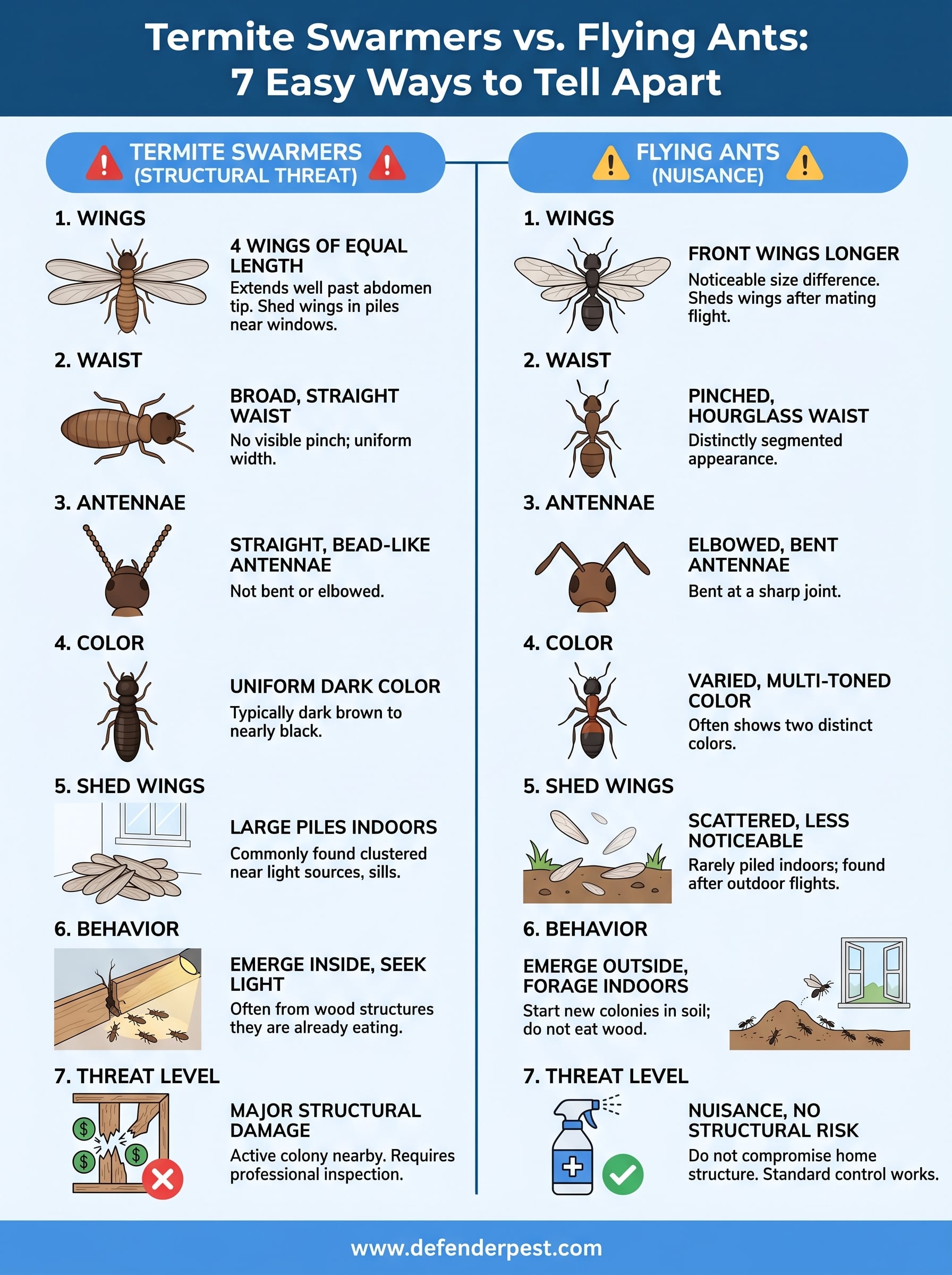
Termite swarmers have four wings of equal length , all extending well past the tip of the abdomen. Flying ants also have four wings, but their front wings are noticeably longer than the rear wings . This size difference is visible without any magnification and is one of the most reliable single identifiers you'll find.
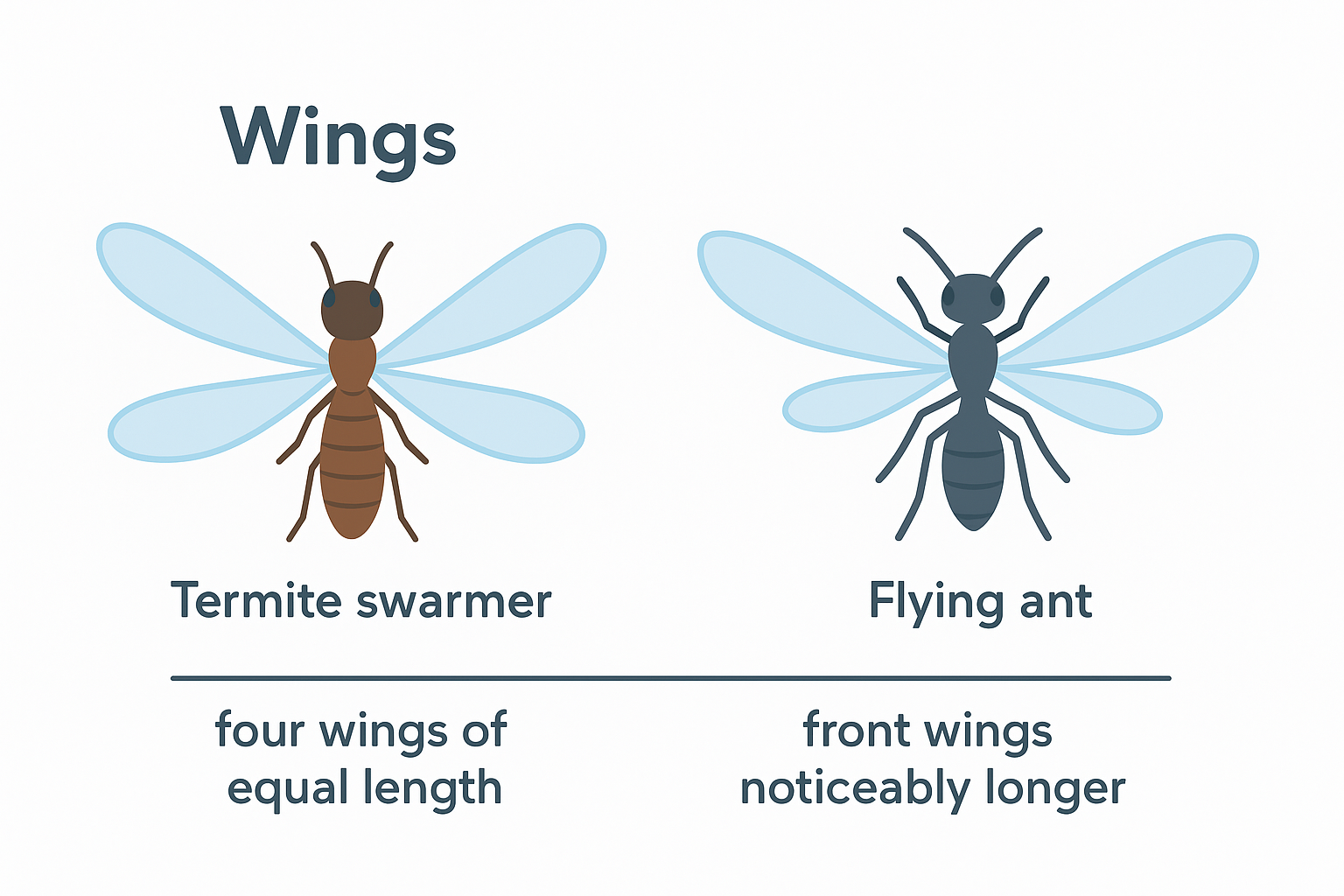
If you find shed wings clustered near a door frame or windowsill, equal-length wings almost certainly point to termites.
Waist and antennae
Termites have a broad, straight waist with no visible pinch connecting the thorax and abdomen. Flying ants have a sharply pinched waist that gives them a segmented, hourglass appearance. Check the antennae as a quick second confirmation:
| Feature | Termite Swarmer | Flying Ant |
|---|---|---|
| Waist | Broad, no pinch | Pinched, hourglass shape |
| Antennae | Straight, bead-like | Bent at a sharp elbow joint |
Other clues: color, size, and shed wings
Beyond the waist and antennae, color and body size give you additional data points when working through the termite swarmers vs flying ants comparison. These details won't always be enough on their own, but combined with wing and waist checks, they narrow your identification quickly .
Color and size
Termite swarmers tend to be darker , ranging from dark brown to nearly black, with a uniform color throughout the body. Flying ants show more color variation , including black, brown, and reddish tones, and they often display two distinct colors across their body segments.
| Feature | Termite Swarmer | Flying Ant |
|---|---|---|
| Color | Dark brown to black, uniform | Black, brown, or reddish, often two-toned |
| Body length | ~3/8 inch including wings | 1/8 to 1/2 inch depending on species |
Shed wings
One of the clearest physical clues you'll find is a pile of shed wings near a windowsill, door frame, or light fixture. Termite swarmers drop their wings shortly after landing, leaving behind matched pairs of equal-length wings in concentrated spots.
A cluster of uniform shed wings indoors is one of the strongest visual indicators of a termite presence in your home.
Flying ants also drop their wings after mating, but you'll rarely find them piled in concentrated groups inside a structure the way termite swarmers do.
Swarm behavior and where you'll spot them
Behavior and location give you two more reliable data points when distinguishing termite swarmers vs flying ants. Both insects swarm to mate and start new colonies, but when and where they appear follows distinctly different patterns.
When swarms happen
Termite swarmers in Sacramento most commonly appear in spring , typically between February and May, when temperatures warm and humidity rises after rain. Flying ant swarms follow a similar seasonal window but can emerge across a wider stretch of the year, from spring through late summer, depending on the species and local conditions. Because both insects can fly at the same time of year, timing alone should never be your only guide when identifying what you're seeing.
Spotting winged insects indoors during early spring, especially after rain, points more strongly to termites than to ants.
Where to look
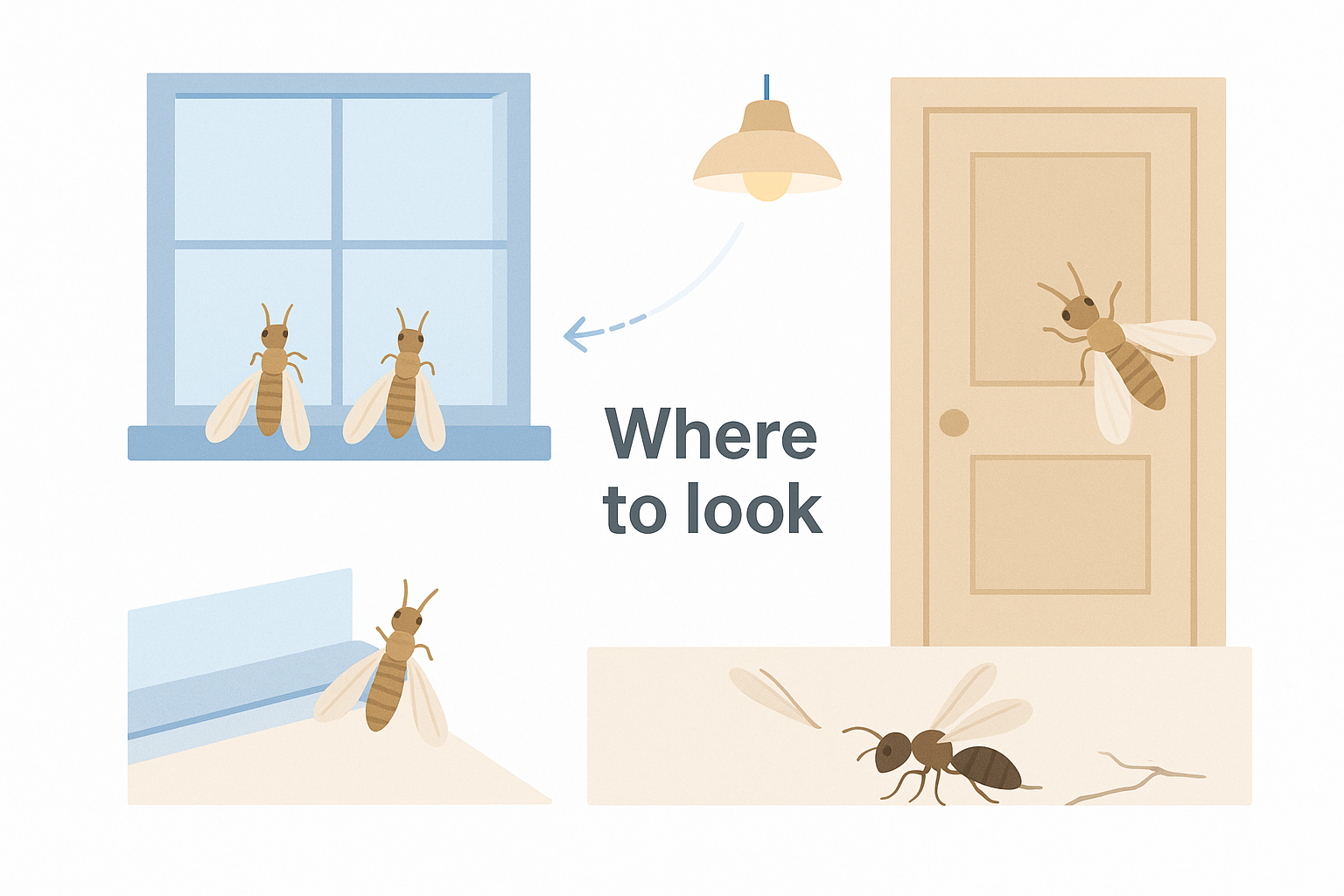
Termite swarmers move toward light , so you'll typically find them clustered near windows, sliding glass doors, and light fixtures. They often emerge directly from baseboards, door frames, or wood structures that workers have already been feeding on. Flying ants usually appear outdoors first , near soil or pavement cracks, and move indoors only when foraging. If you keep finding swarmers inside your home with no clear outdoor entry point, that pattern strongly suggests termites are already established within your structure.
What to do right now if you see swarmers
Finding winged insects inside your home puts you at a decision point. Before you reach for a spray can or try to clean everything up, take two minutes to document what you're seeing . Your actions in the next few minutes directly affect how well a professional can assess the situation and how quickly a treatment plan comes together.
Photograph and preserve a specimen
Take clear photos of the insects from multiple angles before they scatter. If possible, collect one or two in a sealed zip-lock bag or a small container. This gives any pest professional a concrete starting point for confirming whether you're dealing with termite swarmers vs flying ants , rather than relying on your description alone.
A photograph showing the wings, waist, and antennae clearly can cut your inspection time significantly.
Avoid disturbing the source area
Do not spray insecticide directly into the area where swarmers are emerging. Spraying kills the swarmers but leaves the underlying colony untouched , and it can scatter worker termites deeper into your walls, making a professional inspection harder to complete accurately. Mark the location and leave it alone until a licensed inspector evaluates it.
While you wait, check nearby areas for additional signs of termite activity, including mud tubes along your foundation , hollow-sounding wood, or small holes in drywall. These details help a professional narrow the inspection scope quickly.
What to do next
Now that you can distinguish termite swarmers vs flying ants by their wings, waist, antennae, color, and behavior, the next step is acting on what you find. If your identification points to flying ants, a standard pest control visit handles the situation. If the evidence points to termites, time is your biggest factor . Every day a termite colony operates inside your structure, workers are actively feeding on wood you cannot see .
Defender Termite & Pest Management has served Sacramento-area homeowners since 1999, covering everything from initial inspection to structural wood repair . If you spotted swarmers indoors, found shed wings near a window frame, or noticed mud tubes along your foundation, do not wait to get a professional on-site. Request a termite inspection with Defender Termite & Pest Management and get a clear answer on what is happening inside your home before the damage gets worse.