Lawn Pest Control Near Me: How to Find and Hire a Pro
To find lawn pest control near me that works, follow four steps: identify the pest in your yard, shortlist two or three licensed local companies, compare written quotes by visits and coverage instead of price alone, and prepare the yard before the first treatment. Done in that order, you hire once and get results, instead of paying for a spray that misses your real problem.
The search itself is the hard part. Typing the phrase into Google returns ads, directories, and national call centers that all promise a pest-free yard. Meanwhile you are dealing with brown patches that peel up like carpet, ticks on the dog, flea bites around your ankles, or mosquitoes that end every evening on the patio. It is hard to tell who is licensed, what a fair quote contains, and whether the plan targets your pest at all.
Defender Termite & Pest Management has served the Sacramento area since 1999 as a family-owned company, and this guide follows how yard pest work is scoped and judged in practice. You will learn how to identify grubs, ticks, fleas, and mosquitoes, when to treat each one, how to verify a company in California, what a quote must include, and how to follow up so you know the treatment worked.
Why lawn pest control works best when it is local
Professional lawn pest control means a licensed technician inspects your yard , treats the pests found there, and tells you what to change so they stay away. A local company does this better than a distant one because it knows your climate and can return quickly if a treatment falls short.
What a lawn pest control visit covers
A good visit starts with an inspection, not a spray . The technician walks the turf, shrub beds, shaded corners, fence lines, and the spots where your pets rest, then treats only the zones that match the pest. Common targets are grubs in the soil, ticks, fleas, and mosquitoes in the lawn edges and foliage, and ants that nest in the turf.
Treatments come in a few forms. Granular or liquid products go on the turf for grubs and fleas. A liquid barrier on shrubs, fence lines, and shaded edges targets mosquitoes and ticks. The better companies also point out breeding sites you can remove yourself, such as standing water and leaf litter, because no product works well in a yard that keeps supplying new pests.
Why a local company fits yard pests
Local knowledge shows up in timing and in problem-spotting. Summers in the Sacramento area are hot and dry, so most lawns survive on irrigation. That makes leaking sprinkler heads, overwatered strips, and shaded beds the damp pockets where fleas, mosquitoes, and grubs gather. A technician who works your neighborhood year after year knows those patterns, whether you live in Sacramento, Roseville, Folsom, Elk Grove, or Vacaville.
Accountability is the second reason. When a treatment fails, a local company can come back and look at the same yard instead of opening a ticket with a call center. A family-owned business also has its name on every job in the neighborhood, and that shows in how it answers a complaint.
The right company is the one that knows your yard's conditions and returns when a treatment falls short.
What to have ready before you call
Companies quote faster and more accurately when you give them the same few facts . Gather these before you dial :
- The approximate size of your lawn and beds, or at least your lot size
- The pest or damage you see, and where in the yard it shows up
- Photos of the damage, the bites, or the insect itself
- Pets, children, and any vegetables or fruit you grow in the yard
- Your irrigation schedule and any known leaks
- Whether you want a one-time fix or a season-long program
Step 1. Identify the pests in your yard
You can identify the main yard pests in about 20 minutes with four simple checks , and knowing which one you have decides both the treatment and the timing . Do these before you call anyone. A company that hears "I have grubs, here are photos" can quote you accurately.
Run four quick checks
Work through these in order, and note where in the yard each one turns up.
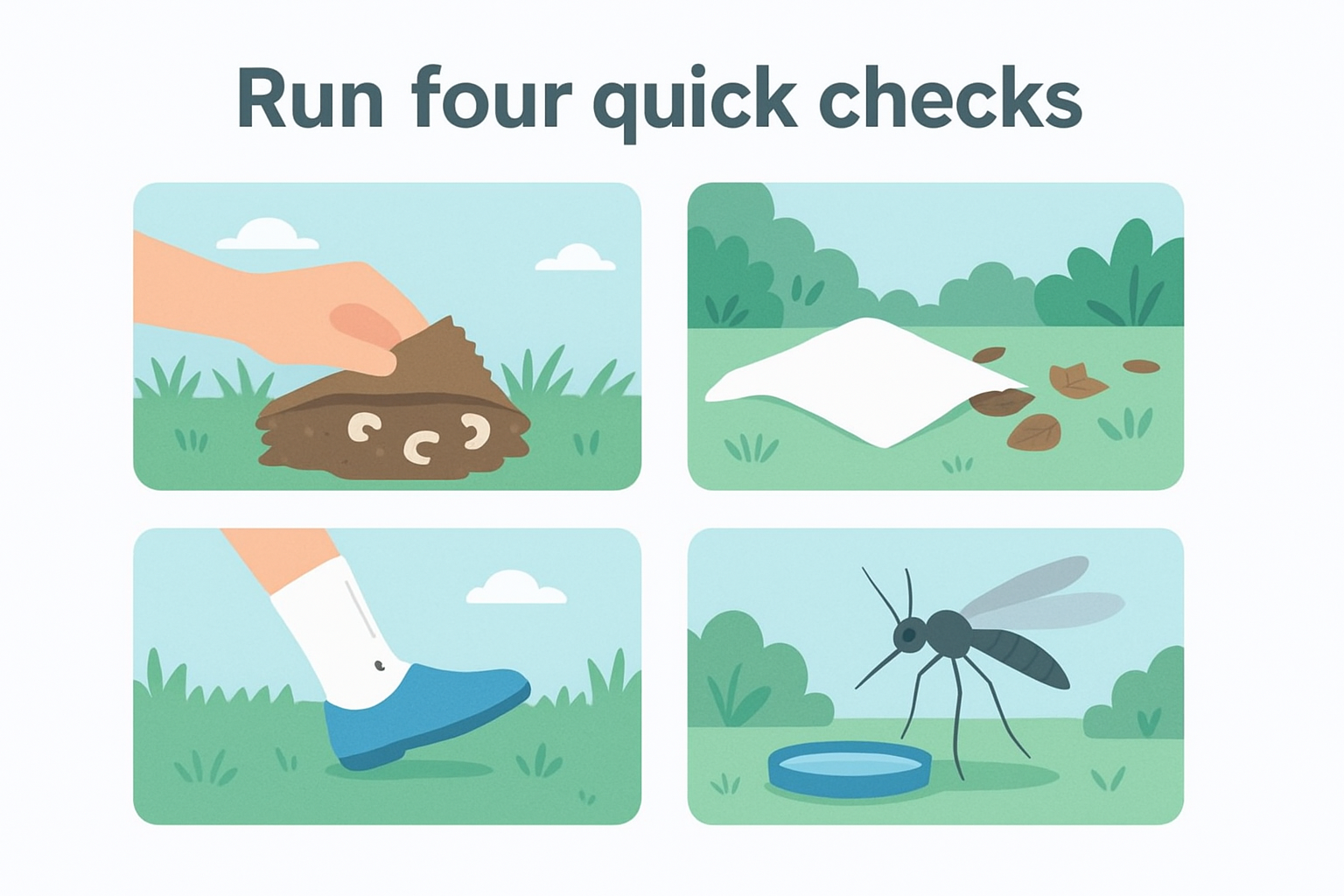
- Grubs. Tug at a brown patch. If the turf lifts like loose carpet, cut a one-foot square, peel it back, and dig 3 to 4 inches down. Count the white, C-shaped larvae. More than roughly 5 to 10 per square foot is the usual point where treatment makes sense. Birds, skunks, or raccoons digging up the lawn are another sign.
- Ticks. Drag a white cloth over lawn edges, leaf litter, and shaded brush. Check the cloth every few yards.
- Fleas. At dusk, walk the spots where your pets rest wearing white socks pulled to your knees. Tiny dark specks that jump onto the fabric are fleas.
- Mosquitoes. Look for standing water in plant saucers, gutters, buckets, and low spots, and for tiny wrigglers in the water. Note whether bites happen at dusk near dense shrubs.
Once you know the pest, timing becomes the next question, and it answers when you should put pest control on your lawn. The windows below are typical for Northern California, but the exact dates depend on species and weather , so ask the company what it found in your yard.
| Pest | Where to look | Typical treatment timing |
|---|---|---|
| Grubs | Roots under thin or dead turf | Preventive in late spring to early summer, corrective in late summer and fall |
| Ticks | Lawn edges, leaf litter, shaded brush | Can stay active in cooler months, so ask about fall to spring visits |
| Fleas | Damp, shaded spots where pets rest | Warm months, treated at the first sign because populations grow fast |
| Mosquitoes | Standing water, dense shrubs, shaded foliage | Spring through fall, with repeat visits about every 3 to 4 weeks |
Identify the pest first, because the product and the timing both depend on it.
Decide whether to treat the yard yourself
Yes, you can treat your yard for pests yourself, and for a small, mild problem it is often reasonable. Retail granules and hose-end sprays handle light flea or ant activity , and dumping standing water costs nothing. Whatever you buy, follow the label exactly , since it sets the rate, the pests covered, and the re-entry time.
Hire a professional when any of these apply:
- Grub damage covers more than a patch or two
- You are finding ticks, which carry disease and need targeted edge treatments
- Mosquitoes keep coming back and need repeat applications
- You cannot confirm the pest, or a store-bought product already failed once
- Children or pets use the yard and you want someone to choose products and explain re-entry
Step 2. Shortlist and vet local companies
Shortlist three companies with a real local address , a verifiable state license , and proof of insurance, then check each claim before you ask for a price. Three is enough to see a fair range without spending a week on phone calls.
Build a shortlist of three
Start with map results and your neighbors. Open each company's Google Business Profile, look for a street address in your area , and read the one- and two-star reviews first. Pay attention to how the owner replies, because a calm, specific answer says more than a wall of five-star ratings. Ask a neighbor with a healthy lawn who treats it, which is a real test of the work.
Be careful with directory pages and "near me" ads. Many are lead-generation sites that sell your phone number to whoever pays, so the company that calls back may not be local at all. If a website lists no address or technician names , move on.
Verify license and insurance
State agencies license pest control work in California. Lawn and landscape applications generally fall under the California Department of Pesticide Regulation, while structural pests such as termites and household insects fall under the Structural Pest Control Board. Ask each company which license covers the work and for the number, then look it up with the agency. Request proof of liability insurance too.
Defender, for example, is licensed and insured, and its residential program starts with a thorough inspection of your home and yard before it builds a customized plan. That inspection-first pattern is what to look for in any lawn pest control company you call.
Ask these questions on the call
Keep the call to five minutes and ask the same questions of every company:
- Which pests do you find in yards like mine, and how do you confirm them?
- Which products will you use, and can I see the labels?
- Who applies them, and is that person a licensed applicator or supervised by one?
- How many visits do I need, and how far apart?
- What happens if pests return between visits, and is re-service free?
- How long must children and pets stay off the treated areas?
A company that cannot name its products, its license, and its visit schedule is not ready to treat your yard.
Step 3. Compare quotes and treatment plans
Compare lawn pest control quotes on what they cover, how many visits they include, and what happens if pests return , not on the price of one visit. A low per-visit price attached to too few visits is the most common way a quote looks better than it is.
What a written quote must include
Ask each company to put the following in writing. A verbal "we'll take care of it" is not a quote, and missing items are your cue to ask before you sign.
- The pests covered, named one by one
- The areas treated, such as turf, beds, perimeter, and trees
- The number of visits and the spacing between them
- The type of product, including any lower-impact options
- The price per visit and the season total
- Re-service and guarantee terms
- Cancellation terms for recurring plans
- Re-entry instructions for people and pets
What drives the price, with an example
Price depends on lot size, the pest, the number of visits, and how bad the infestation is . Gated yards, dogs that cannot be moved, and heavy shrub cover add time. A one-time grub treatment usually costs less than a season-long mosquito program, because mosquito barrier treatments are typically repeated every 3 to 4 weeks, while grub control often needs one or two well-timed applications. Honest figures depend on your lot, so this guide skips a price list and shows you how to compare.
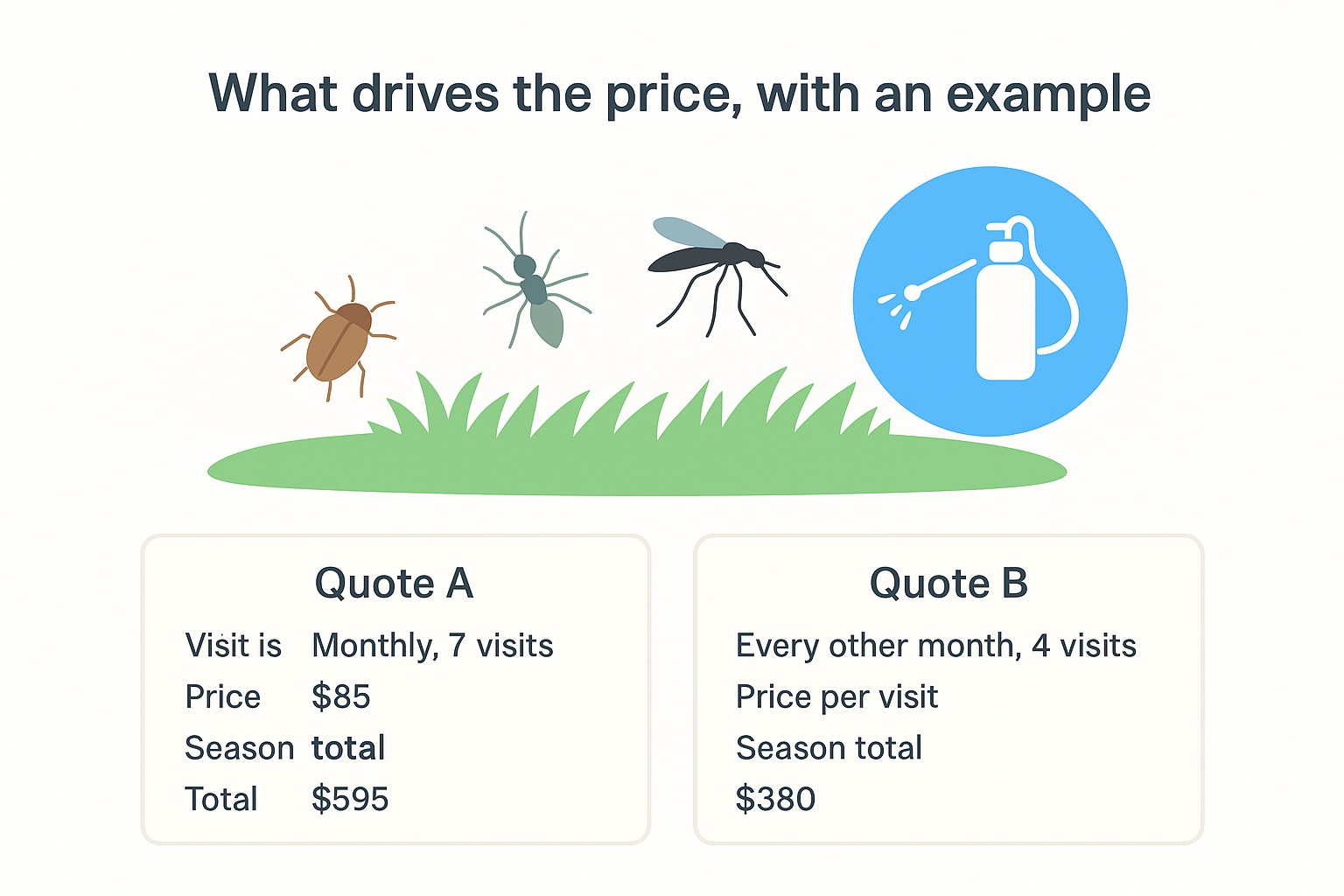
Say you get two quotes for mosquito and flea control from April through October. The numbers below are illustrative, not a price list.
| Quote A | Quote B | |
|---|---|---|
| Visit schedule | Monthly, 7 visits | Every other month, 4 visits |
| Price per visit | $85 | $95 |
| Season total | $595 | $380 |
| Re-service between visits | Free | Not stated |
Quote B costs $215 less ($595 minus $380), yet it leaves gaps of about two months in a program where mosquitoes need monthly attention , and it says nothing about re-service. For mosquitoes, Quote A is the better buy. If grubs were your main problem, B's lighter schedule could be enough, but ask B to state its re-service terms before you decide.
The cheapest price per visit is rarely the cheapest plan.
Request quotes with one message
Send the same message to all three companies so the answers are comparable. Copy this and fill in the brackets:
 Subject: Quote request for lawn pest treatment

Hello,

I'm looking for a quote to treat my yard for [grubs / ticks / fleas / mosquitoes].

Address: [street, city, ZIP]
Lawn and bed size: [approximate square feet or lot size]
What I see: [brown patches, bites, ticks on pets, standing water]
Pets and children: [yes or no, and what kind]
Irrigation: [automatic or manual, known leaks]
Goal: [one-time treatment or season-long program]

Please send a written quote that lists the pests covered, areas treated,
number of visits and spacing, price per visit and total, re-service and
guarantee terms, and your state license number. Photos are attached.

Thank you,
[Name, phone]
Step 4. Prepare your yard and track results
Prepare the yard before each visit, remove what feeds pests between visits , and judge the outcome against a timeline. That is how you know whether the treatment worked or whether it is time to call back.
Get the yard ready for the visit
Good prep takes about 15 minutes. Check each item against your company's own instructions, because products differ.
- Mow a day or two before the visit, not right after, unless your technician says otherwise.
- Pick up toys, pet bowls, hoses, and cushions so the technician can reach edges and beds.
- Unlock gates and keep dogs inside.
- Close windows and bring children and pets indoors during the application.
- Ask about watering. Some turf products need to be watered in, while sprays on foliage need to dry first.
- Keep people and pets off treated areas until the product dries , or longer if the technician says so.
Cut off what feeds pests between visits
Between visits, remove the conditions pests rely on. Tip out standing water weekly , because mosquitoes can breed in a bottle cap of water. Fix leaking sprinkler heads, rake leaf litter, and trim shrubs back from fences and the house so light and air reach the soil. Treat your pets with a vet-recommended flea and tick preventive , since a treated yard still sends pests back in on an untreated animal.
If a neglected pool or pond next door is breeding mosquitoes, report it to your local mosquito and vector control district. That is a public service, and it removes a source no yard treatment can reach.
Judge results and know when to call back
Expect mosquito numbers to fall noticeably within the first week or two . Fleas can take a few weeks, because pupae keep hatching after the first treatment. Grub damage will not green up by itself, so reseed the dead patches once the grubs are controlled. If you see no improvement after the first follow-up visit , call and ask for re-service.
Keep a simple record of visit dates, products used, and what you notice. It makes any conversation about re-service factual. Look for companies that back their work in writing. Defender's residential program, for example, activates its management plan 30 days after the initial treatment and comes with a pest free guarantee.
Treatment is not finished at the visit; it is finished when the pests stay gone.
Put the plan to work
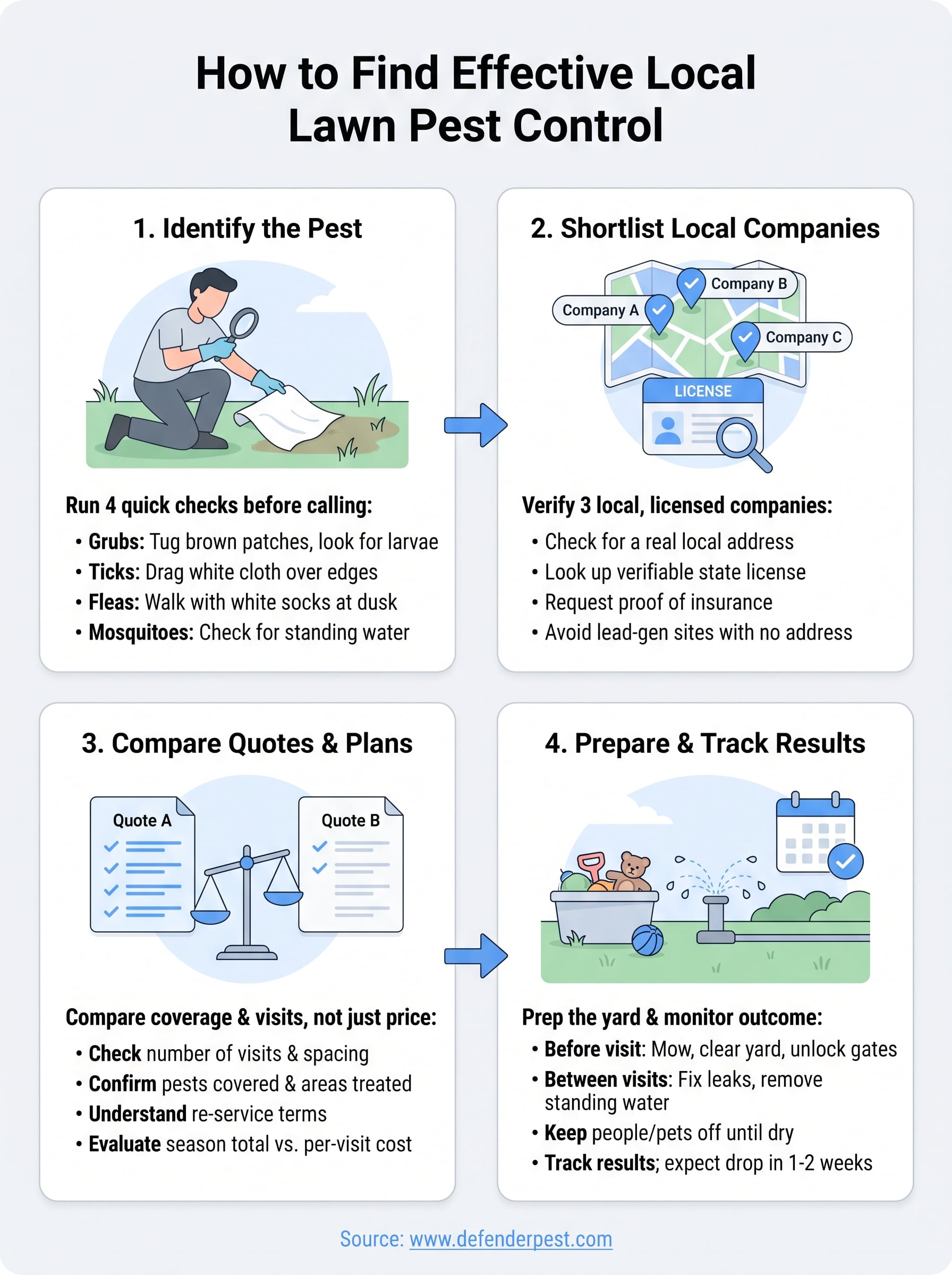
Finding lawn pest control near you comes down to four moves. Identify the pest with simple checks, shortlist three licensed and insured local companies, compare written quotes on visits and coverage, and prepare the yard so the treatment can do its job. Do them in order and you hire once, with a plan that matches your pest and your season.
If you live in the Sacramento area and want help with your yard, request a quote from Defender Termite & Pest Management and share what you found in Step 1. You can also call the pest control line at (916) 389-2847 to talk it through with a local, family-owned team.