When To Treat Lawn For Grubs: Preventive Vs Curative Windows
A few grubs hiding beneath the surface might not seem like a big deal, until brown patches start spreading across your lawn in late summer. By then, the damage is already done, and your treatment options are limited. Knowing when to treat lawn for grubs is the difference between a simple preventative application and an expensive, uphill battle to save your turf. Timing is everything , and most homeowners miss the ideal window because they don't realize a problem exists until it's too late.
Grub control breaks down into two distinct approaches: preventative treatments applied before eggs hatch and curative treatments used to knock out larvae already feeding on your grass roots. Each has a specific seasonal window, and choosing the wrong one, or applying at the wrong time, means wasted product and continued damage .
At Defender Termite & Pest Management, we've been helping Sacramento-area homeowners protect their properties from destructive pests since 1999, and that includes the lawn-destroying grubs that thrive in Northern California's climate. This guide walks you through exactly when to apply each type of treatment, how to identify an active infestation, and what steps to take based on the time of year you're dealing with the problem.
Know the grub life cycle and timing in Northern California
Understanding what grubs are doing underground at each point in the year is the foundation of effective grub control . Grubs are the larval stage of beetles, most commonly the Japanese beetle, masked chafer, or June bug , and their life cycle determines exactly when your lawn is vulnerable and when treatments actually work. Skipping this knowledge leads to wasted product applications and continued root damage under the surface.
The beetle's life cycle from egg to adult
Adult beetles emerge from the soil in late May through July in the Sacramento region, feed on plants and foliage above ground, and then burrow a few inches into your lawn to lay eggs. Those eggs hatch within two to four weeks , typically in late July through early August, releasing small first-instar larvae that immediately begin feeding on grass roots close to the surface.
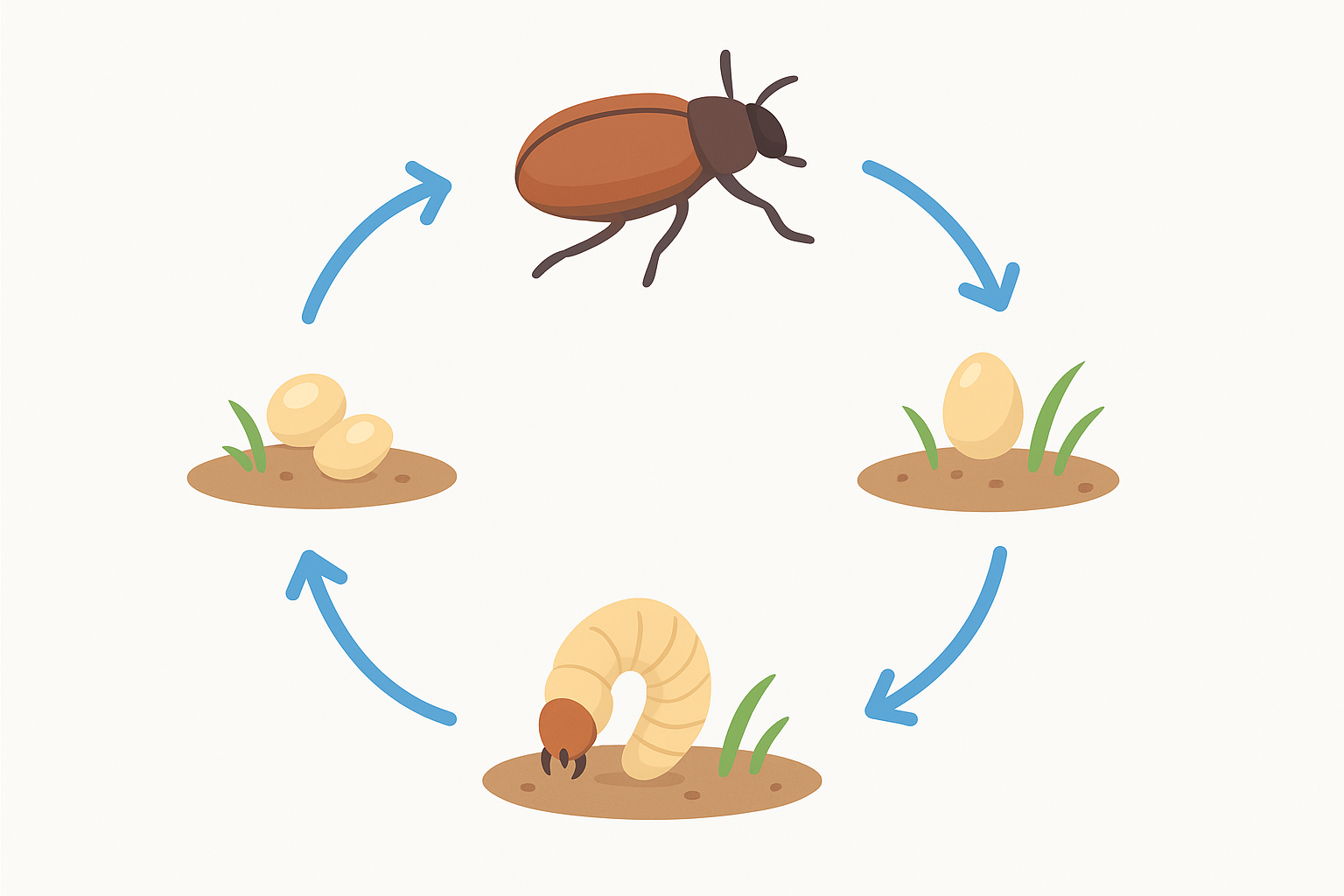
The larvae develop through three distinct stages called instars . First and second-instar grubs are relatively small, mobile, and feeding aggressively within the top 2 to 3 inches of soil through August and into September. This shallow position matters because pesticide products penetrate the soil and reach them far more reliably at this stage than at any other point in the cycle. By late October, as soil temperatures drop below 60°F, grubs burrow 4 to 8 inches deeper to survive winter. In spring, they migrate back up briefly before pupating and transforming into the adult beetles that restart the entire cycle.
The window between egg hatch and the grubs' fall migration deeper into soil is the most critical period to understand when to treat lawn for grubs in Northern California.
How Northern California's climate shifts the treatment calendar
Sacramento's hot, dry summers and mild winters compress and shift the grub life cycle compared to cooler parts of the country. Beetle activity and egg-laying often begin two to three weeks earlier here than in the Pacific Northwest or the Upper Midwest, which means grubs reach their peak feeding stage sooner than most national treatment guides account for. Relying on a generic calendar calibrated for a colder region puts your application behind the actual biological timeline in your yard.
Soil temperature drives every stage of this cycle , not the month on your calendar. Eggs hatch when soil at a 2-inch depth reaches approximately 70°F, which typically occurs in the Greater Sacramento area by mid-to-late July . Because summer heat arrives early and lingers here, the curative treatment window also closes earlier than homeowners expect. Waiting until September to apply a curative product frequently means grubs have already burrowed too deep for a surface treatment to reach them in effective concentrations.
Rainfall patterns create one more challenge specific to this region. Grub control products, especially preventative systemic treatments , require moisture to move down through the soil profile and reach the zone where eggs are hatching. Sacramento's dry summer means you will need to irrigate your lawn deeply immediately after any grub treatment application , regardless of whether you use a granular or liquid product. Without that watering step, the active ingredient stays near the surface and never contacts the larvae feeding at root depth.
| Life Cycle Stage | Approximate Timing in Sacramento | Soil Depth |
|---|---|---|
| Adult beetle activity / egg-laying | Late May through July | Surface to 2 inches |
| Egg hatch / early instar larvae | Late July through mid-August | 1 to 3 inches |
| Peak larval feeding (2nd instar) | Mid-August through September | 2 to 4 inches |
| Late instar grubs moving deep | October | 4 to 8 inches |
| Overwintering grubs | November through February | 6 to 10 inches |
| Spring migration and pupation | March through May | Rising to 2 to 4 inches |
Step 1. Confirm you have grubs before you treat
Treating your lawn for grubs without confirming they're actually there wastes money and exposes your soil to unnecessary chemicals. Several other problems, including drought stress, fungal disease, or poor soil compaction , can produce brown patches that look identical to grub damage on the surface. Before you decide when to treat lawn for grubs, you need to get down and physically verify what's happening beneath your turf.
Look for the warning signs above ground
Irregular brown patches that appear in late July through September are the most common signal that grubs are feeding on your grass roots. Unlike drought stress, which tends to brown your lawn uniformly, grub damage creates spongy or uneven dead zones that spread outward from a central point. You may also notice increased bird, skunk, or raccoon activity digging up sections of your lawn, because wildlife detects and feeds on the larvae below the surface.
- Brown patches that don't respond to watering during summer
- Turf that feels spongy underfoot in localized areas
- Visible digging or animal disturbance in irregular patches
- Grass that peels back easily like a loose rug
Do the sod pull test
The most reliable way to confirm an infestation is the sod pull test , and it takes about two minutes. Cut a one-square-foot section of sod at the edge of a brown patch using a spade or flat shovel, then fold the flap back to expose the first 3 to 4 inches of soil. Count every white, C-shaped larva you find in that section of soil and root zone.
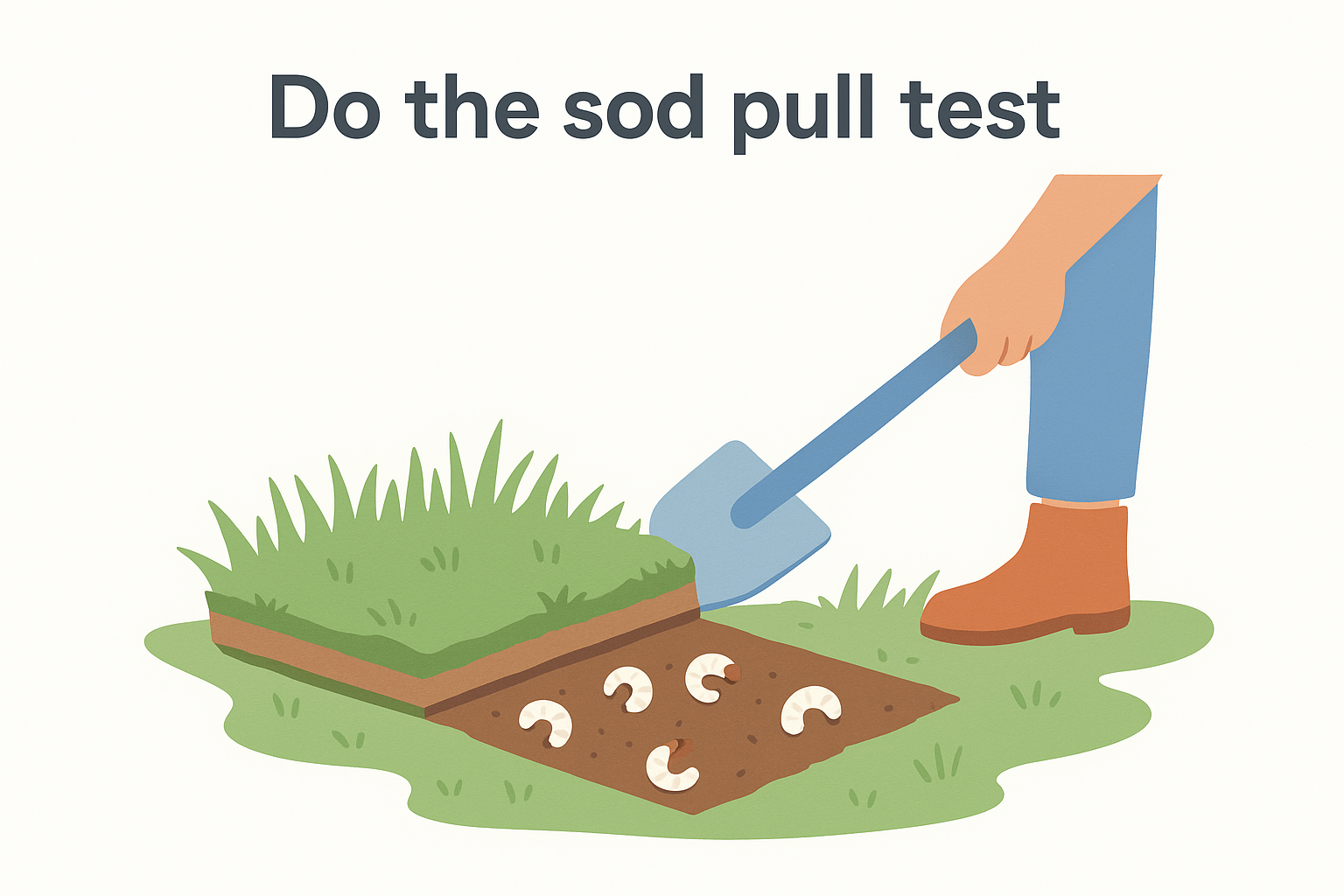
If you find 10 or more grubs per square foot , your lawn has crossed the damage threshold and treatment is justified.
Finding fewer than five grubs per square foot generally means your lawn can tolerate the population without significant damage, especially if the turf is otherwise healthy. Test at least three or four spots across your lawn, including both visibly damaged areas and areas that still look green, since grubs spread unevenly. This count gives you an accurate picture of infestation severity before you commit to a treatment product or schedule.
Step 2. Treat preventively in the best window for your lawn
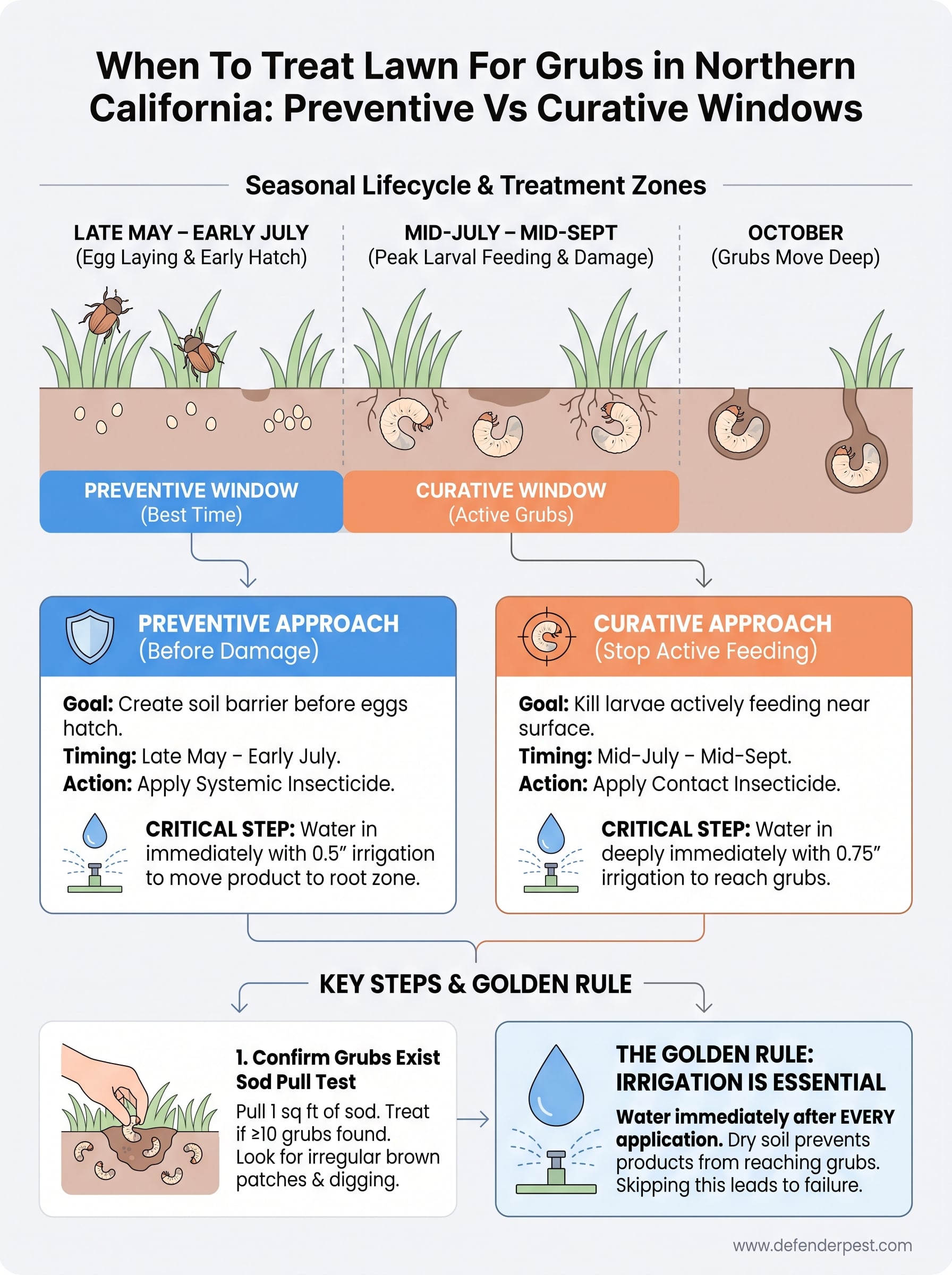
Preventive grub control works by placing a systemic insecticide in the soil before eggs hatch, so that newly emerging larvae contact the active ingredient as they begin feeding on grass roots. This approach is far more effective than waiting for visible damage to appear, and it gives you far more control over the outcome. The ideal preventive window in the Sacramento area runs from late May through early July , before adult beetles finish laying eggs and before hatching begins in earnest. Missing this window by even a few weeks significantly reduces the product's effectiveness.
Choose the right product for preventive treatment
The two most common active ingredients used in preventive grub products are imidacloprid (found in products like Bayer Season-Long Grub Control) and chlorantraniliprole (found in products like Scotts GrubEx). Chlorantraniliprole has the wider application window, performing reliably when applied as early as April through early July, while imidacloprid works best when applied closer to the actual hatch window in June and July. Read the product label carefully and match your application date to the active ingredient you choose, because applying too early with the wrong formulation can leave your lawn unprotected by the time eggs actually hatch.
Apply in the June-to-early-July window
June through early July is the single most reliable window for preventive treatment when you want to know when to treat lawn for grubs in Northern California. During this period, adult beetles are still active and laying eggs, but hatching has not yet occurred, which means the active ingredient has time to move through the soil and reach the zone where larvae will emerge.
Apply your preventive grub treatment and then water your lawn immediately with at least half an inch of irrigation to carry the active ingredient down to root depth.
Follow this checklist before and after applying a preventive product:
- Mow your lawn to a normal height before application so granules reach the soil
- Apply the granular or liquid product evenly using a calibrated spreader or sprayer
- Water deeply within 24 hours of application, targeting at least half an inch of irrigation
- Record the product name, application date, and application rate so you can troubleshoot if damage still appears
- Recheck your lawn for brown patches in late August to confirm the treatment held
Step 3. Treat curatively when grubs actively feed in your soil
Curative treatments work differently than preventive ones. Instead of building a chemical barrier before eggs hatch, curative products target actively feeding larvae already present in your soil. This approach requires precise timing because it only works while grubs remain in the shallow feeding zone within the top 2 to 4 inches of your lawn. Once they migrate deeper in October, surface applications lose their effectiveness almost entirely.
Identify your curative treatment window
The reliable curative window in the Sacramento region runs from mid-July through mid-September . During this stretch, second-instar grubs are feeding aggressively near the surface and are small enough that contact insecticides can reach and kill them before they cause irreversible root damage. Acting during this period gives you a genuine chance to stop an active infestation before dead patches become permanent.
Once you push past mid-September and soil temperatures begin to drop, grubs start burrowing deeper and curative products rarely reach them in concentrations high enough to work.
If you confirmed a damaging grub population through the sod pull test in Step 1, treat as soon as possible within this window. Waiting even two weeks can shift the grubs into a later developmental stage that is harder to kill and positioned deeper in the soil profile.
Choose the right curative product
When deciding when to treat lawn for grubs with a curative approach, your product selection matters as much as your timing. The two most effective active ingredients for curative control are trichlorfon (found in products like Bayer 24-Hour Grub Killer Plus) and carbaryl. Both are contact insecticides that break down faster in the environment than systemic preventive products, which is exactly why you need grubs near the surface for them to work.
Apply the product using this sequence:
- Mow your lawn first and remove any heavy thatch that blocks soil penetration
- Apply the curative granule or liquid evenly across affected zones and surrounding turf
- Water immediately with at least three-quarters of an inch of irrigation to drive the active ingredient to root depth
- Recheck treated areas with another sod pull test seven to ten days after application to confirm grub mortality
- Repeat the application once if live grubs still exceed five per square foot in the recheck
Step 4. Apply grub control the right way and avoid common mistakes
Getting your timing right is only part of the equation. Even a perfectly timed application can fail if you spread the product unevenly, skip irrigation, or treat the wrong zone of your lawn. Application technique directly determines whether the active ingredient reaches grubs feeding at root depth or sits uselessly on the surface. Knowing when to treat lawn for grubs means nothing if the product never makes contact with the larvae below.
Water your lawn immediately after every application
The single most important step after any grub treatment is deep, immediate irrigation . Without water, granular products stay on the surface and liquid products never penetrate far enough to reach actively feeding larvae. Apply at least half an inch of water within 24 hours of a preventive treatment, and at least three-quarters of an inch within 24 hours of a curative treatment. If your irrigation system runs on an automatic schedule, override it manually and run a full cycle the same day you treat. Dry summers in the Sacramento region make skipping this step especially costly, because there is no natural rainfall to carry the product down into the root zone.
Skipping irrigation after a grub treatment is the most common reason homeowners see no results, even when their timing was exactly right.
Avoid these application mistakes before your next treatment
Many grub control failures trace back to a short list of predictable errors that are easy to correct once you know what they are. Review each of these before and after your next application:
- Using an uncalibrated spreader - An uneven spread rate leaves gaps where grubs survive and continue feeding on your roots
- Treating only the brown patches - Apply product to the surrounding green turf as well, since grubs spread well beyond the visible damage zone
- Applying after heavy rain - Saturated soil increases runoff and prevents the product from binding effectively at root depth
- Ignoring thatch buildup - A thatch layer thicker than half an inch physically blocks granules from reaching soil; dethatch your lawn before you apply any grub product
- Storing leftover product in heat or moisture - Degraded active ingredients lose effectiveness; store sealed bags in a cool, dry location away from direct sunlight
After treatment, run the sod pull test again seven to ten days later to confirm grub mortality. That follow-up count tells you whether your application worked or whether you need to adjust your rate or irrigation before treating a second time.
Next steps
Now you have a clear picture of when to treat lawn for grubs and which approach fits the time of year you're working with. The key decisions come down to three things: confirm grubs are actually present with a sod pull test, match your product and application date to either the preventive window in June or the curative window in mid-July through mid-September, and water deeply every single time you apply.
Your lawn's health depends on acting within the right window, not just buying the right product. If you've found grubs, started seeing brown patches spread, or missed the preventive season entirely, professional treatment gives you the best chance of stopping damage before it becomes permanent. Defender Termite & Pest Management has served Sacramento-area homeowners since 1999 with targeted, effective pest solutions built around Northern California's specific climate. Request a lawn pest inspection and get a treatment plan matched to your exact situation.