Rat Removal Attic Cost: What You Pay and What Drives It
Rat removal attic cost is the total price of getting rats out of your attic and keeping them from coming back. Published price guides put it anywhere from a few hundred dollars for a small, early job to $3,000 to $10,000 or more when cleanup and new insulation are involved. The spread exists because one quote can mean trapping only, while another bundles trapping, sealing, sanitizing and insulation replacement into a single project.
At Defender Termite & Pest Management, we have worked on homes in Sacramento and the surrounding area since 1999. Our rodent work covers inspection, removal, exclusion, repair, and insulation removal, disinfection and reinstallation. Most of the confusion we hear from homeowners comes from comparing two quotes that cover different amounts of work.
This article breaks the price into its parts, shows what pushes each part up or down, and gives you a way to test an estimate before you sign. We do not quote a Sacramento price here, because no honest number exists without seeing your attic. The ranges below are benchmarks from published pest control and attic remediation guides. Treat them as a way to judge a quote, not as a price list.
Why attic rat removal costs range so widely
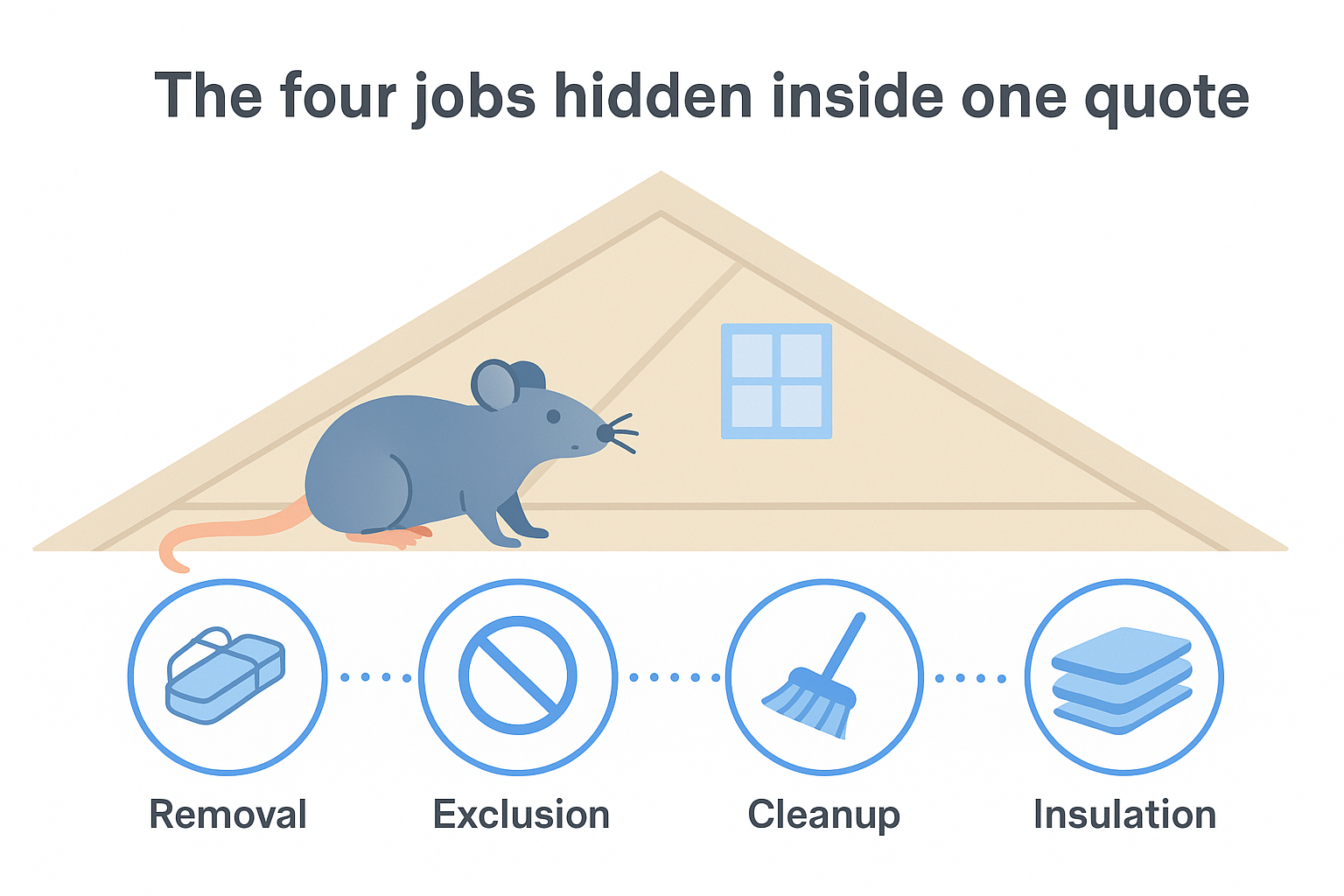
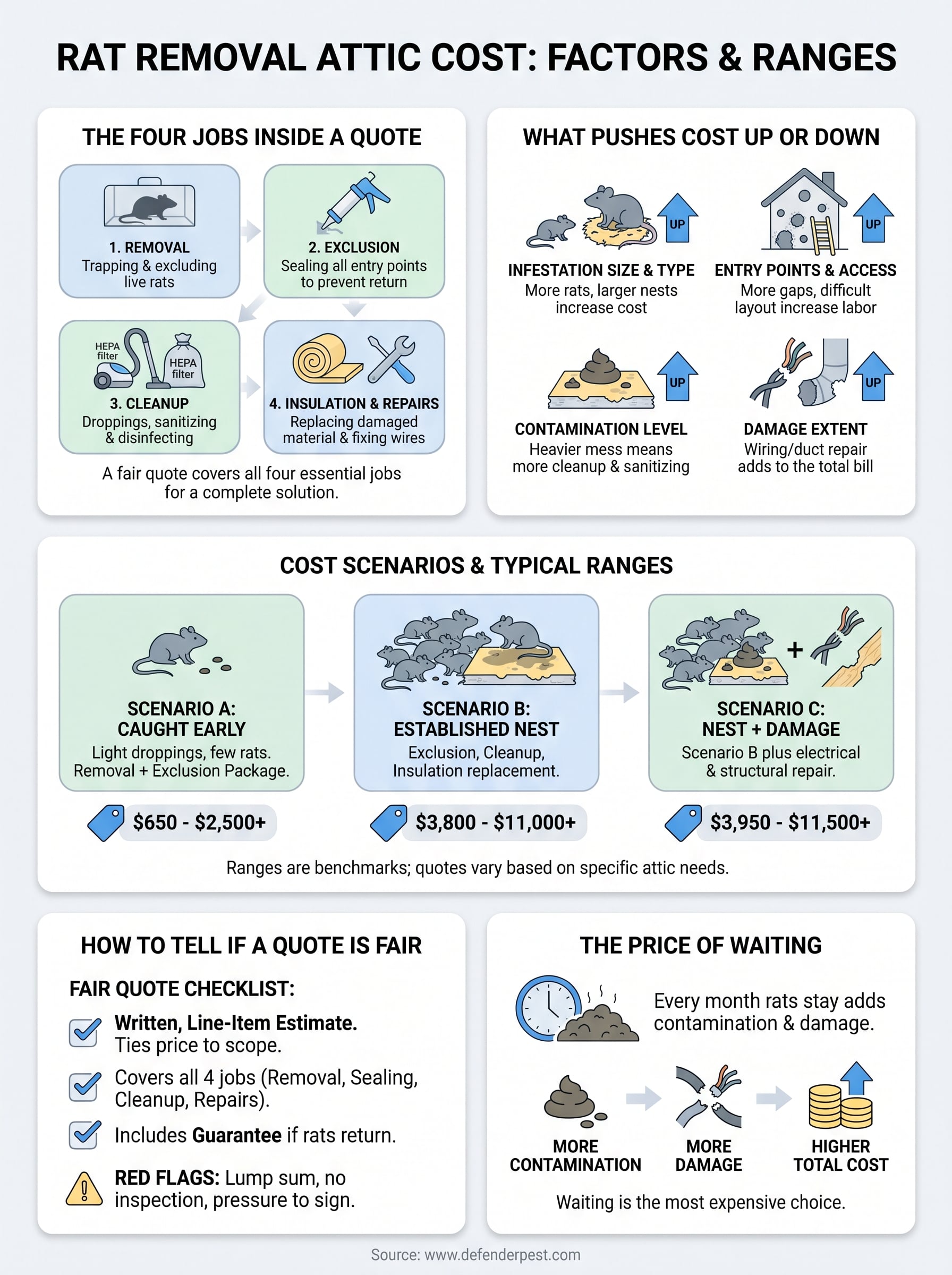
An attic rat job is rarely one service. The cost of rat removal from an attic splits into four jobs: removing the live rats, sealing the entry points, cleaning up the contamination, and replacing damaged insulation or repairing damage. The more of these your attic needs, the higher the total.
The four jobs hidden inside one quote
Removal means trapping or excluding the rats that are there now. Exclusion means sealing every gap they used to get in, which is what keeps the problem from returning. Cleanup covers droppings, urine and nesting material. Insulation and repairs cover the damage left behind. A company that quotes only the first job can look cheap while leaving you with a contaminated attic and an open door.
Here is how published ranges stack up for each piece.
| Job | What it covers | Typical published range |
|---|---|---|
| Inspection | Attic and exterior check to find activity and entry points | $100 to $200, often credited toward the work |
| Trapping and removal | Getting live rats out, with monitoring | $400 to $1,200+ |
| Removal plus exclusion package | Trapping, follow-up visits, sealing entry points | $650 to $2,500+ |
| Exclusion on its own | Sealing gaps, screening vents | $200 to $2,500, depending on the number of entry points |
| Follow-up visits | Checking traps and new activity | $50 to $150 each |
| Attic cleanup and sanitizing | Droppings removal, HEPA vacuuming, antimicrobial treatment | $1,500 to $4,000 |
| Insulation replacement | Removing contaminated insulation, installing new | $1,500 to $4,500 |
| Chewed wiring repair | Electrical repair after gnawing | $150 to $500 |
A rat quote is really four jobs, and the price tells you little until you know how many of them it includes.
What national averages do and do not tell you
One widely cited national figure is an average of $396 for rat extermination, with most homeowners paying between $189 and $656. That number is real, but it is a poor guide for an attic. It blends in sheds, garages and other easy spots, where rats are simple to find and trap. Attics, walls and ductwork cost more because they take more labor, more access time and often more repair.
The same national data adds inspection fees of $100 to $200 and follow-up visits of $50 to $150. So if you see a bare "$400 rat removal" ad, read it as the floor for the easiest version of the job. Your attic quote will usually sit above that average , and the rest of this article explains why.
What pushes your quote up or down
Five things move the price most: how many rats you have, how many entry points they use, how hard the attic is to work in, how contaminated it is, and what damage they caused. Knowing these helps you see why a neighbor's price may not match yours.
Infestation size and rat type
A handful of rats caught early costs far less than a nest that has been active for a season. Rats breed fast, with up to six litters a year, so a small problem grows quickly. More rats mean more traps, more visits and more monitoring time before anyone can safely seal the last gap.
The type of rodent matters too. Mice cost less to remove than rats, because rats are larger, cause more expensive damage and need more aggressive exclusion. In California attics, the roof rat is the usual culprit. They climb well and enter at roof level, so the sealing work happens up on the roofline, not just at the foundation.
Entry points, access and attic layout
Exclusion pricing is where quotes diverge most. Rats can squeeze through gaps about the size of a quarter, and older homes with several rooflines, dormers or worn fascia and soffit areas can have 10 to 20 or more entry points. Each one takes materials and labor. A newer home with a few gaps may land near the low end of the exclusion range, while an older one with many openings lands near the top.
Access adds time. A large attic, a small hatch, low clearance or stored boxes all slow the crew. Tradespeople bill for time, so a cramped crawl attic costs more than a roomy one with a walk-up stair.
Contamination, insulation and damage
Contamination is often the single biggest swing. Scattered droppings in one corner mean a light cleanup. Urine-soaked insulation, tunnels through batts and a strong odor mean full removal and sanitizing. Insulation removal and replacement scales with the size of the attic, so this is where square footage matters. Removal itself is rarely priced per square foot, but cleanup and new insulation are. Tangled fiberglass batts take longer to remove than loose blown-in material.
Then comes damage. Chewed wiring, ducts and framing each add a line item. Electrical repair alone can run $150 to $500, and heavier damage costs more. Damage grows the longer rats stay , which is why timing matters (more on that in the last section).
Cleanup, insulation and repairs, not the rats themselves, are what turn a $1,000 job into a $5,000 job.
How to tell if your quote is fair
A fair quote names every job in writing, ties the price to the scope of your attic, and explains what happens if rats come back. You do not need to know pest control to check this. You need a short list of questions and a rough sense of where your situation falls in the ranges.
Check that the quote covers all four jobs
Ask these questions before you accept any estimate:
- Does the price include a full attic inspection and an exterior inspection, not just a look through the hatch?
- Is exclusion included, and does the quote say how many entry points it expects to seal?
- How many follow-up visits are covered, and what does each extra visit cost?
- Is cleanup included, or is it a separate line? Does it use HEPA equipment?
- What happens to contaminated insulation? Is removal and replacement priced now or after inspection?
- What is the guarantee if rats return after the work?
Any quote that answers only the first question is a partial quote. A low price that leaves out exclusion and cleanup will often cost more once you add the missing jobs.
A worked example for a typical attic
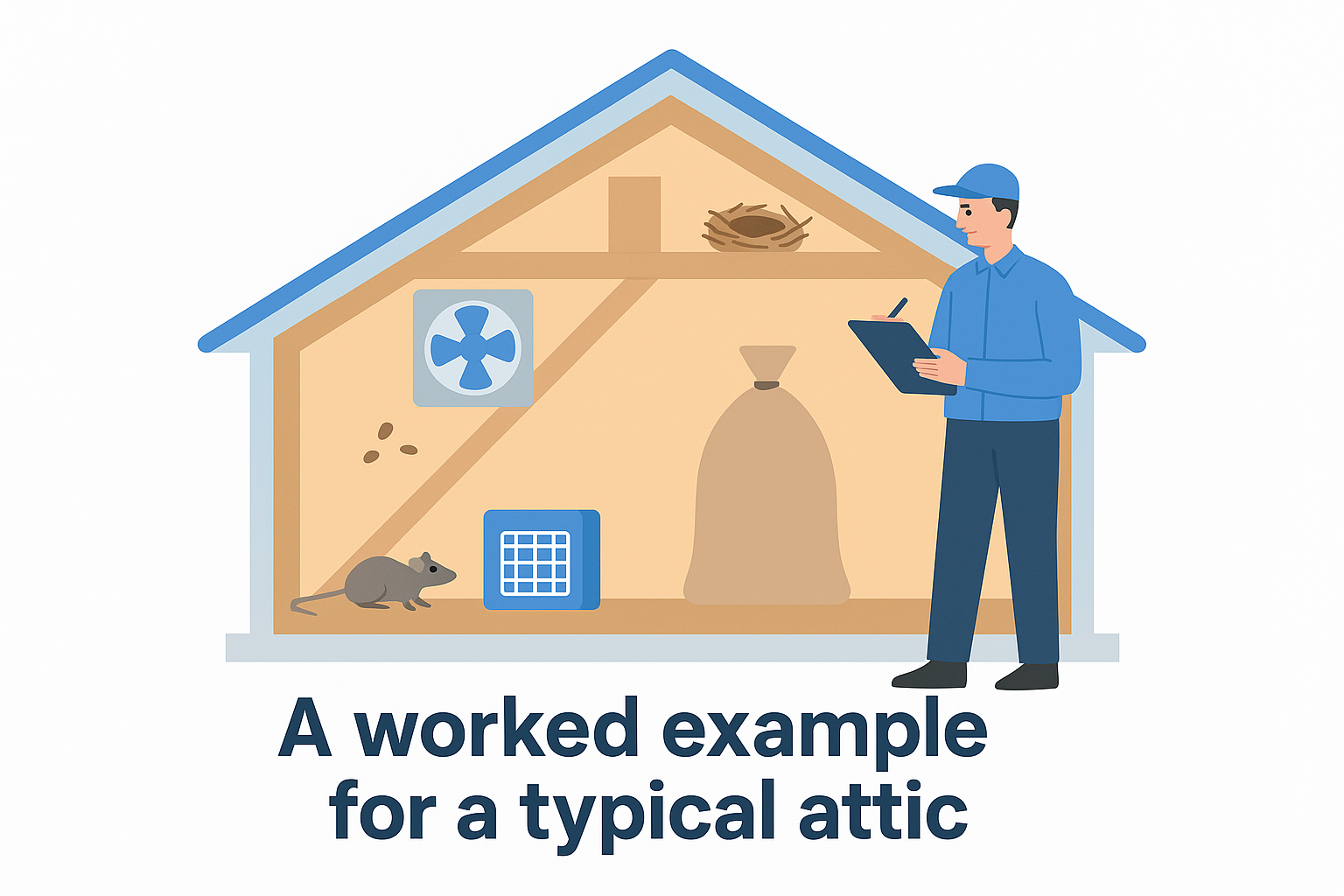
Take a 1,500 square foot attic in an older single-story home with roof rats. Below are three realistic scenarios, built by adding the published ranges from the table above.
| Scenario | What the job includes | Estimated total |
|---|---|---|
| A: Caught early | Light droppings, a few rats. Removal plus exclusion package. | $650 to $2,500 |
| B: Established nest | Exclusion ($800 to $2,500), cleanup ($1,500 to $4,000), insulation ($1,500 to $4,500) | $3,800 to $11,000 |
| C: Nest plus wiring damage | Scenario B plus electrical repair ($150 to $500) | $3,950 to $11,500 |
Published guides often quote whole projects at about $3,000 to $10,000 or more, which sits just under the sums above because not every attic needs every line at its highest price. If a quote for Scenario B comes in at $1,200, ask what was left out. If it comes in at $14,000 for a standard attic, ask for the line items.
Red flags, timing and what a fast fix really means
Be cautious of a quote with a single lump sum, no inspection, a pitch that skips sealing, or pressure to sign on the spot. Sealing an attic before you confirm that every rat is out can trap live animals inside, so a good company monitors first. A fast fix looks like trapping and exclusion together, followed by a check that activity has dropped to zero. Expect the full process to take one to three weeks for removal and monitoring, or two to four weeks when cleanup and new insulation follow.
Insist on a written, line-item estimate. A fair price is one you can trace to specific work.
Insurance, DIY and the price of waiting
Most homeowners policies do not pay for rat removal or the cleanup after it, so plan to cover the job yourself. You can handle small preparation tasks, but contaminated attic work belongs to professionals. And waiting is the most expensive choice, because rats do not leave on their own.
Does insurance pay for rat removal?
Usually no. Standard homeowners policies treat rodent infestations as a maintenance issue, so removal and cleanup are typically excluded . Some policies may cover resulting damage in limited cases, such as chewed wiring that causes a fire or a gnawed pipe that causes water damage. Read your policy and call your insurer before you assume either way, and plan the budget as out of pocket.
What you can do yourself
You can set a few traps for a small mouse problem, trim branches that touch the roof, store food in sealed containers and move trash cans away from the house. Those steps lower the odds of a return visit and keep a professional's job simpler.
Cleaning is different. Dry sweeping or using a household vacuum on droppings can send contaminated dust into the air, and rodent waste can carry pathogens such as hantavirus. Contaminated insulation should come out with HEPA equipment and containment , not a broom. Full exclusion also needs a close inspection from roofline to foundation, and a single missed gap brings the rats back.
Why waiting costs more
Rats stay in an attic as long as it offers shelter, warmth and a food source nearby. A pair can become a colony within months. As the colony grows, droppings soak into insulation, wiring gets chewed and more entry points open up. A job that could have cost a few hundred to a couple thousand dollars can move into the multi-thousand-dollar range within a year. Fall and winter also raise demand as rats seek warmth, so booking early can mean shorter waits. If you hear scratching at night, get an inspection now.
Every month a rat stays in your attic adds contamination, damage and cost.
Getting a number you can trust
Rat removal attic cost comes down to four jobs: removal, exclusion, cleanup and insulation or repairs. Early catches run from hundreds to a couple thousand dollars, while established infestations with contaminated insulation can reach $10,000 or more. The fair test is simple: a written, line-item quote that covers every job your attic needs, with a clear guarantee behind it.
If you want a number for your own attic, you can request a rodent control estimate from Defender online. We inspect first, explain what we find, and stand behind our rodent work with a 100% satisfaction guarantee. We are licensed and insured, and we handle emergencies around the clock.