Termite Control Pesticides: What They Are and How They Work
Termite control pesticides are registered insecticides, called termiticides, that kill termites or keep them out of a structure. They come in four main forms: liquid soil treatments such as fipronil, baits, wood treatments such as borates, and fumigant gas. For most homes with subterranean termites, a professionally applied non-repellent liquid is the standard choice. Baits suit special cases, and fumigation handles drywood termites spread through a house.
Which one fits depends on the termite species, the type of building, and how far the infestation has spread. This article explains how each type works, how they differ, which products homeowners see on shelves, and the rules for using them safely. It also explains why a spray that kills the termites you can see rarely protects the house.
Defender Termite & Pest Management has worked in Sacramento since 1999 and applies these treatments as a licensed, insured company. What follows is the practical view from inspecting, treating, and repairing termite damage in real homes.
Why termite control pesticides matter
Termite pesticides matter because termites work out of sight, and only a product built to reach the hidden colony protects the structure. The EPA reports that termites cause billions of dollars in structural damage every year, and that property owners spend over two billion dollars treating them.
Why spraying what you see fails
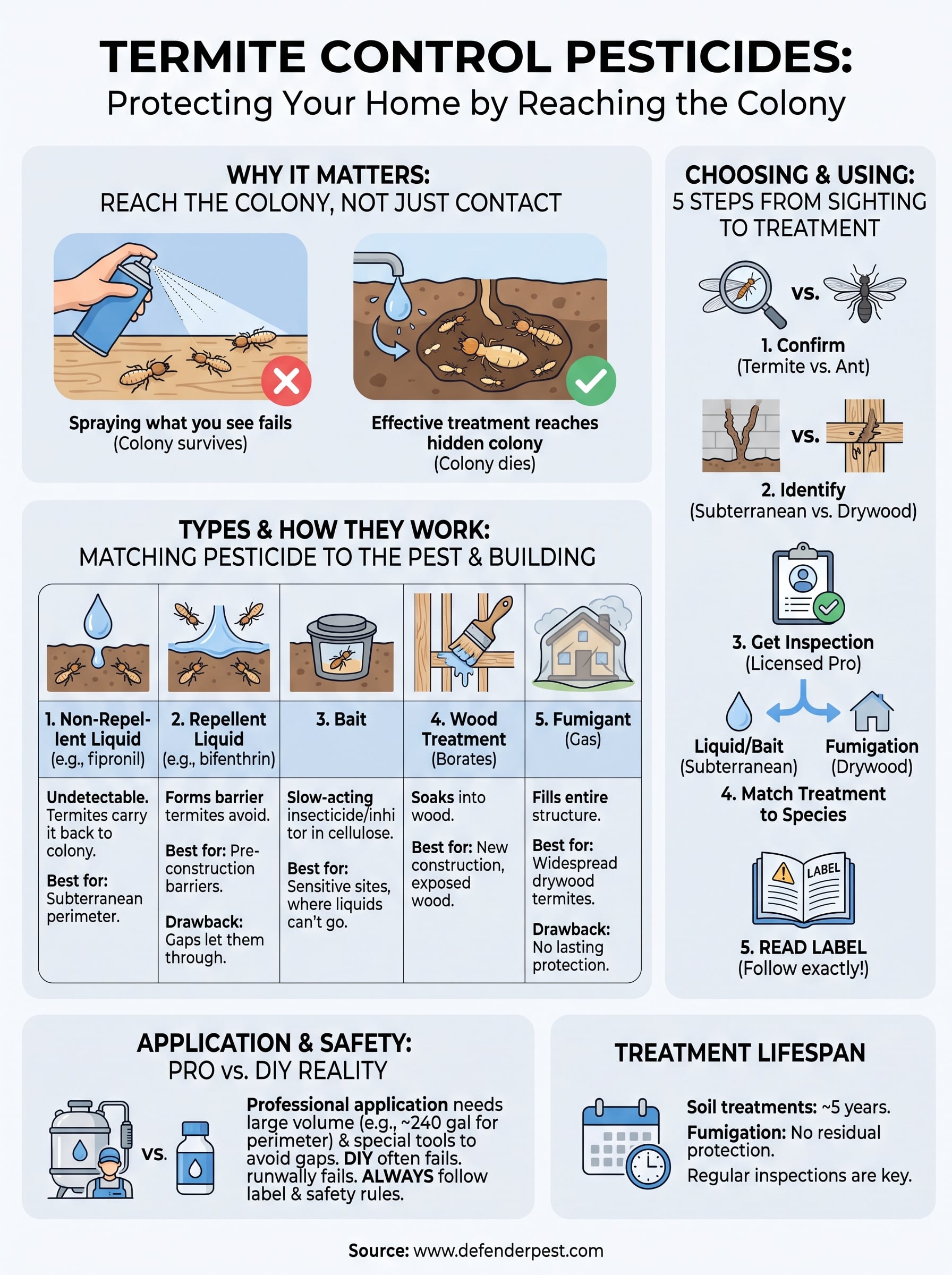
Subterranean termites nest in the soil and travel to your wood through shelter tubes. They rarely show themselves, so most people find out when a swarm appears or when damage turns up during a remodel. A spray that kills the few termites you can see leaves the colony alive.
The EPA makes the same point about contact-only products . They kill termites that touch the pesticide, not the whole infestation. A termite problem is a colony problem, and the product has to reach the colony.
A termiticide protects a home only when it reaches the colony, not just the termites you can see.
What a termiticide has to prove
Before a product is sold as a termiticide, the EPA requires proof that it protects structures. It requires a minimum number of years of proven effectiveness and specific label statements. That is why the label is your first filter .
If the label does not include directions for controlling termites and protecting the structure, the product is not meant for that job. When you compare products, look for those directions and ignore the "kills termites on contact" claims on the front.
Types of termite pesticides and how they work
Termite pesticides fall into five groups: non-repellent liquids, repellent liquids, baits, wood treatments, and fumigants. The table sets them side by side.
| Type | Common active ingredients | How it works | Best for | Main drawback |
|---|---|---|---|---|
| Non-repellent liquid | Fipronil (Termidor SC, Taurus SC), imidacloprid | Termites cross treated soil, carry the product back, and the colony dies | Subterranean termites, whole-perimeter barriers | Needs trenching and rodding with pro equipment |
| Repellent liquid | Bifenthrin, cypermethrin, permethrin | Forms a barrier termites avoid | Pre-construction barriers | Little colony-wide effect, and gaps in the barrier let termites through |
| Bait | Hexaflumuron, noviflumuron, diflubenzuron | Termites eat cellulose laced with a slow insecticide or growth inhibitor | Sites where liquids are a poor fit | Slow, needs regular monitoring |
| Wood treatment | Borates | Soaks into wood so feeding termites ingest it | New construction, exposed wood | Does not reach the soil colony |
| Fumigant | Sulfuryl fluoride (Vikane) | Gas fills the whole structure | Drywood termites throughout a house | No lasting protection afterward |
Liquid termiticides: repellent versus non-repellent
Liquid termiticides are applied to the soil around and under a structure. The big difference is whether termites can detect them. Non-repellent products such as fipronil are slow-acting and undetectable, so foraging termites walk through the treated soil, pick it up, and spread it to nestmates. Termidor SC and Taurus SC both contain 9.1% fipronil.
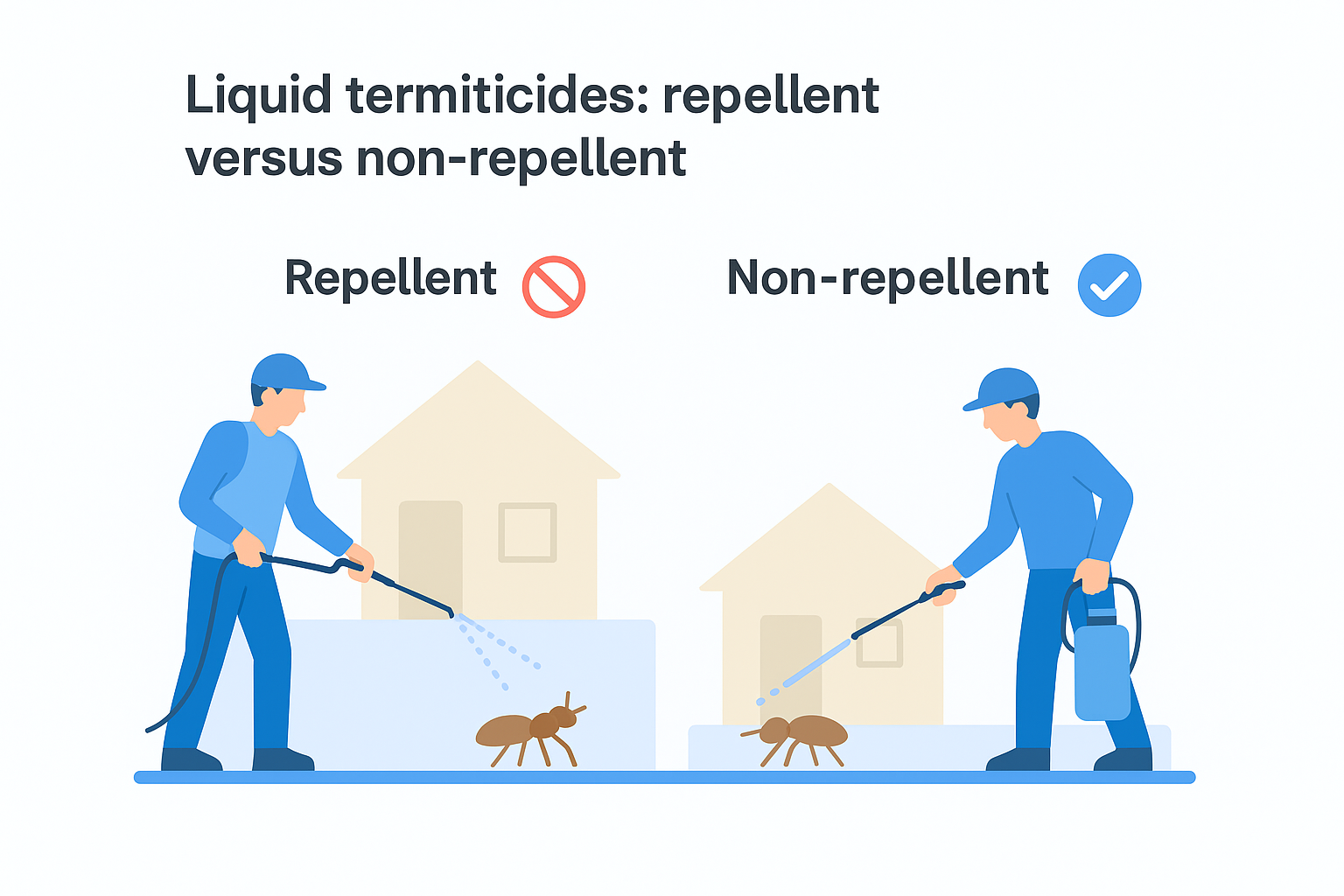
Repellent products , mainly pyrethroids like bifenthrin, cypermethrin, and permethrin, work as a barrier termites avoid. That works only while the barrier is unbroken. Kentucky's entomology extension notes that most older liquid termiticides were repellent, and that current fipronil products replaced them for good reason. Imidacloprid is another non-repellent option.
Non-repellent liquids win because termites cannot tell they are being poisoned, so they spread it for you.
Baits, borates, and fumigants
Baits use cellulose with a slow-acting insecticide or an insect growth regulator. Stations go in the soil around the building and are checked regularly. Baits do not create a barrier, and they rarely give quick control. Their service agreements also tend to cost more than conventional treatment warranties. They earn their place in the bait versus liquid treatment choice when liquids cannot be used, such as near a well or where the infested area is hard to reach.
Borates are sprayed onto wood, usually during new construction. Fumigation with sulfuryl fluoride gas (Vikane) treats an entire structure and is the usual answer for drywood termites spread through a house. It kills what is there but does not stay behind to stop the next colony.
How to choose and use a termiticide
Start by confirming the pest and the species, then match the product type to the situation. Labels and licensing decide the rest.
Five steps from sighting to treatment
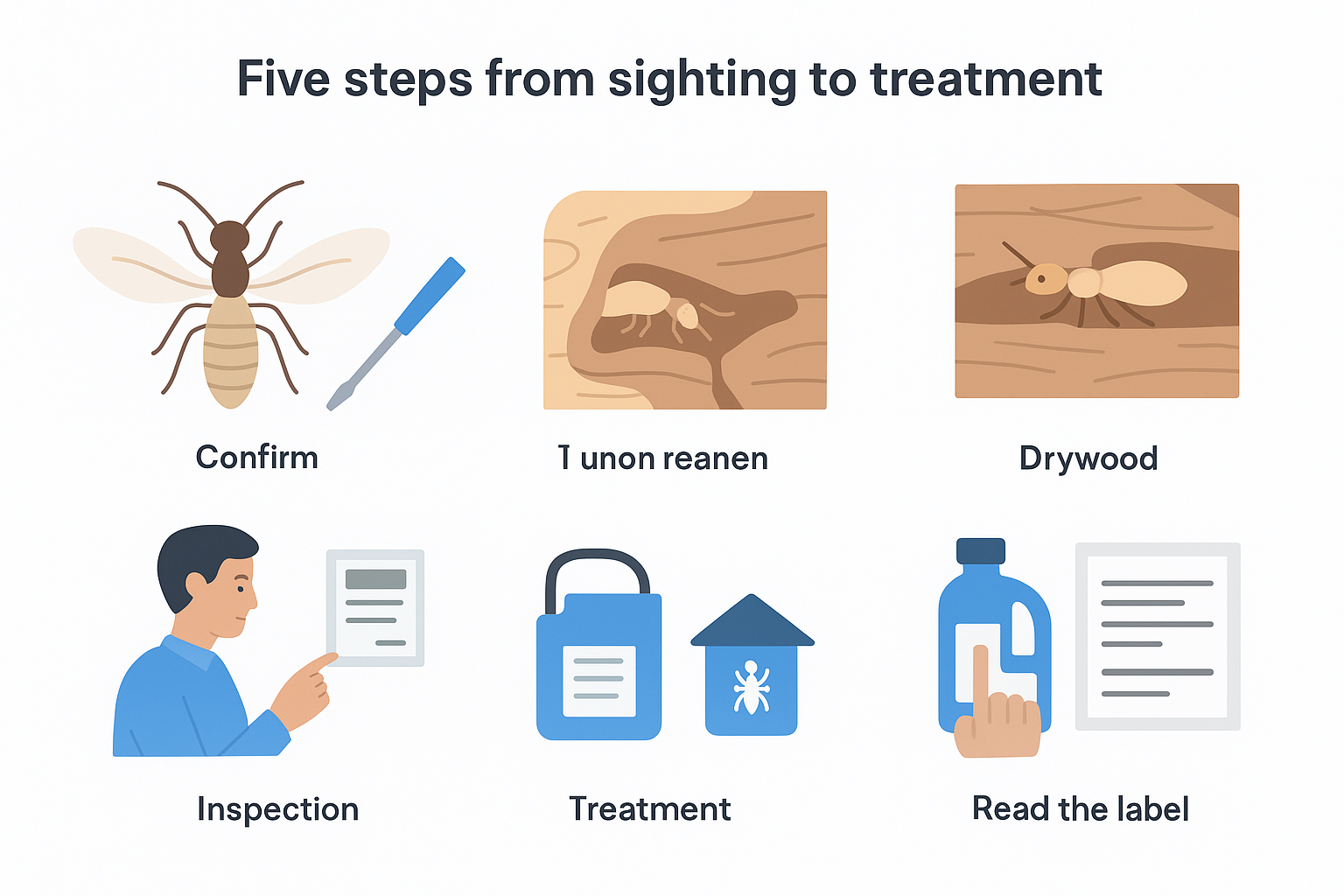
- Confirm it is a termite. Termite wings are roughly equal in length and the antennae are straight. Flying ants have longer front wings and elbowed antennae. Probe exposed wood with a flathead screwdriver and listen for hollow spots.
- Identify the type. Subterranean termites build mud tubes from the soil to your wood. Drywood termites live inside the wood itself.
- Get an inspection. A licensed Structural Pest Control Operator inspects in about an hour and a half to two hours and writes up a Wood Destroying Pests and Organisms Inspection Report.
- Match the treatment. Subterranean termites usually call for a liquid barrier or bait. Drywood termites call for localized treatment when activity is limited, or fumigation when it is widespread.
- Read the label before anything is applied. It states the approved use, the risks, and when you can safely re-enter.
What a soil treatment really takes
Retail names you will see include Termidor SC, Taurus SC, and Premise (imidacloprid) for liquids, and Trelona for baits. The product is the easy part. The label rate commonly runs about 4 gallons of diluted mix per 10 linear feet, per foot of depth. A 150-foot perimeter treated to 4 feet needs 150 × 0.4 gallons × 4, which is 240 gallons of mixed product .
That volume is why pros use a large tank, a pump, and trenching tools. Poor application can leave gaps termites walk through, and it can contaminate the home or nearby drinking water wells. Even with the right product, DIY soil treatment often fails on application.
The product matters less than the application, and a perimeter treated with gaps protects nothing.
Safety, limits, and when to call a professional
Termiticides are tested but still toxic, so follow the label exactly and hire a licensed professional for soil and structural treatments. The EPA requires more than 100 scientific studies before it registers a pesticide, and still describes many termiticides as highly toxic.
Safe handling rules
- Never apply a product to a use its label does not list.
- Ask the applicator in writing when you may re-enter the treated building. The time varies by product.
- Check the company's state license before work begins.
- If something goes wrong, contact your state pesticide regulatory agency or the National Pesticide Information Center at 1-800-858-7378.
Prevention reduces how much pesticide you ever need. Keep soil near the foundation dry, fix leaks promptly, keep vents clear, and store firewood away from the house.
How long treatments last
Soil and barrier treatments typically last about 5 years. Fumigation takes 3 to 5 days, and Defender backs it with a two-year guarantee from completion. Defender subcontracts the fumigation itself to a reputable fumigation company. Treatment stops the termites but does not repair what they ate, so structural damage needs a separate wood repair, which Defender covers with a one-year warranty.
Picking the right termite treatment
Termite control pesticides work when the product reaches the colony, the type matches the termite, and a trained applicator follows the label. Non-repellent liquids such as fipronil suit most subterranean problems, baits fill specific gaps, borates protect wood, and fumigation handles drywood termites throughout a home.
Start with a proper inspection so the treatment matches what is actually in your walls or soil. If you live in the Sacramento area, you can request a termite inspection and quote from Defender and get a plan built around your home.