Integrated Pest Management Definition: Principles & Steps
Most pest problems don't start with a single bug, they start with conditions that invite pests in. That's the core idea behind the integrated pest management definition : a strategy that prioritizes long-term prevention and targeted action over blanket chemical applications. It's an approach we use every day at Defender Termite & Pest Management, and it's one of the reasons our Sacramento-area customers see lasting results rather than recurring infestations.
IPM isn't just a buzzword or a government checkbox. It's a structured, science-backed framework that combines inspection, identification, threshold-setting, and treatment selection to control pests effectively while minimizing unnecessary risk to people, pets, and the environment. Whether you're a homeowner spotting termite damage or a business owner maintaining health and safety compliance , understanding IPM helps you make smarter decisions about how your property gets treated.
This article breaks down what integrated pest management actually means, walks through its core principles and steps, and explains how this approach applies to real-world pest situations in homes and commercial properties.
What integrated pest management means
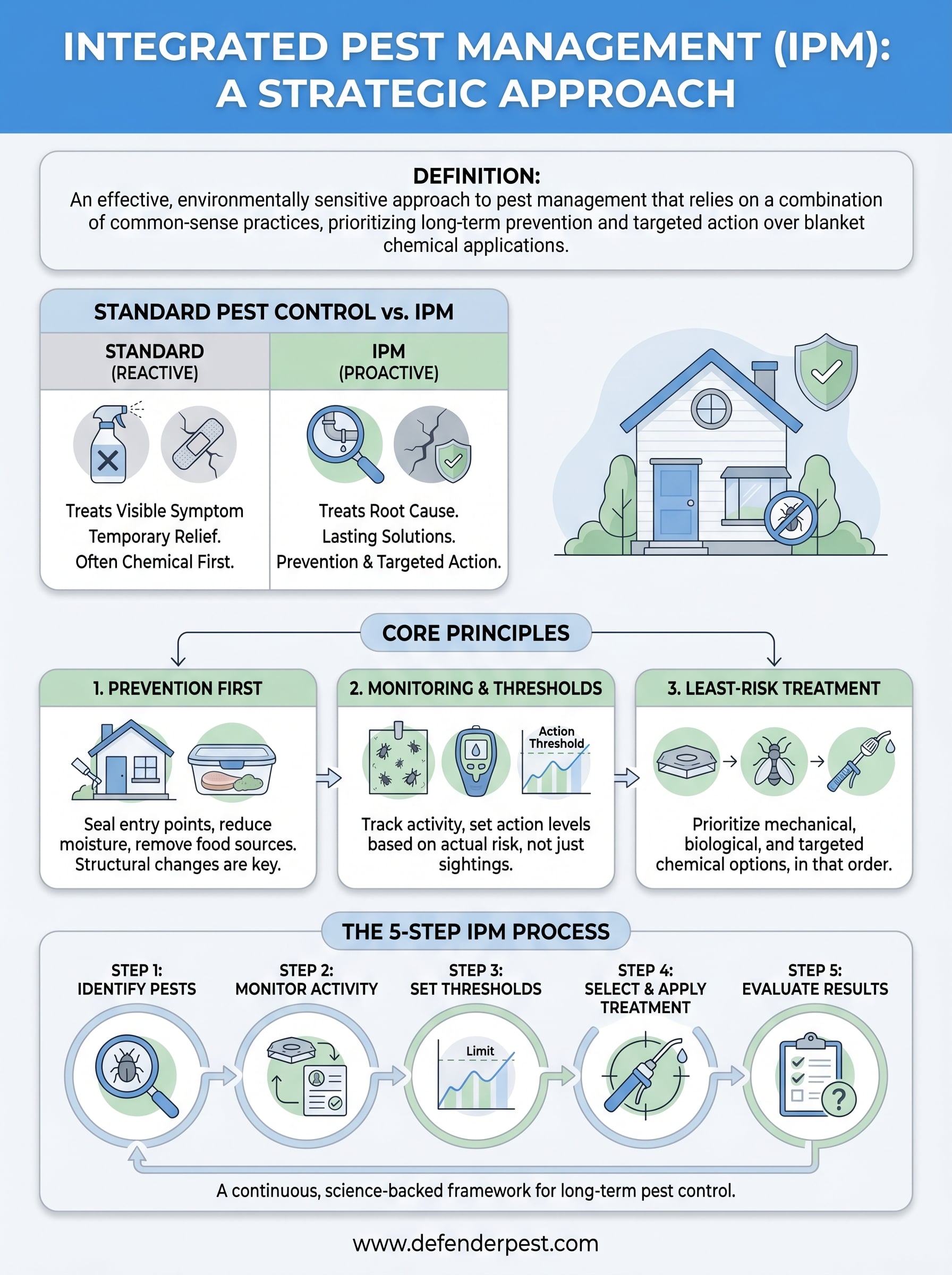
The integrated pest management definition , as established by the U.S. Environmental Protection Agency, describes IPM as an effective and environmentally sensitive approach to pest management that relies on a combination of common-sense practices . Rather than defaulting to chemicals as a first response, IPM uses information about pest life cycles and their interaction with the environment to manage pest damage in the most economical way possible, with the least hazard to people, property, and the environment.
How IPM differs from standard pest control
Standard pest control often follows a reactive pattern: you spot a pest, a technician sprays, and the problem temporarily disappears. IPM works differently because it treats the root cause rather than just the visible symptom. A technician using IPM will examine why pests entered your property in the first place, looking at moisture problems , entry points, food sources, and structural gaps, then address those conditions directly.
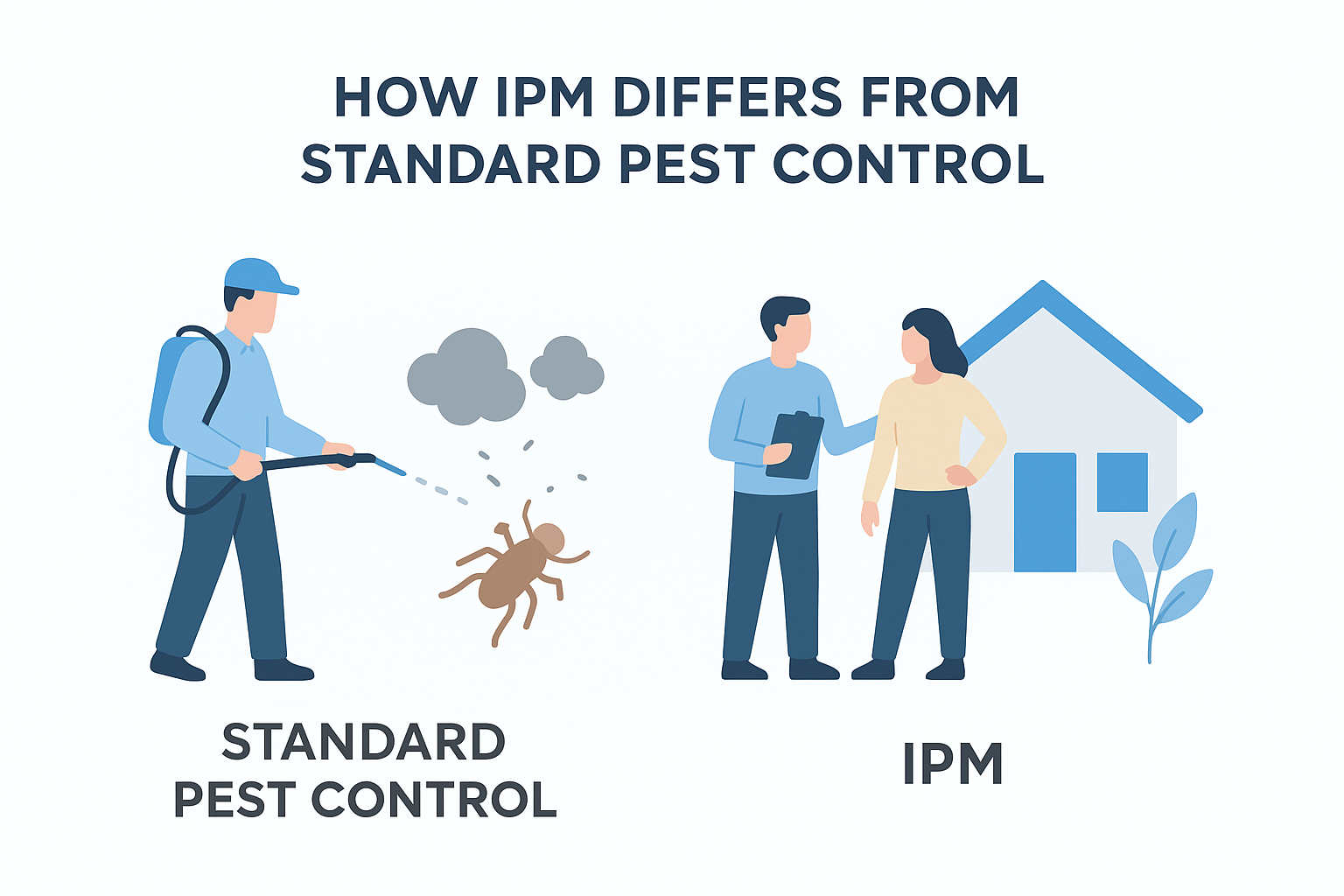
Eliminating the conditions that attract pests prevents future infestations far more effectively than repeated chemical treatments alone.
Your role in this process matters too. IPM treats pest management as a collaborative effort between the technician and the property owner. When you understand what draws pests to your space , you can make changes that reinforce whatever treatment is applied and reduce how often intervention is needed.
The role of monitoring and thresholds
One concept that separates IPM from reactive pest control is action thresholds . Not every pest sighting requires an immediate chemical response. IPM practitioners monitor activity levels first, then determine whether the pest population is large enough to cause actual harm before selecting a treatment method. This disciplined approach protects you from unnecessary pesticide exposure while still addressing genuine threats before they grow into serious, costly infestations.
Common monitoring methods used in IPM include:
- Sticky traps to track insect activity over time
- Regular site inspections to identify new entry points
- Moisture meters to locate conditions that attract wood-destroying pests
Why IPM matters for homes and businesses
The difference between a one-time treatment and a lasting solution often comes down to strategy and consistency . Most pest problems that return repeatedly do so because the underlying conditions were never addressed in the first place. Whether you own a home in Folsom or manage a commercial property in Sacramento, unresolved pest activity can damage structures, compromise health standards, and create costly long-term liability.
Treating pests without addressing the root cause is like patching a leak without fixing the pipe.
What homeowners and businesses risk without IPM
Homeowners face structural damage from termites and wood-boring insects that go undetected for months or even years without a systematic inspection process. A purely reactive approach delays detection and dramatically amplifies repair costs over time, turning manageable problems into major renovations.
Business owners carry an additional layer of risk. Pest activity in commercial spaces can trigger regulatory violations, health code failures, and reputational damage that affects revenue directly. A structured IPM program grounded in the integrated pest management definition gives your business documented evidence of active prevention. Inspectors and auditors recognize this as a credible, defensible standard of care, and your customers notice the difference too.
Core principles of IPM
The integrated pest management definition rests on guiding principles that shape every decision from the first inspection to the final treatment. These principles keep pest control focused on practical outcomes rather than unnecessary intervention, and they apply equally to a homeowner dealing with ants and a facility manager handling a rodent problem.
Prevention comes first
Your property's physical conditions determine how attractive it is to pests. Sealing entry points , reducing moisture , and removing food sources form the first line of defense in any IPM program. When you eliminate what pests need to survive, you reduce how often active treatments become necessary.
Structural prevention is the single most cost-effective pest control investment you can make.
- Caulking gaps around pipes and utility lines
- Fixing roof leaks and plumbing drips
- Storing food in sealed containers
Least-risk treatment selection
When action is required, IPM prioritizes the lowest-risk treatment available for the situation. Mechanical controls, habitat modifications, and biological options get evaluated before chemical applications. Chemical treatments are still used when necessary, but they're chosen deliberately rather than applied as a default response.
Treatment options evaluated in order of preference:
- Physical barriers and traps
- Biological controls
- Targeted chemical applications
The five steps to apply IPM
The integrated pest management definition only holds practical value when it translates into a repeatable, structured process. These five steps give pest professionals and property owners a clear path from first observation to verified, lasting results.
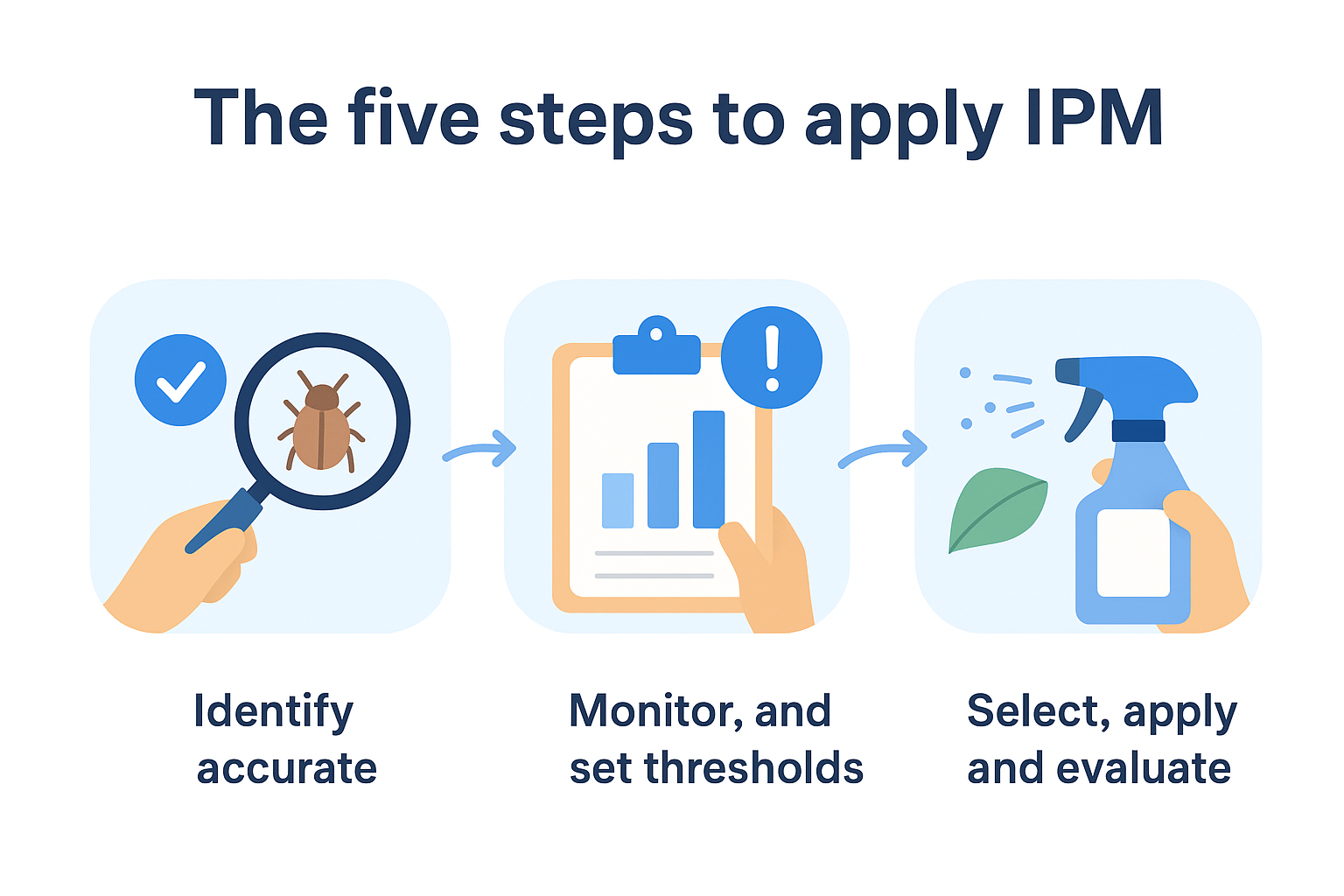
Skipping steps in this process often returns you to the same recurring pest problems you started with.
Identify, monitor, and set thresholds
Your first move is accurate pest identification , because every treatment decision depends on knowing exactly what you're dealing with. After identification, you monitor activity levels using traps, inspections, and environmental checks to determine whether pest pressure has crossed a threshold that justifies intervention.
- Identify the pest accurately before taking action
- Monitor activity and document your findings consistently
- Set action thresholds based on actual risk, not just pest sightings
Select, apply, and evaluate
Once a threshold is crossed, you choose the least-risk treatment suited to your specific pest and environment, then apply it carefully according to label directions and site conditions. The final step is evaluating results after treatment, which means confirming that pest levels dropped, that conditions improved, and determining whether any further action is still needed. Evaluation also feeds directly back into step one, keeping the process continuous rather than one-time.
Examples of IPM in real settings
The integrated pest management definition becomes clearest when you see it applied to actual situations. Real-world IPM looks different depending on the environment, but the same core logic applies: find what drives pest activity, correct those conditions, and apply targeted treatment only where it's needed.
Seeing IPM in practice helps you recognize whether your current pest control approach is actually solving the problem rather than just delaying it.
IPM in residential homes
Homeowners dealing with ants or cockroaches often find the problem starts with moisture, food access, or structural gaps around the kitchen or plumbing. An IPM approach seals those entry points and removes attractants before applying any targeted treatment to active areas.
- Fix dripping faucets and plumbing leaks
- Seal gaps around pipes and baseboards
- Store dry goods in airtight containers
IPM in commercial properties
Businesses in food service or healthcare face stricter pest thresholds because even low activity can trigger regulatory violations and failed inspections . IPM gives commercial operators a documented, defensible program tied to monitored thresholds rather than guesswork, which satisfies auditors and protects your reputation.
Regular monitoring logs and scheduled inspections create a clear, verifiable record of prevention that carries real weight when a health inspector walks through your facility.
Final takeaways
The integrated pest management definition comes down to one core idea: treat the cause, not just the symptom. Prevention, monitoring, and targeted treatment work together to give you lasting results that repeated chemical applications alone simply cannot deliver. When your pest control approach follows this structured framework, you stop cycling through the same infestations and start building real, durable protection for your property.
Whether you manage a family home in Folsom or a commercial facility in Sacramento, the principles of IPM apply directly to your situation . Accurate identification, action thresholds, and least-risk treatment selection are not complicated concepts. They are practical tools that any property owner can understand and benefit from when working with the right pest professional.
If you want a pest management partner who applies this approach consistently, contact Defender Termite & Pest Management to get started with a thorough inspection and a plan built around your property's specific needs.