Placer Mosquito and Vector Control District: Services and Contact Info
If you live in Roseville, Rocklin, Auburn, or anywhere else in Placer County, mosquito season isn't just an annoyance. It's a real health question, and the agency responsible for answering it is the Placer Mosquito and Vector Control District . Most homeowners have heard the name on a truck or a door hanger but don't actually know what the district does, how to reach them, or when a problem is theirs to solve versus a job for a licensed pest company.
This article breaks down exactly what the district covers, from mosquito surveillance and larvicide treatments to vector-borne disease monitoring like West Nile virus tracking. We'll also walk through how to request mosquitofish for backyard ponds or unused pools , file a service request, and get direct contact information so you're not stuck searching a county website.
We put this together because we field calls every week from Sacramento-area property owners who assume any bug problem falls under pest control services , when mosquitoes and standing water issues are actually a public vector control matter. Knowing the difference saves you time and gets your property the right treatment faster.
Why the Placer Mosquito and Vector Control District matters
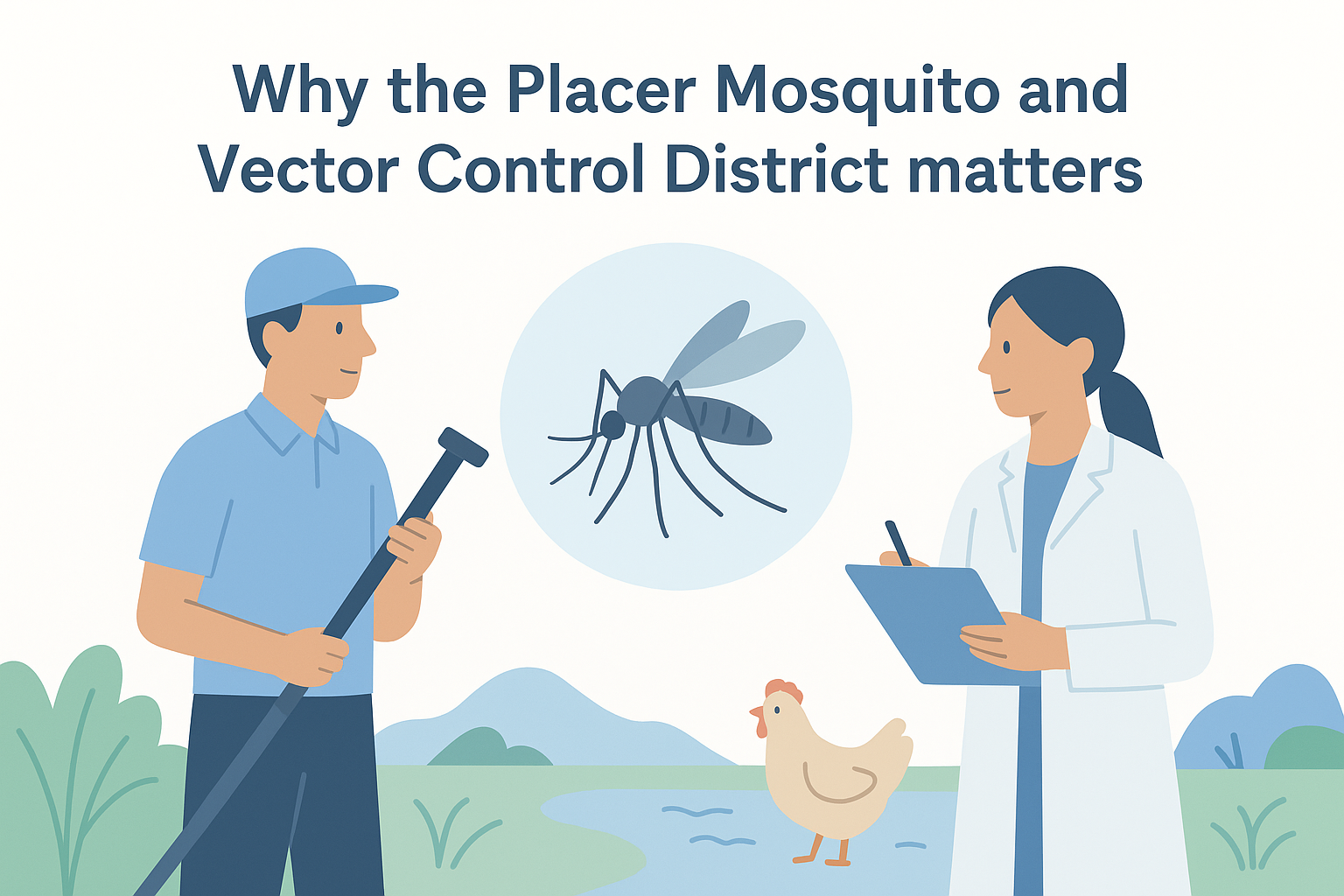
Mosquitoes in Placer County aren't just a backyard nuisance. They're a documented vector for West Nile virus , and the district exists specifically to track and interrupt that transmission before it reaches people or pets. Every summer, district staff trap mosquitoes across the county, test them for disease, and monitor "sentinel" chicken flocks that act as an early warning system. When virus activity spikes in a specific zip code, that's the district's data driving the response, not a guess.
A single test result from a trapped mosquito can trigger a targeted spray before anyone in the neighborhood ever gets sick.
Here's what makes Placer County's situation unique: the terrain runs from valley rice fields near Roseville to foothill creeks near Auburn, and both environments breed mosquitoes differently. Rice fields create massive, predictable standing water. Foothill drainage creates smaller, harder-to-spot pockets in culverts, ditches, and neglected pools. The Placer Mosquito and Vector Control District covers both, which means its inspectors know where to look in ways a general pest technician typically wouldn't.
Funded by property owners, working for property owners
The district isn't a private company chasing service fees. It's a special district funded through a benefit assessment on property tax bills, which means every homeowner in its service area is already paying for mosquito surveillance and control whether they call in or not. That funding model matters practically: inspections, mosquitofish, and standing-water treatments are typically free to residents, because you've already covered the cost through your tax assessment.
The stakes go beyond itchy bites
West Nile virus isn't the only concern on the district's radar. Depending on the season, staff also watch for:
- St. Louis encephalitis activity in local bird populations
- Western equine encephalitis in horse and livestock areas
- Invasive Aedes mosquito species, which can carry Zika and dengue and behave differently than native mosquitoes
That range of responsibility is exactly why the district, not a general pest company, takes the lead on vector-borne disease monitoring in Placer County.
How to contact the Placer Mosquito and Vector Control District
Getting a hold of the right department beats waiting on hold with your county's general line. The Placer Mosquito and Vector Control District operates as its own agency, separate from city or county pest departments, with dedicated staff who field service requests all season long.
Direct contact information
Use this table as your quick reference before you start searching:
| Contact Method | Details |
|---|---|
| Phone | (916) 380-5444 |
| Website | placermosquito.org |
| Service area | Most of Placer County, including Roseville, Rocklin, Lincoln, and Auburn |
| Office hours | Weekdays, standard business hours |
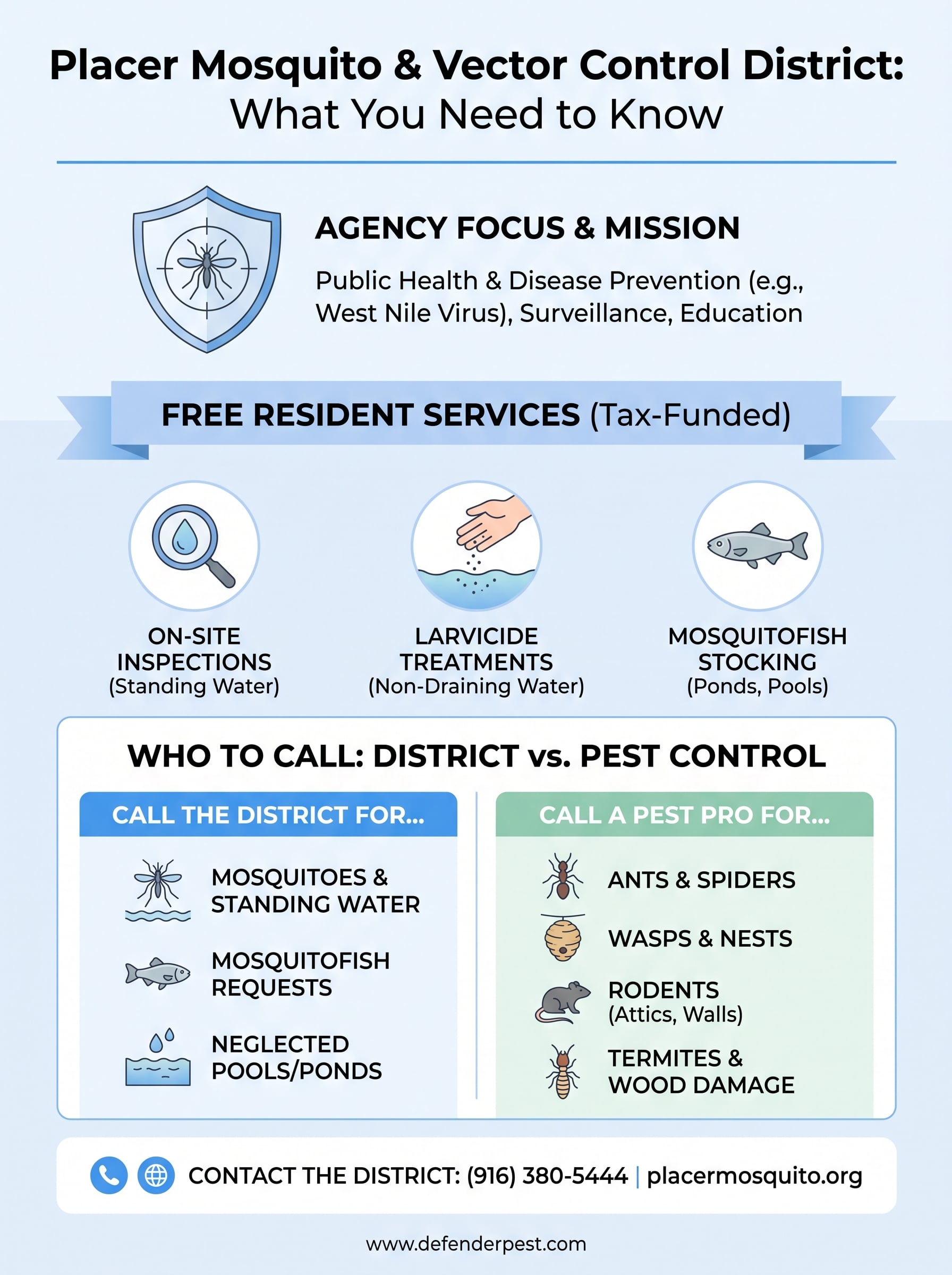
Call the district directly for mosquito and standing-water issues; call a licensed pest company for anything crawling instead of flying.
Save that number in your phone if you own property with a pool, pond, or low-lying yard, since those are the spots most likely to trigger a service call.
Submitting a request online
Most residents skip the phone entirely and use the district's online service request form , which lets you flag a mosquito problem, standing water on a neighboring property, or a request for mosquitofish without waiting for office hours. Include your address, a description of the water source, and photos if you have them. Field staff typically respond within a few business days during peak season, faster if virus activity has already been detected nearby. Verify current hours and contact details on the official site before visiting in person, since staffing shifts with the season.
Services the district provides to residents
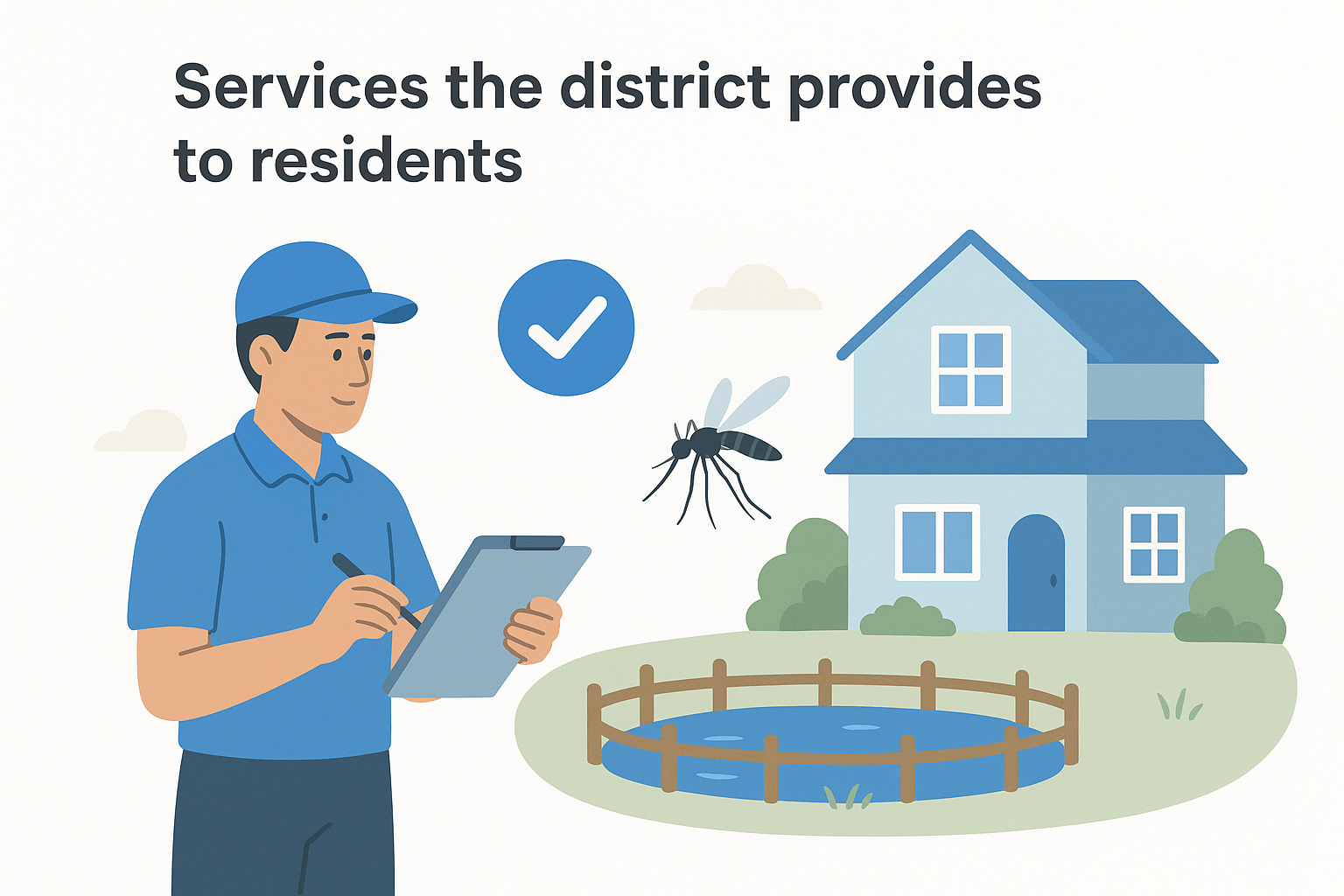
Beyond trapping and testing, the Placer Mosquito and Vector Control District offers a handful of direct services that most residents never think to request. Field technicians will inspect your property for standing water, identify breeding sites you might have missed, and apply treatment at no charge. That last point surprises a lot of new homeowners, since they assume any on-site treatment means a bill.
What's included in a standard service call
District staff typically handle:
- Free inspection of pools, ponds, fountains, and drainage areas
- Larvicide treatments for standing water that can't be drained
- Mosquitofish stocking for ornamental ponds and neglected pools
- Neighborhood-level fogging when trap data shows elevated virus activity
- Public education materials for schools, HOAs, and community groups
If you can point to standing water on your property, the district can almost certainly treat it for free.
Why this matters for real problems, not just prevention
Green, unmaintained pools are one of the district's biggest recurring calls, especially with foreclosures or long vacancies in Placer County. A neglected pool can produce thousands of mosquitoes in a single week, and it's a public health service the district treats as a priority rather than a courtesy. Requesting help doesn't require proof of a bite or an active infestation. Suspecting a breeding site nearby, even one on a neighbor's property, is reason enough to call. Reporting it early is almost always faster and cheaper than waiting for a swarm to force the issue.
How to request mosquitofish or report a problem
Requesting mosquitofish is simpler than most homeowners expect, and it's free. These small fish eat mosquito larvae before they hatch, making them the go-to fix for ornamental ponds, unused pools, livestock troughs, and even rain barrels. You don't need a diagnosed infestation to qualify. Owning a water feature that could breed mosquitoes is reason enough to ask.
Steps to request mosquitofish
Follow this process to get fish delivered or picked up:
- Visit the district's online request form or call (916) 380-5444.
- Describe your water source (pond, pool, trough, fountain) and its approximate size.
- Provide your address and the best time for a technician visit.
- Pick up fish at the district office if you prefer, rather than waiting for a delivery.
- Release fish according to the technician's instructions, since overstocking can stress the population.
Mosquitofish work around the clock and never need reapplying, unlike most larvicide treatments.
Reporting standing water or a suspected problem
Another common request involves flagging standing water you've noticed, even on a property that isn't yours. Neglected pools, clogged gutters, and forgotten kiddie pools are common culprits, and the district investigates every tip regardless of who owns the land. Submit a report through the same online form or phone line, include the cross streets if you don't have an exact address, and mention whether you've noticed unusual mosquito activity nearby. Anonymity is fine. You're not required to give a name for the district to send someone out.
When to call a pest control professional instead
Mosquitoes and standing water fall squarely under the Placer Mosquito and Vector Control District , but plenty of pest problems don't. If you're dealing with ants in the kitchen, wasps nesting under the eaves, spiders in the garage, or rodents chewing through your attic insulation, that's a job for a licensed pest control company , not the district. Vector control staff won't treat structural pests, and calling them for a rat problem just delays your actual fix.
If it flies and breeds in water, call the district. If it crawls, nests, or burrows into your home, call a pest professional.
Termites deserve special mention here. The district has zero role in termite inspections or treatment, and waiting on the wrong agency can let damage spread for months. That's where a company like Defender Termite & Pest Management comes in, offering termite inspections, elimination, and even structural wood repair for damage that's already been done.
Quick reference: who handles what
| Problem | Who to call |
|---|---|
| Mosquitoes, standing water | Placer Mosquito and Vector Control District |
| Termites, ants, spiders, wasps | Licensed pest control company |
| Rodents in attics or walls | Licensed pest control company |
| Lawn-damaging insects | Licensed pest control company |
Understanding this split saves you a wasted call and gets the right technician on-site faster, whether that's a district inspector checking your pool or a pest professional inspecting your foundation for termite activity.
Staying protected in Placer County
The Placer Mosquito and Vector Control District handles what most homeowners never think about until a swarm shows up: standing water, mosquitofish, and disease surveillance across the county. Knowing that number and website means you're never stuck guessing who to call when a pond needs fish or a neglected pool starts breeding trouble. Placer County's mix of valley and foothill terrain keeps the district busy year-round, and that free service is worth using the moment you spot a problem.
But vector control stops where structural pest issues start. Termites, ants, rodents, and wasps need a different kind of expertise, one that includes inspection, treatment, and repair when damage has already set in. If that's what you're facing, contact Defender Termite & Pest Management for an inspection that covers what the district can't, so your home stays protected on every front, not just the one buzzing around your backyard.