Pest Control for Carpenter Ants: How to Get Rid of Them
You spotted a few large black ants near your kitchen window, or maybe you found small piles of sawdust-like material along a baseboard. Either way, something feels off, and you're right to be concerned. Pest control carpenter ants requires a different approach than dealing with the sugar ants raiding your pantry, because these ants don't just wander into your home looking for food. They nest inside damp or damaged wood, and left alone, they can weaken structural beams over time.
Getting rid of carpenter ants for good means finding the nest, not just spraying the ants you see on the counter. That's the mistake most homeowners make: they treat the trail and ignore the source, so the colony keeps growing behind the walls. Real carpenter ants pest control starts with identifying moisture problems and satellite nests before any product goes down.
In this guide, we'll walk through how to spot a carpenter ant infestation early, which treatments actually work, and when carpenter ant pest control calls for a professional inspection instead of another store-bought spray. We've handled these cases across Sacramento homes since 1999, and we'll share what separates a temporary fix from lasting protection for your home's wood.
What to know before treating a carpenter ant infestation
Before you buy a spray or bait station, take fifteen minutes to confirm what you're actually dealing with. Carpenter ant pest control only works if you correctly identify the pest first, because treating carpenter ants like odorous house ants or termites wastes time and money while the colony keeps expanding. Sacramento's mild, humid winters give carpenter ants plenty of opportunity to move into water-damaged fascia boards, leaky window frames, and old deck posts, so the diagnosis matters as much as the treatment.
Confirm it's carpenter ants, not termites
Homeowners frequently confuse the two, and the wrong assumption leads to the wrong fix, so it helps to know how to compare wings, waists, and antennae before you decide what you're facing. Carpenter ants don't eat wood, they excavate it to build smooth galleries for nesting, so you'll find frass (a sawdust-like debris mixed with insect parts) rather than mud tubes. Termites, on the other hand, leave behind mud tunnels and hollowed wood that sounds papery when tapped.
| Sign | Carpenter Ants | Termites |
|---|---|---|
| Debris | Sawdust-like frass pushed out of galleries | Mud tubes on foundations or walls |
| Wood damage | Smooth, clean tunnels | Layered, honeycomb-like damage |
| Wings (swarmers) | Two pairs, unequal length | Two pairs, equal length |
| Body shape | Pinched waist | Straight waist |
| Behavior | Active mostly at night | Active year-round, hidden |
Getting the pest ID right the first time saves you weeks of wasted treatment and hidden structural damage.
Understand what draws them into your home
Getting to the root cause matters more than the ants themselves. Carpenter ants target wood that's already softened by moisture, so a leaking gutter, a poorly sealed bathroom vent, or a woodpile stacked against your siding is often the real invitation, and it's one of several things that attract ants in the house. Look for spongy trim, discolored drywall, or a faint hollow sound when you knock on a baseboard, since these spots usually mark satellite nests connected to a larger parent colony outdoors. Effective pest control carpenter ants treatment always pairs the chemical work with fixing these moisture problems, otherwise new ants move into the same damaged wood within a season. If you skip this step, you're treating a symptom while the actual attractant, wet or decaying wood, stays put and keeps drawing in workers from nearby colonies.
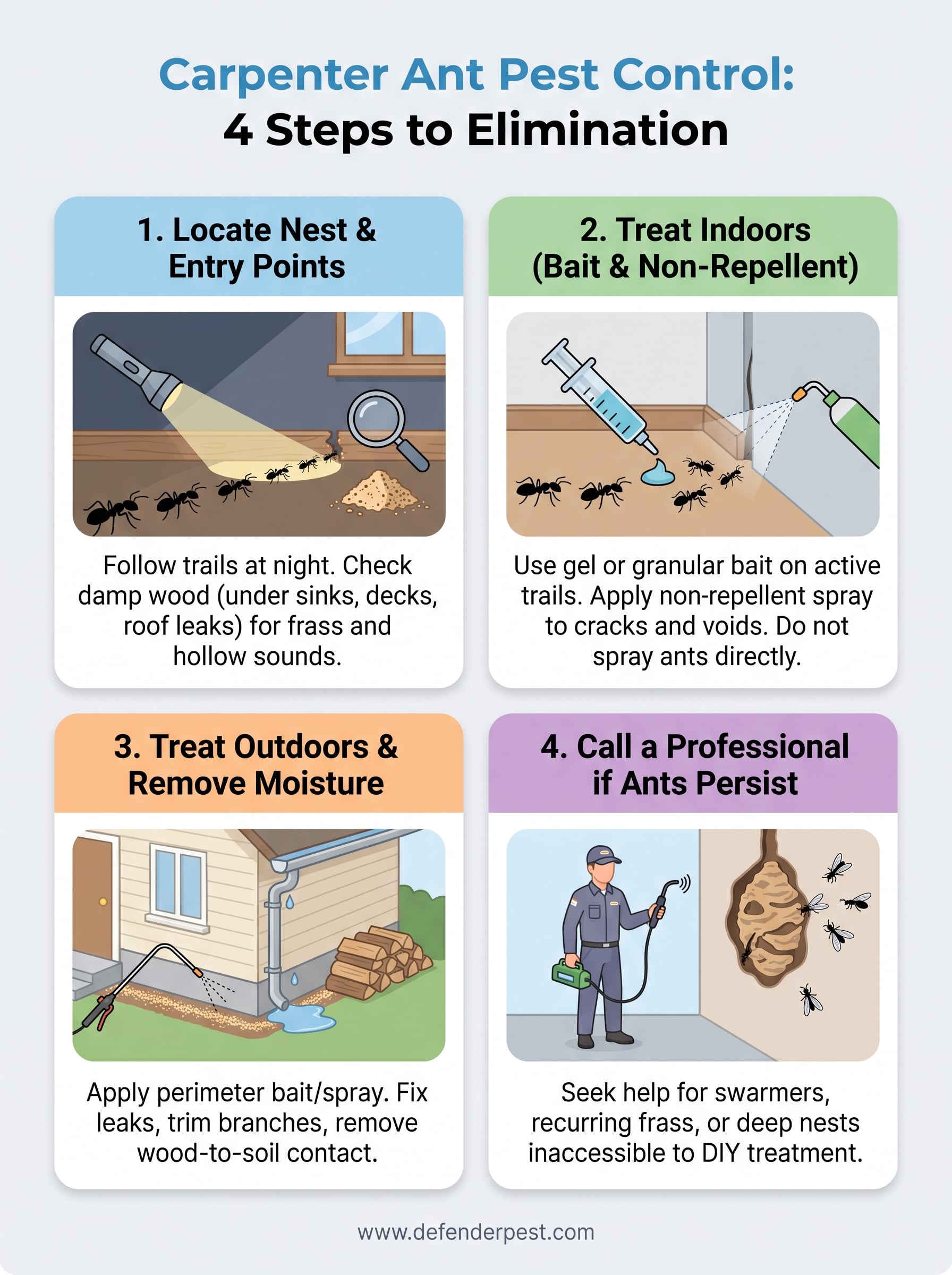
Step 1. Locate the nest and entry points
Finding the nest is the single most important step in carpenter ant pest control , and it's the step most homeowners skip. Spraying visible ants without finding the colony just kills a few scouts while the queen keeps producing more workers somewhere in your walls or eaves. Give yourself an evening to watch and track before you buy anything.
Follow the trail at night
Carpenter ants forage most actively between dusk and midnight, so grab a flashlight and watch where the trail leads instead of guessing during the day. Dab a small bit of honey or sugar water near where you've seen activity, then trace the workers back to their entry point, whether that's a gap in the foundation, a gap around a pipe, or a crack in the siding, the same pheromone trail tracking that gets rid of ants in the house. Sightings near a window frame or attic vent often mean the nest sits close by, since carpenter ants rarely travel far from a reliable food source.
Find the nest before you spray anything, or you're just thinning the workforce while the queen keeps rebuilding.
Check likely nest sites
Moisture-damaged wood is where carpenter ants build, so inspect these spots closely before moving to treatment:
- Around leaking roof valleys, chimneys, and skylights
- Under bathroom and kitchen sinks with old caulking
- Inside hollow porch posts or deck railings
- Behind siding near clogged gutters
- Woodpiles, tree stumps, or fence posts touching your foundation
Tap suspicious wood with a screwdriver handle. A hollow, papery sound usually confirms an active gallery underneath.
Step 2. Treat indoors with bait and non-repellent spray
Once you've traced the trail and confirmed likely nest sites, it's time to bring in products built specifically for carpenter ant pest control . Skip the repellent sprays sold at most hardware stores, since those scatter the colony instead of eliminating it, splitting one nest into three or four you now have to track down separately. Slow-acting bait and non-repellent liquids work because the ants carry the active ingredient back to the colony themselves, wiping out workers you'll never see.
Repellent sprays scatter carpenter ants into new hiding spots. Non-repellent products let them carry the kill back to the queen.
Set gel or granular bait near active trails
Place a pea-sized dab of gel bait directly on the trail you tracked the night before, ideally within a few inches of the entry point. Carpenter ants prefer protein-based bait over sugar during the spring nesting season, then shift toward sugars in summer, so check which one they're actually taking before committing to a single product. Give the bait five to ten days to work; resist the urge to spray the ants gathering around it, since killing them on contact interrupts the transfer back to the nest.
Apply non-repellent spray at cracks and voids
For gaps you can't bait directly, like weep holes, expansion joints, or wall voids near plumbing, a non-repellent spray creates an invisible barrier the ants walk through without detecting it. Treat baseboards, window frames, and any crack within a few feet of confirmed activity, then leave the area undisturbed for at least a week. Combining both methods indoors covers ants that forage on open trails and those tunneling silently behind drywall, which is exactly the one-two punch carpenter ants pest control needs to actually reach the colony instead of just the scouts you happen to spot.
Step 3. Treat outdoors and remove moisture sources
Once indoor bait and non-repellent spray are working, shift attention to the parent colony outside, since indoor treatment alone rarely reaches the main nest hiding in a stump, woodpile, or rotted fence post. Carpenter ant pest control fails most often when homeowners treat the satellite nest indoors but ignore the outdoor colony feeding it new workers.
Treat the parent colony outdoors
Apply granular bait around the foundation perimeter, especially near woodpiles, tree stumps, and any wood-to-soil contact points you found during your nighttime trail check. A non-repellent perimeter spray along the foundation and up the base of exterior walls adds a second barrier that catches foragers moving between the outdoor nest and your house. Reapply according to the product label, usually every 30 to 90 days, since rain and irrigation break down the barrier faster than you'd expect.
Outdoor treatment stops new workers from replacing the ones you kill indoors.
Eliminate moisture sources
Standing water and rotting wood are what pulled carpenter ants onto your property in the first place, so fix these before any spray or bait keeps them away long-term:
- Redirect downspouts so water drains away from the foundation
- Trim tree branches and shrubs touching the siding or roofline
- Remove or elevate woodpiles at least 20 feet from the house
- Repair leaking hose bibs, sprinkler heads, and gutters
- Grind out old stumps instead of leaving them to rot
If your yard has recurring insect pressure beyond ants, our lawn care insect control service targets the moisture-loving pests that damage landscaping and invite ants closer to your foundation, and there are also natural ways to control lawn bugs you can try first.
Step 4. Call a professional if ants persist
Sometimes bait and spray get you most of the way there, but the trail keeps coming back after two or three weeks. That's your signal that carpenter ant pest control has moved beyond a DIY job, usually because the nest sits somewhere you can't reach, like inside a wall cavity, under a slab, or deep in a structural beam. At that point, more store-bought product just delays the real fix, lets damage spread further into your framing, and pushes up the eventual carpenter ant extermination cost.
Signs the infestation is bigger than a spot treatment
Watch for these red flags that point to a colony too established for over-the-counter products:
- Winged swarmers appearing indoors, especially in late spring
- Frass piles reappearing in the same spot within days of cleanup
- Multiple entry points active at once, not just one trail
- Rustling sounds inside walls at night
- Bait stations sitting untouched despite visible ant activity nearby
If the trail keeps returning after a few weeks of treatment, the nest is bigger than the products you're using.
What a licensed technician does differently
Technicians carry moisture meters, borescopes, and access to non-repellent formulations that aren't sold to the general public, so they can find satellite nests hidden behind drywall or under flooring without guessing. Defenders inspects the full structure, not just the room where you spotted activity, then treats the parent colony and any satellite nests together so the whole population collapses instead of splitting into new hiding spots. Given how quickly moisture-damaged wood turns into a bigger repair bill, our termite and pest inspection team can also flag structural damage carpenter ants have already caused before it spreads further.
Keeping carpenter ants from coming back
Carpenter ants don't show up at random. They follow moisture and soft wood, so the fixes that keep them out are the same ones that stop the current infestation: dry gutters, trimmed branches, and no wood-to-soil contact anywhere near your foundation. Pest control carpenter ants works best as an ongoing habit, not a one-time spray. Walk your yard every few months and check the spots you fixed, since a new leak or a fallen branch can undo weeks of treatment fast.
Most homeowners who beat carpenter ants for good combine their own moisture repairs with a professional follow-up inspection, catching satellite nests before they turn into a second infestation. That's exactly what separates a temporary win from lasting protection. If you want that peace of mind, book carpenter ant pest control in Sacramento with Defender Termite & Pest Management and let our team confirm your home is actually clear, not just quiet for now.