Mouse Exclusion Service Near Me: What It Is And How It Works
Mouse Exclusion Service Near Me: What It Is And How It Works
You've caught two mice this month and you're starting to wonder if traps alone will ever solve the problem. They won't. Traps remove the mice already inside, but they do nothing about the gaps under your siding or the pipe chase behind your dryer that let new ones in every week. If you're searching for a mouse exclusion service near me , you're already past the trap-and-hope stage and looking for a permanent fix.
A proper exclusion service means a technician physically inspects your home or building, finds every entry point mice can squeeze through (and that's a hole as small as a dime), and seals each one with rodent-proof materials like steel mesh, sealant, or hardware cloth. It's structural pest control , not just bait stations. Done right, it stops the cycle instead of just managing it month to month.
In this article, we'll walk through exactly what a mouse exclusion inspection looks like, the common entry points our Sacramento-area technicians find again and again, the materials that actually hold up against rodents, and how to tell a thorough exclusion job from a quick patch that won't last the winter.
Why mouse exclusion matters more than traps or poison
A single mouse can produce 5 to 10 litters a year, with up to a dozen pups per litter. Do the math and you'll see why trapping alone rarely wins. You're not fighting one mouse, you're fighting a population that doubles faster than you can reset snap traps. Every entry point you leave open is a door that stays open for the next generation, not just the mouse you caught last week.
Traps only remove what's already inside
Snap traps and glue boards work on the mice that have already found their way in. They do nothing for the gap under your garage door or the vent screen that rusted through two winters ago. Homeowners often tell us they've caught six, eight, ten mice over a season and still hear scratching in the walls. That's because the entry points never got addressed. Trapping without sealing is a maintenance chore, not a solution.
Trapping mice without sealing their entry points is like bailing water out of a boat with a hole still in the hull.
Poison carries risks that outweigh the benefit
Rodenticide baits kill mice, but they also introduce secondary poisoning risks for pets, birds of prey, and curious kids who find a bait station that wasn't secured properly. The EPA has tightened restrictions on certain rodenticides specifically because of unintended exposure to wildlife and non-target animals. Poisoned mice also tend to die inside wall voids, crawl spaces, or ductwork, leaving you with an odor problem that can last for weeks. None of that solves the structural issue that let them in.
Why exclusion is the only permanent fix
Exclusion attacks the actual cause: the openings in your foundation, siding, roofline, and utility penetrations that give mice access in the first place. Once those gaps are sealed with the right materials, mice simply can't get in, regardless of how many are living in your yard or neighborhood. This is why pest control professionals increasingly treat exclusion as the foundation of any rodent program, with trapping used only to clear out mice already present at the time of sealing.
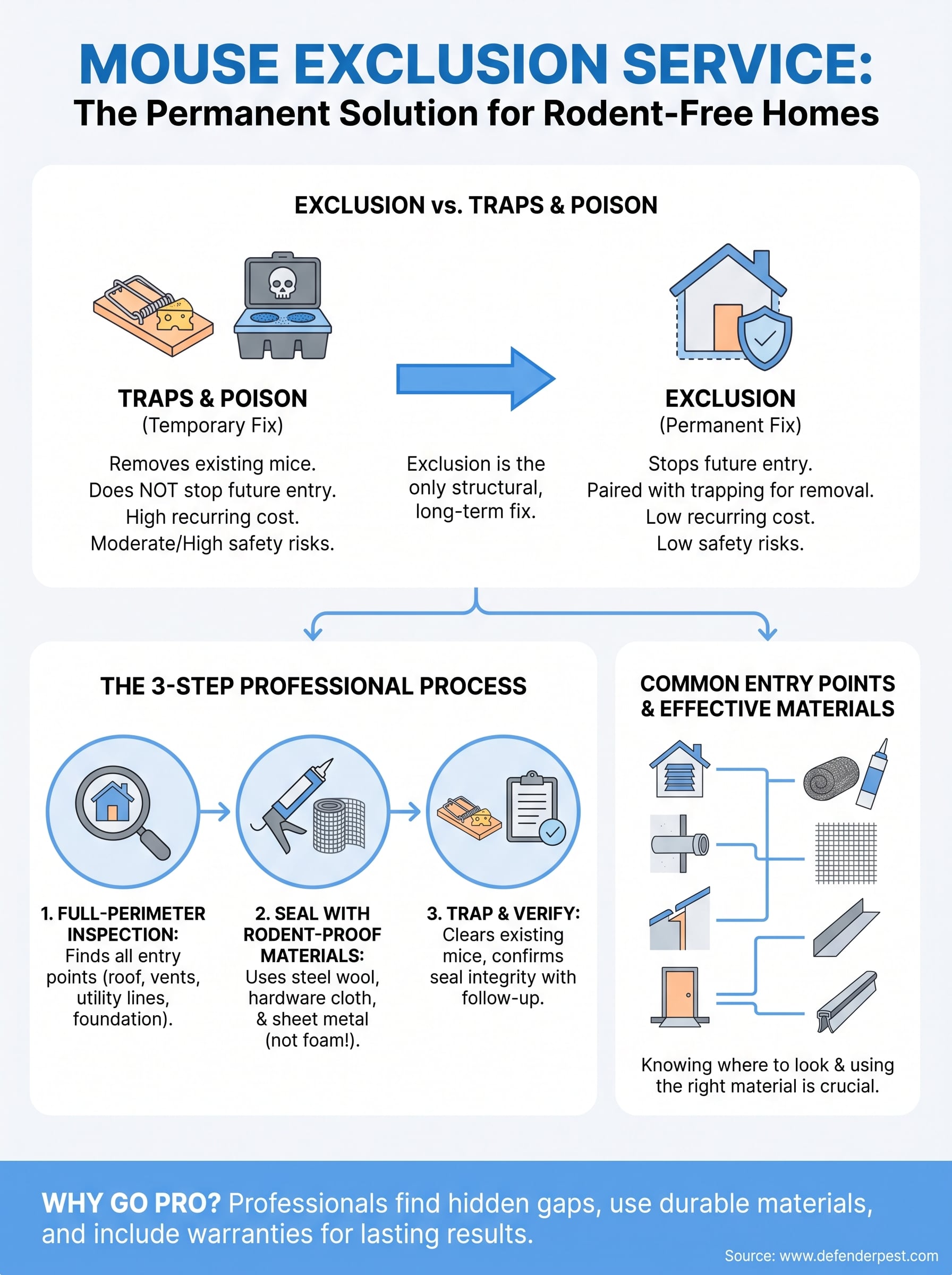
Here's how the three approaches stack up when you look at what each one actually accomplishes:
| Method | Removes existing mice | Stops future entry | Ongoing cost | Health/safety concerns |
|---|---|---|---|---|
| Traps | Yes | No | Recurring | Low |
| Poison/bait | Yes | No | Recurring | Moderate to high |
| Exclusion | No (paired with trapping) | Yes | One-time, occasional touch-up | Low |
The health argument matters too. Mice shed droppings, urine, and dander that can trigger asthma and carry pathogens like Hantavirus, according to the CDC. A home that's truly sealed against entry protects your family's health in a way that a bait station in the attic never will. If you want the infestation to actually end rather than just quiet down for a few weeks, exclusion has to be part of the plan.
How professional mouse exclusion services work
Professional exclusion is a process, not a single visit with a caulk gun. A trained technician follows a specific sequence designed to find every gap, seal it with materials that hold up over time, and confirm the job worked before calling it done. This is what separates a mouse exclusion service from a general pest spray.
The full-perimeter inspection
Technicians walk the entire exterior of your home or building, checking the foundation, roofline, utility penetrations, and vents inch by inch. Inside, they check crawl spaces, attics, and areas around plumbing and HVAC lines where mice commonly travel between floors. A thorough inspection typically covers:
- Foundation cracks and gaps around the slab
- Utility penetrations for gas, water, and electrical lines
- Roof vents, soffits, and fascia boards
- Garage door seals and thresholds
- Dryer vents and crawl space access points
Sealing with rodent-proof materials
Once every entry point is mapped, the technician seals each one using materials chosen for that specific gap: steel wool paired with sealant for small cracks, galvanized hardware cloth for vents, and sheet metal for larger structural gaps. Foam alone doesn't count as exclusion , since mice chew through it in minutes. A competent technician documents each sealed point, often with before-and-after photos, so you know exactly what was addressed.
A mouse exclusion job isn't finished until every entry point is both sealed and verified, not just patched and hoped for.
Trapping and verification
Because sealing alone doesn't remove mice already living inside, most services pair exclusion with a trapping phase to clear out the existing population. Technicians then return within a set window, usually a few weeks, to check traps, confirm no new droppings or gnaw marks have appeared, and re-inspect the sealed points for wear. This follow-up step is what turns exclusion from a one-time patch into a lasting fix, and it's the step homeowners doing DIY sealing almost always skip.
Common mouse entry points and sealing materials used
Mice don't need much room to work with. A mouse can squeeze through a gap the size of a dime, and a young mouse can fit through something even smaller, so the entry points technicians look for aren't always obvious from a quick walk around the yard. Knowing where to look is half the job , and the other half is choosing a material that actually holds up against constant gnawing.
Where mice actually get in
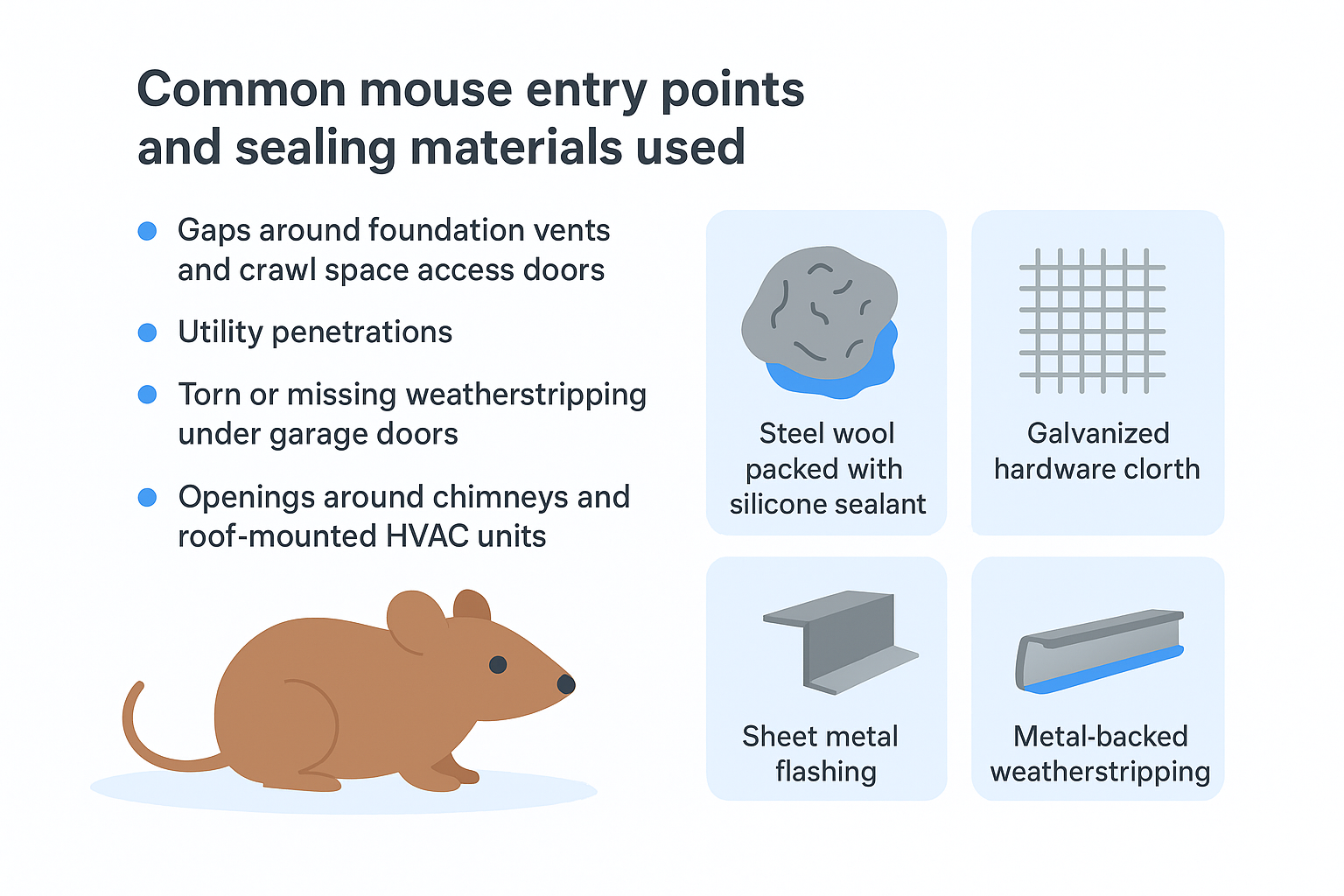
After years of inspections across Sacramento-area homes, a handful of spots show up again and again as the culprits:
- Gaps around foundation vents and crawl space access doors
- Utility penetrations where gas, water, or cable lines enter the wall
- Torn or missing weatherstripping under garage doors
- Damaged dryer vent flaps and screens
- Roofline gaps where fascia boards have pulled away from soffits
- Openings around chimneys and roof-mounted HVAC units
Older homes tend to have more of these gaps simply because materials shrink, settle, and crack over decades. Newer construction isn't immune either; builders often leave utility penetrations loosely packed with expanding foam that mice chew through within days.
Matching the material to the gap
Not every hole calls for the same fix, and using the wrong material is one of the most common reasons sealing fails. Steel wool and hardware cloth resist chewing in a way foam and plastic never will.
| Entry point type | Recommended material |
|---|---|
| Small cracks and crevices | Steel wool packed with silicone sealant |
| Vents and openings | Galvanized hardware cloth |
| Larger structural gaps | Sheet metal flashing |
| Door and window thresholds | Metal-backed weatherstripping |
If a mouse can chew through the material you used, you haven't sealed the gap, you've just relocated it.
A technician who understands these distinctions won't reach for a caulk gun and call it done. They'll match the fix to the failure point, which is exactly why professional exclusion holds up longer than a weekend of patchwork.
DIY sealing vs. hiring a local exclusion service
Grabbing a tube of caulk and a roll of steel wool from the hardware store feels like the cheaper move, and for a single obvious gap, it can work fine. But most homes have far more entry points than a homeowner will ever spot , and missing even one means mice keep finding their way back in.
Where DIY falls short
Without training, most people check the ground floor and call it done. They miss the roofline, the crawl space, the gap behind the dryer vent, and the utility penetration hidden behind landscaping. A technician who inspects hundreds of homes a year knows exactly where to look, because the failure points repeat from house to house. DIY sealing also tends to lean on whatever's on the shelf at the store, which usually means foam or caulk alone rather than the steel mesh and hardware cloth that actually resist chewing.
DIY sealing fixes the gaps you can see. Professional exclusion finds the ones you can't.
Where professional service pays off
A local exclusion service brings a systematic inspection, commercial-grade materials, and a verification visit that confirms the seal held. That follow-up step matters more than most homeowners expect, since a gap that looked sealed in October can loosen by January once the weather shifts. Here's how the two approaches compare on the points that matter most:
| Factor | DIY sealing | Professional service |
|---|---|---|
| Entry points found | Only the obvious ones | Full-perimeter inspection |
| Materials used | Foam, caulk (store-bought) | Steel mesh, hardware cloth, sheet metal |
| Verification | None | Follow-up visit included |
| Time investment | Several weekends | One or two visits |
| Long-term reliability | Often fails within a season | Built to hold for years |
When DIY makes sense
If you've got one clear gap, say a torn dryer vent flap, and no history of infestation, sealing it yourself is reasonable. But once you're dealing with recurring sightings, droppings in multiple rooms, or an older home with a lot of settling, bringing in a local exclusion service saves you from chasing the same problem all winter .
What to look for in a mouse exclusion service near you
Not every company that offers rodent control actually does exclusion work. Some just set traps and bait stations and call it a day. Before you hire anyone, ask specifically what their process looks like, because the difference between a real exclusion service and a general pest visit shows up in the details.

Ask about the inspection process
A company worth hiring will describe a full-perimeter inspection, not a five-minute walk around your yard. Ask whether they check the roofline, crawl space, and utility penetrations, or just the ground-floor gaps that are easy to spot. If the answer is vague, that's a sign the technician isn't trained for structural exclusion work.
Confirm the materials they use
Foam and caulk alone don't stop a mouse for long. Ask directly whether the technician uses steel wool, galvanized hardware cloth, or sheet metal for larger gaps. A company that can name its materials without hesitation has likely done this hundreds of times before.
If a technician can't tell you what material they'll use on your specific gap, they probably haven't sealed one like it before.
Check for warranties and follow-up visits
Exclusion work should come with some kind of guarantee, since materials can loosen with weather and settling. Look for these before signing anything:
- A written warranty covering re-entry within a set period
- A scheduled follow-up visit to check sealed points and traps
- Documentation (photos or a written report) of every entry point sealed
- Local licensing and experience specific to your region's construction styles
Prioritize local, hands-on experience
A local mouse exclusion service near me search should turn up companies familiar with the housing stock in your specific area. Sacramento homes, from older bungalows near midtown to newer builds in Elk Grove, each have their own common failure points. Defender Termite & Pest Management has handled exclusion work across these neighborhoods since 1999, which means the technician showing up at your door already knows where your home is likely to have gaps before they even start looking.
Keeping mice out for good
Mice don't stop trying just because you caught a few in traps. They keep testing your foundation, your vents, and your rooflines until they find a way back in. A real mouse exclusion service ends that cycle by sealing every gap with materials that actually hold up, then verifying the work instead of walking away after one visit. That's the difference between managing an infestation for years and closing the door on it for good.
Grabbing steel wool from the hardware store might handle one obvious gap, but most homes have entry points you'll never spot without a trained eye. If you've been searching for a mouse exclusion service near me because traps alone haven't solved anything, it's time to bring in someone who inspects for a living. Reach out to Defender Termite & Pest Management and get your home fully inspected and sealed before the next generation moves in.