Integrated Pest Management for Rodents: The Complete Guide
If you've set a dozen traps and still hear scratching in the attic, you're not alone. Most rodent problems don't come back because homeowners lack effort, they come back because a single tactic can't outpace a mouse or rat colony that's already found food, water, and an easy way in. Integrated pest management for rodents fixes that by treating control as a system, not a one-time fix.
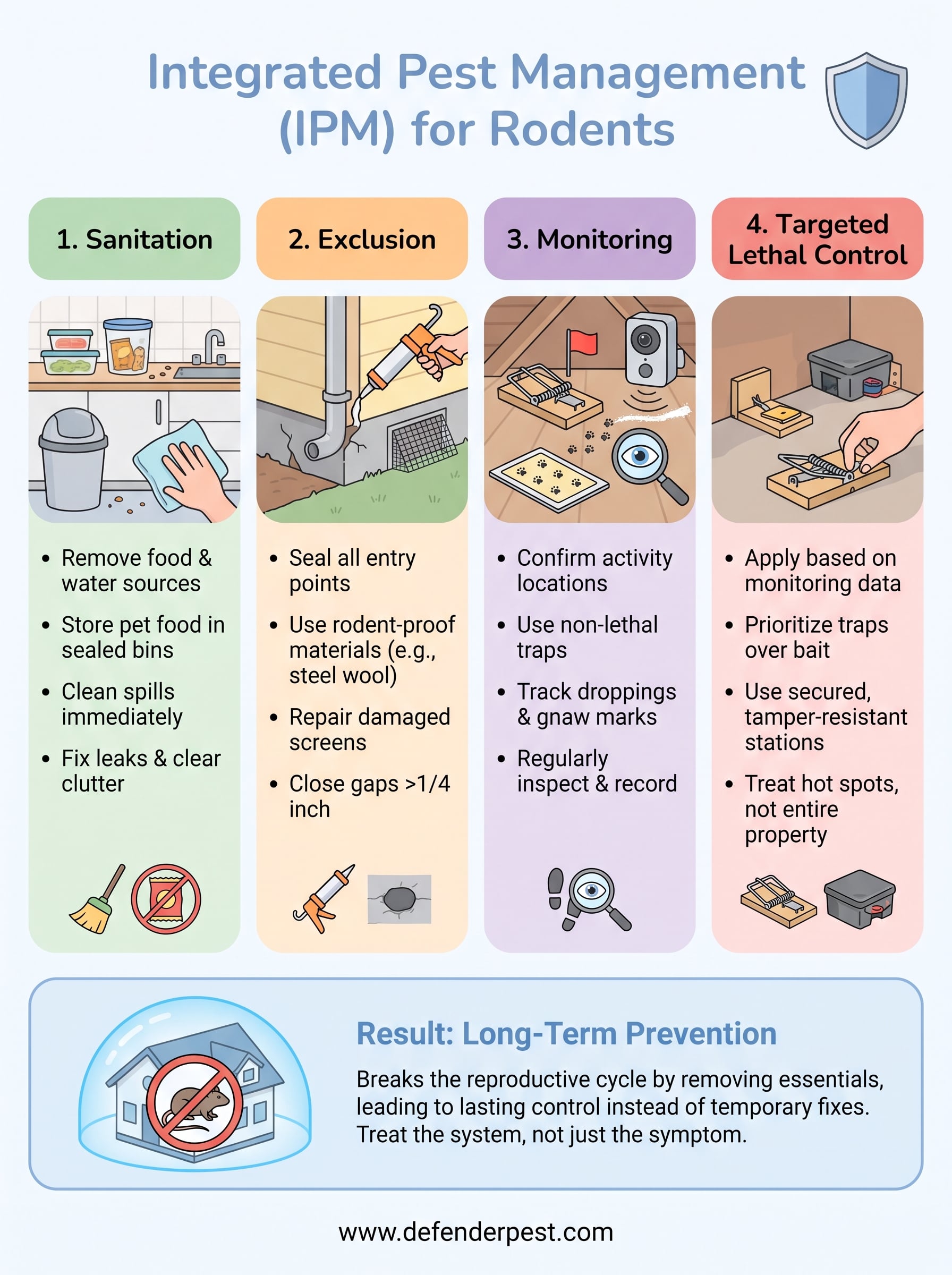
At its core, this approach means combining sanitation and exclusion with targeted monitoring and lethal control , applied in the right order and reassessed over time. You seal entry points, remove food sources and nesting material, place monitoring stations to confirm activity, and use traps or rodenticides only where data shows they're needed. That's the difference between guessing and actually solving the problem for good.
In this guide, we'll walk through each piece of an effective IPM program for rodents: identifying species and entry points, sanitation steps that cut off food and shelter, exclusion techniques that seal your property, and monitoring methods that tell you the plan is working. We've applied this framework across homes and businesses in the Sacramento area since 1999, and we'll share what actually holds up in the field.
Why integrated pest management works for rodent control
Rodents survive because they adapt faster than a single tactic can respond. Snap a trap here, and a mouse learns to route around it within days. Drop bait in one corner, and rats that avoid it keep breeding in the wall void you never checked. Single-tactic pest control treats symptoms, while an integrated approach treats the whole system that's letting rodents thrive on your property in the first place.
The problem with one-tool thinking
Most homeowners start with whatever's easiest to buy at the hardware store, usually snap traps or bait stations. Those tools work, but only against the rodents already inside. They do nothing about the gap under your garage door, the pet food left out overnight, or the ivy touching your roofline that gives rats a bridge into your attic. Treating the symptom without addressing the cause means you're refilling traps every few weeks indefinitely, and the population never actually shrinks because new rodents keep replacing the ones you catch.
A trap without exclusion is just a subscription to the same problem.
How the pieces reinforce each other
Integrated pest management works because each component compensates for what the others miss. Sanitation removes the food and water that let a colony grow past a few individuals. Exclusion cuts the access points so new rodents can't replace the ones you remove. Monitoring tells you where activity is actually happening instead of where you assume it is. Lethal control, applied precisely at those confirmed points, then does far less work than it would trying to fix an open, unsecured structure. This is the same science-based framework the U.S. Environmental Protection Agency recommends for structural pest problems, and it's why pest management professionals rely on it instead of blanket pesticide applications. You can read the EPA's own overview of the approach on its integrated pest management page.
What the data actually shows
When you compare outcomes, the gap between a single-tactic approach and a full IPM program isn't subtle. Trapping alone knocks down a visible population temporarily, but reinfestation rates climb fast because the underlying attractants and entry points are still there.
| Approach | Addresses food/water sources | Seals entry points | Confirms activity before acting | Typical reinfestation timeline |
|---|---|---|---|---|
| Traps only | No | No | No | Weeks |
| Rodenticide only | No | No | No | Weeks to months |
| Sanitation only | Yes | No | No | Months |
| Full IPM program | Yes | Yes | Yes | Rare, with maintenance |
The pattern holds across the properties we've serviced in Sacramento since 1999. Homes that get a one-time bait treatment call us back within a season. Homes that go through a full IPM sequence, sealing, sanitation, monitoring, then targeted control, stay clear for years, not months.
Why this matters more for rodents specifically
Rats and mice reproduce faster than almost any other pest you'll deal with in a home. A single female mouse can produce a new litter every three weeks, and those offspring are capable of breeding within about six weeks themselves, according to the Centers for Disease Control and Prevention's guidance on rodent biology and control. That math means a partial fix isn't a slower version of a full fix, it's a losing race. Population growth outpaces removal if you're only trapping or only baiting, because you're never getting ahead of the birth rate. IPM breaks that cycle by cutting off reproduction's fuel source (food and shelter) at the same time you're removing individuals, so the colony can't rebuild as fast as you're knocking it down.
There's also a safety angle that matters for households with kids or pets. Relying heavily on rodenticide as the only tool increases the amount of poison sitting around your property. An integrated plan uses far less bait overall because exclusion and sanitation are doing most of the heavy lifting, and any lethal control gets placed only where monitoring confirms it's needed. That's a safer outcome for your family and a more effective one for actually solving the infestation.
How to build an IPM program for rodents step by step
Building a rodent IPM program isn't complicated, but it does need to happen in the right sequence. Skip a step or do them out of order, and you'll waste effort chasing symptoms instead of fixing the actual problem. Here's the sequence that works, whether you're handling a single-family home or a commercial kitchen.
Start with inspection and identification
Before you seal anything or set a single trap, you need to know what species you're dealing with and where it's active . Roof rats behave differently than Norway rats, and both behave differently than house mice. Roof rats climb and nest high, Norway rats burrow near foundations, and mice can squeeze through a gap the width of a pencil. Walk the perimeter of the structure and look for droppings, gnaw marks, grease trails along baseboards, and entry points at utility penetrations, vents, and rooflines. This inspection is the foundation everything else builds on, so don't rush it.
Set clear thresholds before you act
An IPM program only works if you decide in advance what counts as a problem worth acting on. A single mouse dropping in a garage isn't the same as fresh droppings in a pantry every morning. Setting a threshold for action keeps you from either ignoring a real infestation or overreacting with heavy pesticide use when a lighter touch would do.
 Example thresholds for a residential property:
- 1-2 droppings found once: monitor, no treatment yet
- Fresh droppings found repeatedly in the same spot: place monitoring stations
- Gnaw marks on food packaging or wiring: begin exclusion + trapping immediately
- Live sighting during daylight: escalate to full IPM sequence, call a professional
Sequence the work correctly
Once you know what you're dealing with, follow the steps in order rather than jumping straight to traps or bait:
- Seal entry points first, so you're not creating a revolving door while you work.
- Remove attractants like pet food, birdseed, and compost that's accessible.
- Place monitoring devices (glue boards, snap traps set unarmed, or motion cameras) to confirm where activity is concentrated.
- Apply targeted control only at the confirmed hot spots, using traps before rodenticide whenever practical.
- Re-inspect on a schedule , not just when you hear noise again.
The order of operations matters as much as the tools themselves.
Document and reassess
A program only stays effective if you track what's working. Keep a simple log of where you found activity, what you did about it, and whether it stopped. Reassessing every 30 to 60 days catches new entry points before they turn into a fresh infestation, and it turns your rodent control from a one-time scramble into a maintained system that keeps working season after season.
Sanitation and exclusion tactics that stop rodents at the source
Sanitation and exclusion do the heavy lifting in any rodent IPM program, because they attack the two things a colony needs to survive: food and access. Get these right, and traps or bait become a backup plan instead of your main defense. Get them wrong, and you're stuck resetting the same traps every month while new rodents keep replacing the ones you catch.
Cut off food, water, and shelter
Rodents don't need much to sustain a colony. A spilled bag of birdseed , an uncovered compost bin, or a leaky outdoor faucet can support a breeding population for months without you ever noticing. Walk your property with fresh eyes and look for anything a mouse or rat could eat, drink, or nest in.
- Store pet food and birdseed in sealed metal or thick plastic containers, never in the original paper bag.
- Pick up fallen fruit and nuts from trees daily during harvest season.
- Move firewood and lumber stacks at least 18 inches off the ground and away from exterior walls.
- Trim vegetation and tree limbs back from the roofline; rats use branches as bridges onto the structure.
- Fix dripping outdoor spigots, AC condensation lines, and clogged gutters that pool water.
Take away the food and water, and you've already cut the colony's growth rate before you set a single trap.
Seal the gaps rodents actually use
Exclusion means closing every opening large enough for a rodent to squeeze through, and that bar is lower than most homeowners assume. A mouse needs only a quarter-inch gap , roughly the width of a pencil, while a rat can flatten its body through a half-inch opening. Focus your inspection on the spots that get missed during a casual walk-around.
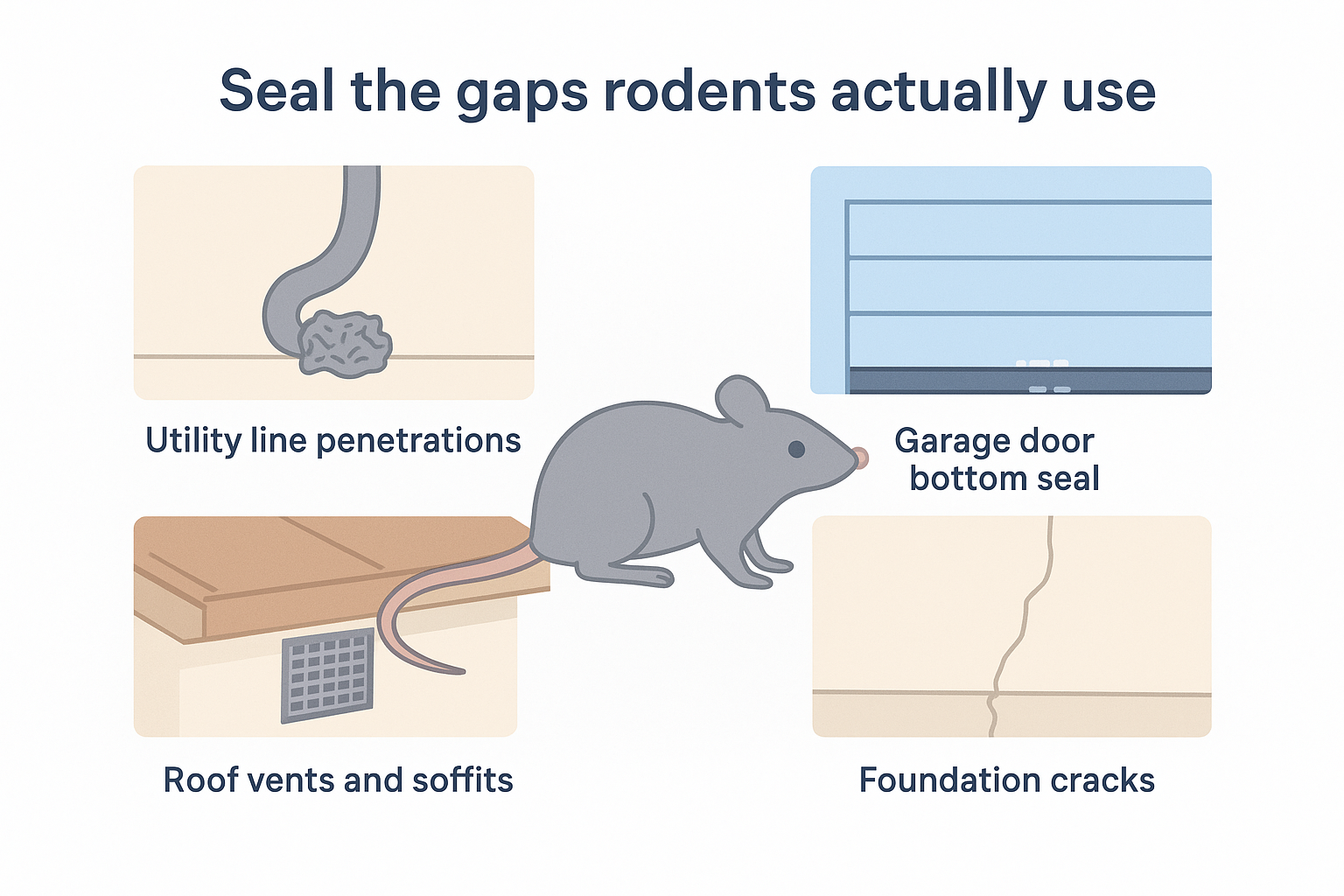
| Entry point | Common gap size | Fix |
|---|---|---|
| Utility line penetrations | 1/4 to 1 inch | Steel wool + expanding foam or copper mesh |
| Garage door bottom seal | Worn rubber gaps | Replace weatherstripping |
| Roof vents and soffits | Missing or torn screens | Hardware cloth (1/4 inch or smaller) |
| Foundation cracks | Hairline to 1 inch | Mortar or concrete patch |
| Dryer and exhaust vents | Loose flaps | Vent covers rated for rodent exclusion |
Use materials rodents can't chew through. Steel wool, copper mesh, and hardware cloth hold up; caulk and expanding foam alone don't, since a determined rat will gnaw right through them within days. Pair the foam with a metal barrier for anything wider than a quarter inch.
Why this stage can't be skipped
Skipping sanitation and exclusion to jump straight to trapping is the single most common reason rodent problems come back. You can remove ten mice from a house with a dozen unsealed entry points and still have ten more inside within a week, because nothing stopped them from walking back in the same way the first group did. Doing this work first means every trap or bait station you place afterward is actually solving the problem instead of just managing its symptoms.
Monitoring, trapping, and rodenticide use within an IPM plan
Once sanitation and exclusion are in place, monitoring tells you whether the work is actually holding. Skipping this step means you're guessing at results instead of confirming them, and guessing is exactly what IPM is designed to eliminate.
Monitoring confirms activity before you act
Place unarmed snap traps, glue boards, or simple track plates (a thin layer of flour or non-toxic powder) at suspected hot spots for a few days before deploying any lethal control. Check them daily and note where droppings, chew marks, or footprints show up. This step turns a hunch into data, so you're placing traps or bait exactly where activity is confirmed rather than scattering them across the whole property. Motion-activated cameras work well in attics and crawlspaces where daily checks aren't practical.
If you can't point to evidence of where rodents are active, you're not ready to set lethal control yet.
Choosing the right trap for the situation
Traps should be your first line of lethal control in almost every residential IPM plan, since they don't introduce poison into a home with kids or pets. Match the trap to the species and location:
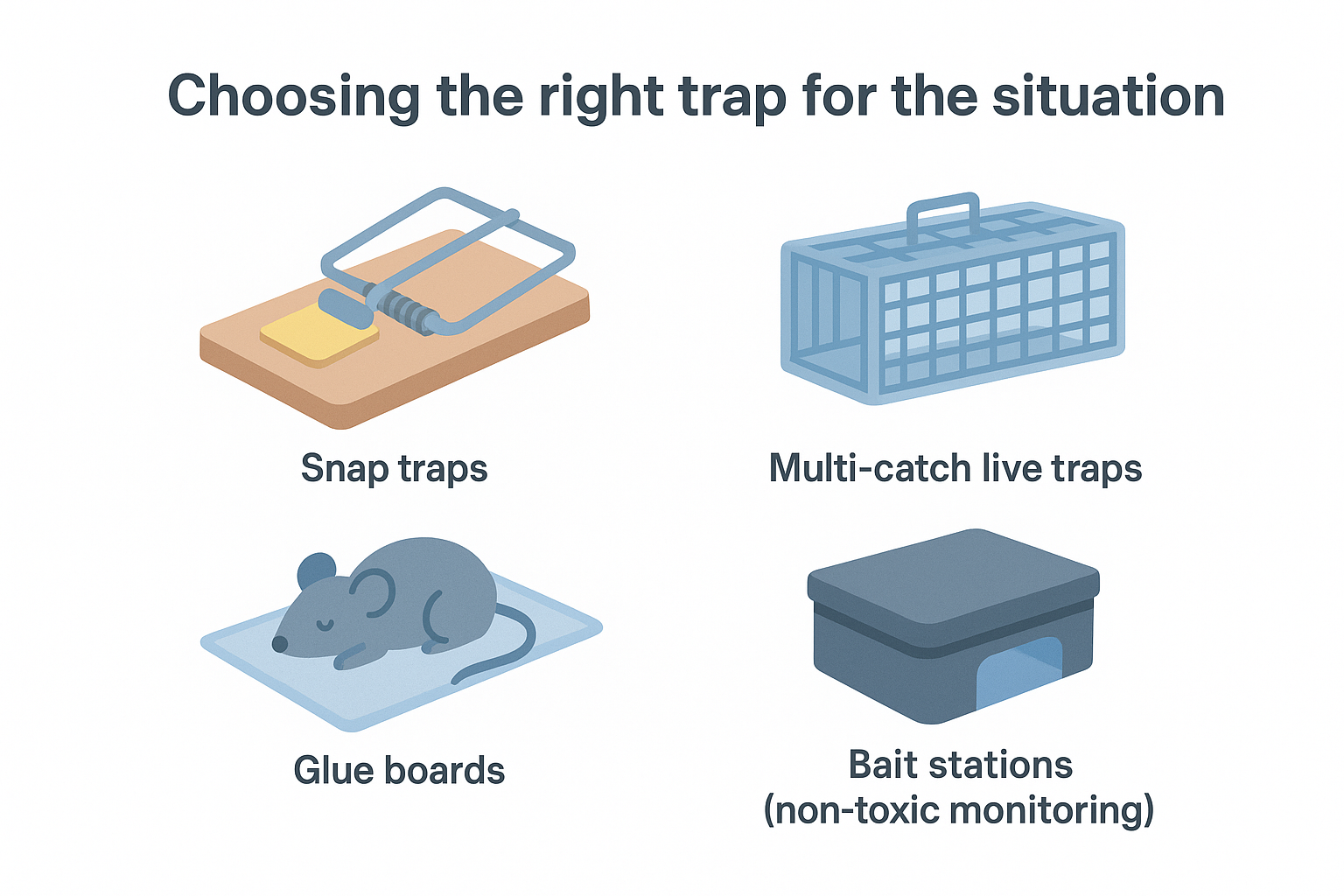
| Trap type | Best for | Placement notes |
|---|---|---|
| Snap traps | Mice and rats indoors | Along walls, perpendicular to travel path |
| Multi-catch live traps | Mice in food-prep areas | Check and clear daily |
| Glue boards | Confirming activity, not primary control | Avoid near pets |
| Bait stations (non-toxic monitoring) | Verifying hot spots before treatment | Tamper-resistant, secured in place |
Set traps perpendicular to the wall, since rodents travel along edges rather than through open floor space. Rebait or reset every few days until activity stops for at least a week.
Where rodenticide fits, and where it doesn't
Rodenticide has a place in IPM, but it's a targeted tool, not a default. Use it when trapping alone can't keep pace with a heavy infestation, or in exterior bait stations that reduce pressure before it reaches the structure. Always use tamper-resistant, locked stations, and place them where children, pets, and non-target wildlife can't reach them. The U.S. Environmental Protection Agency requires this kind of containment for consumer rodenticide products, and its guidance on safe use is worth reading before you buy anything: EPA's rodenticide safety information. Rotate active ingredients only if a professional recommends it, and never scatter loose bait as a substitute for a secured station. Used this way, rodenticide finishes off a problem that sanitation, exclusion, and trapping already brought under control, rather than trying to do the whole job alone.
Common mistakes that undermine rodent IPM efforts
Even a well-designed IPM plan fails when a few predictable mistakes creep in. Most of these come from impatience, not lack of knowledge, homeowners want the noise in the attic gone tonight, so they skip steps that would have solved the problem permanently. Knowing these traps in advance saves you months of repeat treatments.
Jumping straight to bait or traps
Skipping inspection and exclusion to go straight for rodenticide is the single most common mistake we see. Bait without sealing just keeps feeding new arrivals while the ones you poison get replaced within days. You end up buying bait every month indefinitely instead of spending a weekend sealing gaps once. If you take nothing else from this guide, take this: exclusion has to come before or alongside lethal control, never after it as an afterthought.
Bait and traps only work as long as you keep buying them, unless exclusion closes the loop.
Treating one visible spot instead of the whole structure
Homeowners often fix the entry point they can see, like a gap under the garage door, and assume the job is done. Rodents are opportunists, though, and a single sealed entry point rarely matches the number of ways they're actually getting in. Roof rats in particular exploit rooflines, vents, and overhanging branches that never make it onto a ground-level inspection. Walk the entire perimeter, including the roof if you can safely access it, before declaring the structure sealed.
Ignoring the maintenance phase
An IPM plan isn't a one-time project, it's a cycle. Skipping the re-inspection schedule means new gaps from settling foundations, storm damage, or landscaping changes go unnoticed until rodents find them first. Seasonal changes also shift rodent behavior, cooler months push rats indoors looking for warmth, so a structure that was secure in spring can develop new pressure points by fall.
Using the wrong tool for the wrong reason
Glue boards marketed as a control method get used as a primary tactic instead of a monitoring tool, which leaves suffering animals and doesn't reduce the population. Scattering loose rodenticide instead of using locked, tamper-resistant stations creates a real hazard for pets and kids, and it's also inconsistent with EPA containment requirements for consumer products.
Underestimating reproduction speed
Waiting a few weeks between checking traps and resetting exclusion work gives a colony enough time to rebound completely. Given how fast mice and rats breed, a two-week gap in monitoring can undo a month of progress. Treat the whole sequence as ongoing work, not a checklist you finish once and forget.
When to bring in a professional pest control team
DIY sanitation and exclusion handle a lot of rodent problems, but some situations call for expertise you can't build in a weekend. Knowing your limits early saves you from months of repeat treatments and, in some cases, real structural damage that gets worse the longer it sits.
Signs the infestation has outgrown a DIY approach
Certain warning signs mean the colony is bigger or better established than a homeowner can safely handle alone. Watch for these before deciding whether to keep going solo:
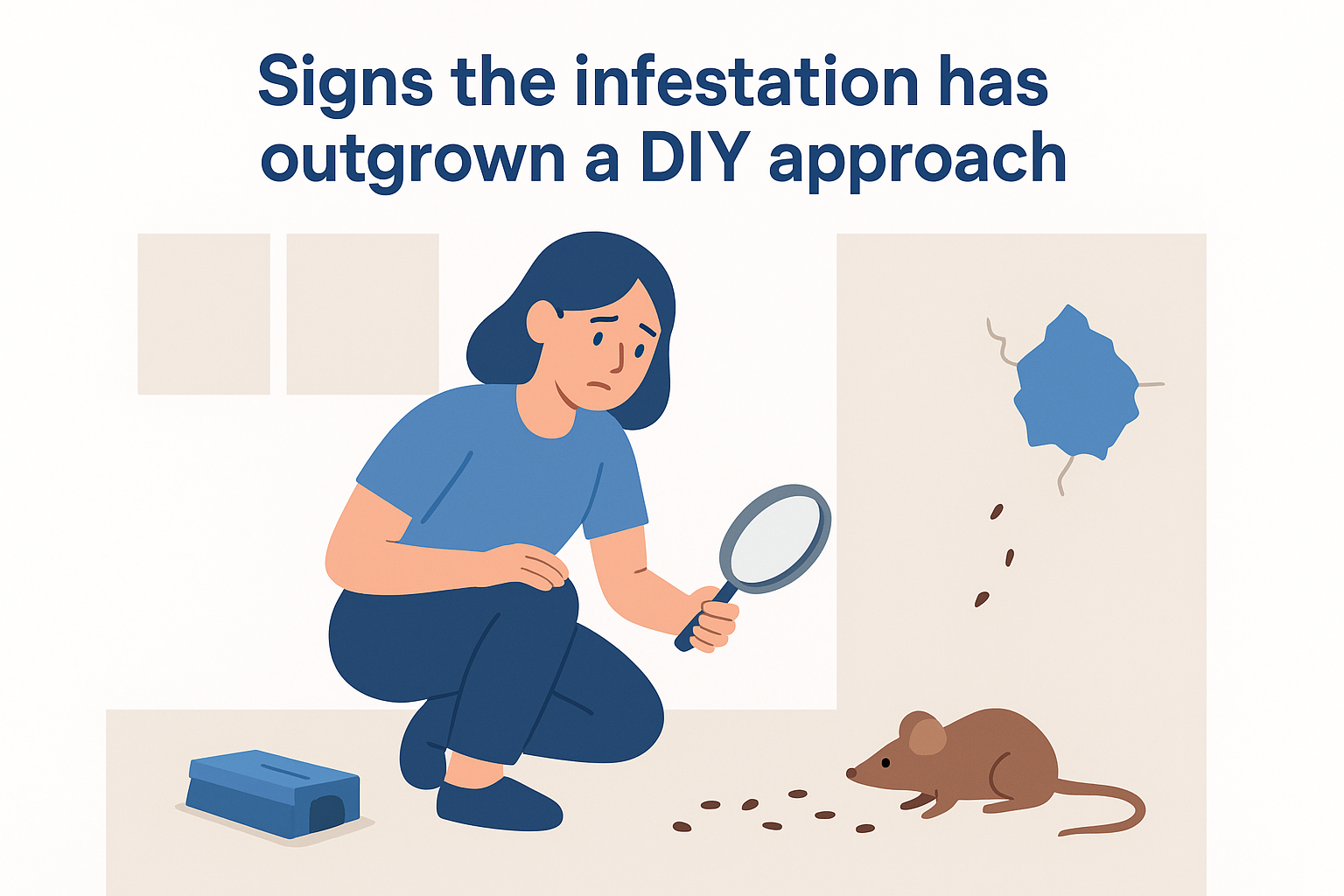
- Daylight sightings of live rodents, which usually means the population has outgrown the available hiding spots
- Droppings or grease trails in multiple rooms rather than one contained area
- Chewed electrical wiring, which creates a fire risk and needs professional assessment
- Activity in hard-to-reach areas like attic insulation, crawlspaces, or wall voids
- Traps that keep catching rodents week after week with no drop in activity
When traps keep filling up at the same rate month after month, the problem is bigger than the tools you're using against it.
Why professional access and equipment matter
A licensed pest management team brings tools most homeowners don't own: thermal cameras to trace movement inside walls, commercial-grade exclusion materials rated for long-term durability, and access to rodenticide formulations that aren't sold over the counter. Structural inspection experience also matters here, since a technician trained to spot rodent damage can catch gnawed joists, chewed vapor barriers, or compromised insulation that a homeowner walks past without noticing. That matters even more when termites or other wood-damaging pests have already weakened a structure, since rodents exploit the same soft spots.
When wood damage complicates the picture
Rodents and termites sometimes show up in the same structure, and the damage can look similar to an untrained eye. Gnaw marks, hollowed wood, and sagging sections near rooflines or foundations need someone who can tell the difference and repair it correctly. This is where a company that handles both pest management and construction-grade wood repair earns its value, since sealing a rodent entry point into damaged wood without fixing the wood first just creates a new opening a season later.
What a professional visit should include
A proper professional visit isn't a quick bait drop and an invoice. Expect a full inspection of the structure inside and out, a written summary of entry points found, a sanitation and exclusion plan, and a monitoring schedule with follow-up visits built in. If a company skips straight to setting bait without inspecting first, that's the same one-tool mistake this guide has been warning against the whole way through, just performed by someone you're paying instead of doing it yourself.
Keeping rodents out for the long term
Rodent control isn't a product you buy once, it's a habit you maintain. Integrated pest management for rodents works because it stacks sanitation, exclusion, monitoring, and targeted control together instead of betting everything on one tool. Seal the gaps, remove the food and water, confirm activity before you act, and reassess every season as your structure and landscaping change. Skip any one piece and you're back to refilling traps every few weeks with nothing to show for it.
Most homeowners can handle the sanitation and basic exclusion work themselves. But once you're seeing daylight sightings, chewed wiring, or damage that might involve termites as well as rodents, it's worth getting a trained eye on the property before the problem gets more expensive to fix. If you're in the Sacramento area and want a team that handles both pest pressure and the structural damage it leaves behind, request a quote from Defender Termite & Pest Management and get a plan built around what your property actually needs.