How To Keep Bats Out Of Your House: Safe, Lasting Fixes
That scratching sound in your attic at dusk isn't your imagination. If you've spotted bats swooping around your roofline or found droppings in your crawl space, you're dealing with a problem that won't resolve on its own. Figuring out how to keep bats out of your house requires more than a quick internet search, it takes an understanding of bat behavior, building construction, and California wildlife regulations that protect several bat species.
Here's what most people don't realize: bats can squeeze through gaps as small as 3/8 of an inch. That means your home likely has dozens of potential entry points you've never noticed, from ridge cap vents to warped fascia boards. And because bats return to the same roost year after year, a half-measure today becomes a recurring headache every spring .
At Defender Termite & Pest Management, we've helped Sacramento-area homeowners handle wildlife and pest intrusions since 1999. Our experience with structural inspections and wood repair gives us a unique perspective on bat exclusion, we don't just remove the problem, we seal and fix the damage left behind. This guide walks you through safe, effective, and legal methods to get bats out and keep them out for good.
Safety and timing basics before you do anything
Before you grab a broom or start stuffing gaps, you need to understand two things: bats are protected wildlife in California , and handling them incorrectly can expose you to serious health risks. Skipping this section is how well-intentioned homeowners end up breaking state law, injuring themselves, or creating a worse problem than they started with.
Know which laws protect bats in California
California classifies all bat species as protected non-game wildlife under the California Department of Fish and Wildlife. That means you cannot trap, kill, or harm bats, even if they've set up a colony in your attic. What you can do is exclude them , which means using one-way devices and physical barriers to let them leave and block them from returning.
Exclusion is legal. Extermination is not. If someone offers to poison or kill your bat colony, that is both illegal under California law and unnecessary.
The rules also change by season, which is the next critical point.
Understand bat disease risks before touching anything
Rabies is the primary concern , and it's serious. The CDC notes that most human rabies cases in the United States in recent decades have been linked to bat exposure. The difficult part is that a bat bite can be too small to see, especially if contact happened while you were asleep. If you wake up and find a bat in your bedroom, treat it as a possible exposure and contact your local health department the same day , not the next morning.
Beyond rabies, bat droppings carry Histoplasma capsulatum , a fungus that causes histoplasmosis , a respiratory illness that can become severe in some individuals. Any cleanup in a guano-contaminated space requires an N95 respirator at minimum , along with disposable gloves, eye protection, and clothing you can wash or discard immediately afterward. Do not dry-sweep droppings; dampen the area first to keep spores from becoming airborne.
Pick the right time of year to act
Timing is one of the most overlooked parts of figuring out how to keep bats out of your house for good. In California, bat maternity season runs roughly from April through August . During this window, female bats give birth and raise pups that cannot yet fly. If you seal entry points during maternity season, you trap those flightless pups inside, where they will die and create a significant odor problem, plus attract secondary pests.
The safest exclusion windows are late August through October and again in February through early March , when bats are mobile enough to leave on their own but no pups are present. Sacramento's mild climate makes these windows fairly reliable, though a warm winter can shift timing slightly. Before starting any work, spend at least two evenings watching your roofline at dusk to confirm bats are actively flying out. That movement tells you the colony is mobile and exclusion can proceed.
| Time of Year | What to Do |
|---|---|
| April to August | Observe only, do not seal entry points |
| Late August to October | Safe window to begin exclusion |
| November to January | Bats may be less active; hold off on sealing |
| February to March | Second safe exclusion window before spring |
Step 1. Get the bat out safely right now
If a bat is flying through your living space right now, stay calm and resist the urge to swat at it . Bats in flight look erratic, but they navigate via echolocation and will not intentionally fly toward you. Your immediate goal is to contain the bat to one room and create a clear exit path. Do not try to grab it with your bare hands under any circumstances.
Gear up before you get close
Before you do anything else, put on thick leather gloves if there is any chance you will need to handle the bat, and have safety glasses on hand. These are not optional. Even if you only plan to open a window, the situation can change quickly. Household rubber gloves are not sufficient because a bat's teeth can puncture them with little effort.
Gather these items before entering the room:
- Thick leather work gloves (not rubber or latex)
- Safety glasses or goggles
- A small cardboard box or plastic container with a lid
- A stiff piece of cardboard or a magazine
Guide the bat toward an exit
Close all interior doors leading to other parts of the house. Turn off ceiling fans immediately so the bat does not collide with the blades. Keep pets and children out of the room. Once the bat is confined, open every window and exterior door in that room and remove any screens that are easy to pop out. Turn off the lights inside and let exterior light draw the bat toward the opening. Most bats will find their way out within a few minutes if given a clear exit.
If the bat does not leave on its own after 20 minutes, use the box-and-cardboard method: wait for it to land on a flat surface, place the box over it, slide the cardboard underneath, and carry the whole thing outside to release it at least a few feet off the ground on a tree or fence post.
Learning how to keep bats out of your house starts with handling the immediate situation without panic or harm. Once the bat is outside, close all windows and doors before moving on to the next step.
Step 2. Confirm if you have a lone bat or a colony
Once you've dealt with any bat in your living space, your next move is to figure out the scale of the problem . A single bat that wandered in through an open door is a very different situation from a breeding colony of 50 or more roosting in your attic . The approach you take for exclusion, and the urgency behind it, depends entirely on this distinction.
Signs that point to a single bat
A lone bat typically shows up unexpectedly in one room and leaves little other evidence behind. If you find no droppings along your roofline, no staining around vents or gaps, and no sounds from your attic or walls at dusk and dawn, you may be dealing with a solitary animal that entered through an open window or door gap. Check these specific spots before drawing any conclusions:
- Window screens with tears or gaps larger than 3/8 inch
- Gaps around air conditioning units or dryer vents
- Any fireplace damper that was left open
If you identify one clear entry point and see no other signs, seal it after confirming no bat is inside, and monitor for a week.
Signs that point to a colony
Colonies leave a consistent pattern of evidence that a single bat does not. The most reliable indicator is watching your exterior walls and roofline at dusk on two separate evenings. A colony will produce multiple bats exiting the same gap in sequence , sometimes dozens within minutes. Beyond the visual confirmation, look for these physical signs:
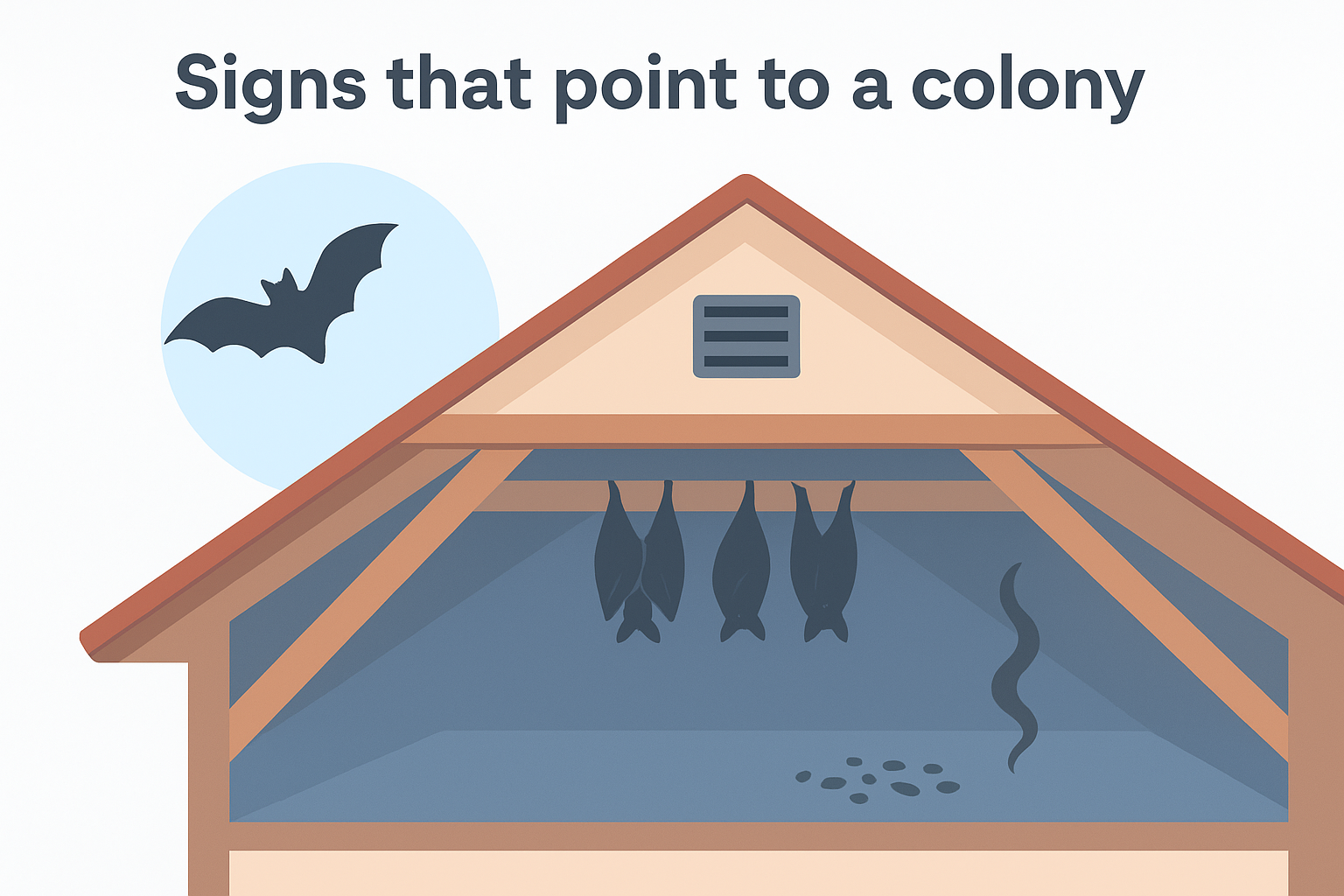
- Dark, greasy staining around a specific gap or vent (oils from bat fur accumulate over time)
- Clusters of small, pellet-shaped droppings below a consistent exit point
- A strong ammonia smell near your attic access or crawl space
- Audible chittering or scratching sounds in the same location each evening
If you confirm a colony, do not attempt to seal any entry points until you complete Step 4 using one-way exclusion devices; premature sealing is the most common mistake homeowners make when figuring out how to keep bats out of your house.
Knowing whether you're dealing with one bat or thirty determines every decision that follows , from the materials you buy to whether you need professional help.
Step 3. Find and mark every entry point
You cannot seal what you cannot find. This step requires a systematic inspection of your entire exterior , not just a quick glance at the roofline. Budget at least an hour and plan to do part of this inspection at dusk, when bats actively exit and show you exactly where they are getting in.
Walk the exterior in a grid pattern
Start at one corner of your house and move methodically around the perimeter, checking from the foundation to the ridge cap without skipping sections. Use a flashlight even during daylight to spot shadowed gaps. Carry blue painter's tape and mark every suspect opening as you go so nothing gets forgotten. Common problem spots include:

- Ridge cap vents and soffit vents with torn or missing screens
- Gaps where fascia boards meet the roofline or where two rooflines intersect
- Cracks where brick or siding meets window or door frames
- Open spaces around pipe penetrations, utility cables, and HVAC lines
- Warped or rotted wood trim that has pulled away from the structure
- Unsealed gaps at the top of exterior walls where they meet the roof deck
Mark every gap larger than 3/8 inch with tape, even if you see no bat sign near it; bats explore new openings regularly.
Use the light test from inside your attic
Once you've finished the exterior walk, go into your attic during the day and turn off any artificial light sources . Let your eyes adjust for two full minutes. Any pinhole or crack that lets in daylight is a gap large enough for a bat to use. Have someone outside help you by holding a bright flashlight flush against the exterior surface in areas you suspect, which makes even small gaps glow clearly from inside.
Take photos of every gap you find during both the exterior walk and the attic light test. Label each photo on your phone with a location note such as "north soffit, third vent from chimney." This documentation becomes your work checklist for Step 4 and helps you confirm nothing was missed when you do a final walkthrough after sealing.
Step 4. Exclude bats and seal the house for good
With every entry point documented from Step 3, you're ready to take the action that solves how to keep bats out of your house permanently. The process runs in two distinct phases: first, you let the bats leave through one-way exclusion devices placed at their active exit points, then you seal every gap on your list once the roost is confirmed empty. Rushing either phase undoes all the work you've done up to this point.
Install one-way exclusion devices at active exits
One-way exclusion devices are simple tubes or netting funnels that let bats fly out but block them from re-entering. You can purchase polypropylene exclusion netting or plastic bat cone tubes at most hardware stores. At each active exit you marked with painter's tape, fasten the device over the opening using staples or caulk around the outer edges, leaving only the forward-facing end open. The bat exits through the tube, cannot locate the correct re-entry angle in the dark, and relocates on its own.
Leave exclusion devices in place for at least five to seven consecutive nights before removing them; pulling them too early is the single most common reason bat exclusions fail and require a second attempt.
Watch your roofline at dusk on two or three evenings after installation. If you still see bats exiting from a gap you believed was covered, mark that spot immediately and add another device before moving forward.
Seal every gap permanently once the roost is clear
After five to seven nights with no observed bat activity at any exclusion device, remove the devices and seal every opening on your checklist. Use the right material for each gap type:
| Gap Type | Best Sealing Material |
|---|---|
| Under 1/4 inch | Paintable silicone or polyurethane caulk |
| 1/4 to 1 inch | Copper mesh packed first, then caulk over it |
| Larger structural gaps | 1/4-inch hardware cloth fastened with screws |
| Rotted or missing wood trim | Wood filler or full board replacement |
After sealing, complete one final exterior walk using the same grid pattern from Step 3 to confirm nothing was overlooked. Check your attic with lights off one last time. Any pinhole of daylight means another gap still needs attention before the job is truly done.
Quick wrap-up and next steps
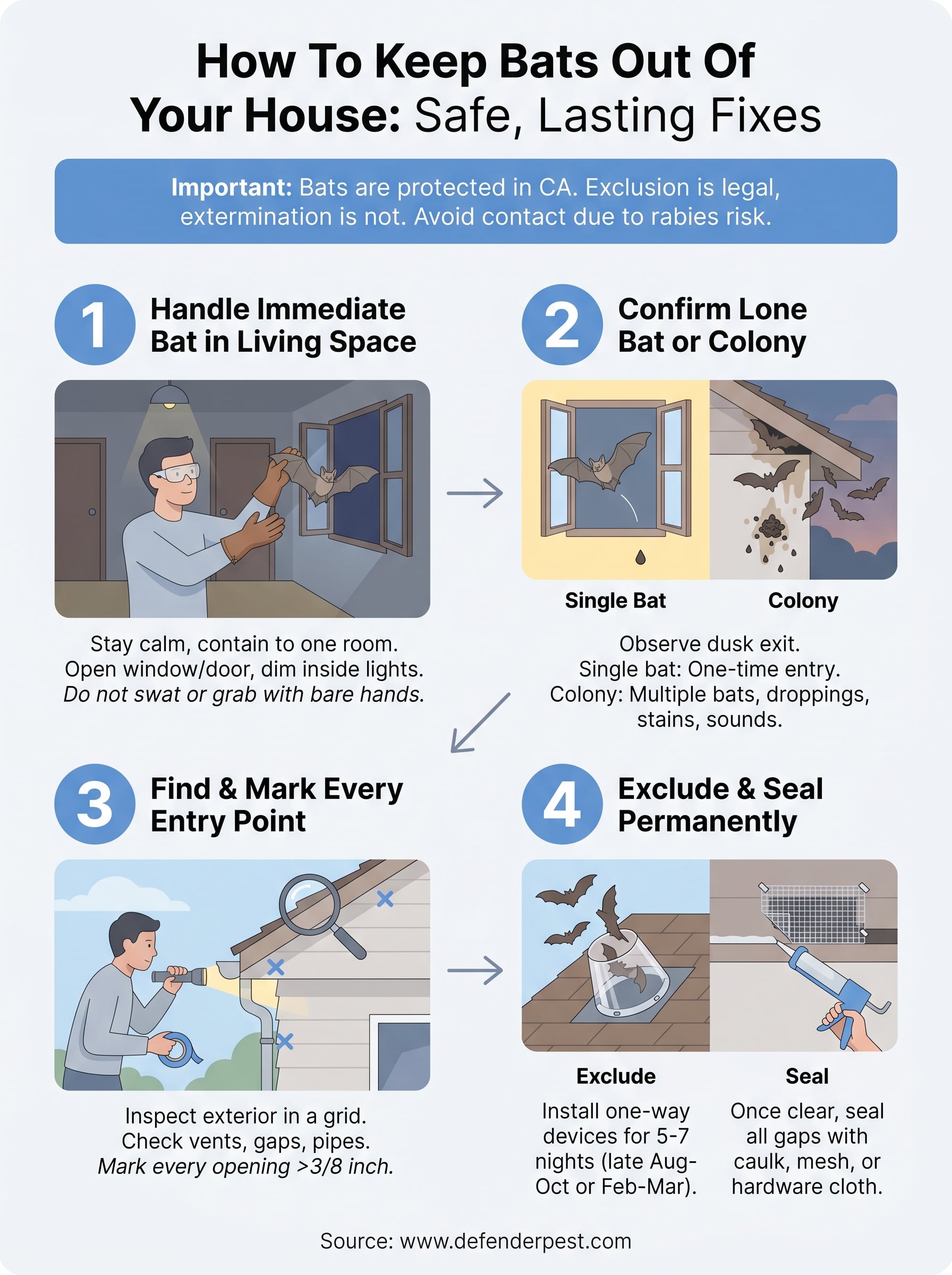
Knowing how to keep bats out of your house comes down to four steps done in the right order: handle any bat in your living space immediately, confirm whether you have a lone bat or a colony, find every entry point systematically , and then exclude and seal in two distinct phases. Skip a step or rush the timing, and the problem comes back next season.
Most homeowners can complete this process on their own when the roost is small and accessible. But if you find a large colony, significant attic damage, or guano contamination , the job crosses into territory where professional help protects both your health and your investment. Defender Termite & Pest Management has handled structural inspections and wildlife exclusion in the Sacramento area since 1999. If you want a trained set of eyes on your property, request a free pest inspection estimate and get a clear plan before the next exclusion window opens.