How to Find Pest Control for Bees Near Me
How to Find Pest Control for Bees Near Me
A bee colony under your eaves or inside a wall cavity is not something you wait out. Searching pest control for bees near me usually means you already found a nest, or heard the buzzing, and you need someone who knows the difference between bees, wasps, and hornets, and treats each one differently. That distinction matters more than most homeowners realize, since some species are protected and require live removal rather than extermination.
This guide walks you through exactly how to vet a local bee removal company, from checking licensing and insurance to asking the right questions before anyone shows up at your property. You'll learn what separates a licensed pest control company from a general handyman with a can of spray, and why that difference protects both your home and the bee population.
We'll also cover what to expect during an inspection , how pricing typically works in the Sacramento area, and when a situation counts as an emergency worth calling for immediate help. If you're dealing with a hive right now, or just want to know who to call before it becomes a problem, this covers what you need before you pick up the phone.
Why hiring a bee control professional matters
Bees behave differently than most stinging insects, and that changes how you should handle them. A honeybee colony can hold 10,000 to 60,000 workers, and if you disturb the hive with a DIY spray, you're not dealing with a handful of angry insects, you're dealing with an entire defensive swarm. Wasps and hornets are aggressive but usually operate in smaller numbers. Bees, especially Africanized honeybees, which are established throughout Central and Northern California, will chase a threat much farther and in far greater numbers than people expect. That's the first reason to skip the hardware-store approach and call someone trained specifically for bee removal near me searches, not general pest work.
A hive disturbed by an amateur doesn't just get angrier, it gets more dangerous to everyone nearby, including neighbors and pets.
Legal protection is the second reason, and it's one homeowners rarely think about until it's too late. Honeybees are a managed agricultural species, and depending on the situation, exterminating a colony instead of relocating it can run afoul of local guidance and beekeeping best practices. The Environmental Protection Agency actively promotes pollinator protection policies because honeybee populations have declined sharply over the past two decades. A trained technician can identify the species on sight, decide whether removal or relocation is the responsible route, and handle the colony in a way that doesn't needlessly kill a beneficial insect population your yard, and everyone else's, depends on.
Insurance and liability round out the case for hiring a pro. If a hive is inside a wall, in a chimney, or up in a roofline, removal often means cutting into structure, which is not a job for a ladder and a wasp-and-hornet can. A licensed and insured company carries coverage that protects you if something goes wrong during the job, whether that's structural damage, an allergic reaction on the property, or a swarm event that spreads beyond your yard. Handymen and unlicensed operators typically carry none of that protection, which means you absorb the risk if things go sideways.
Cost is the last piece, and it works in the professional's favor more often than people assume. DIY treatments fail regularly because they kill visible bees without touching the queen or the comb structure inside a wall. That leaves behind honey, wax, and dead bees that rot, attract secondary pests, and can even soak through drywall. Homeowners end up paying for repairs on top of a second, more invasive extermination call. A licensed pest control company gets it right the first time, often removing the comb and treating the void so a new colony doesn't move into the same abandoned space next spring.
Here's a quick comparison of what's at stake with each approach:
| Factor | DIY Treatment | Licensed Professional |
|---|---|---|
| Risk of multiple stings/swarming | High | Low, protective gear and technique |
| Legal/environmental compliance | Unknown, often overlooked | Follows species-specific guidance |
| Structural access (walls, roofs) | Rarely addressed safely | Trained for cut-outs and repairs |
| Recurrence risk | High, comb often left behind | Low, full colony and comb removal |
| Liability if something goes wrong | Falls on homeowner | Covered by business insurance |
Once you understand what's on the line, the next step is confirming you're actually dealing with bees and not a wasp or hornet nest that needs a different kind of response.
Step 1. Confirm you actually have a bee problem
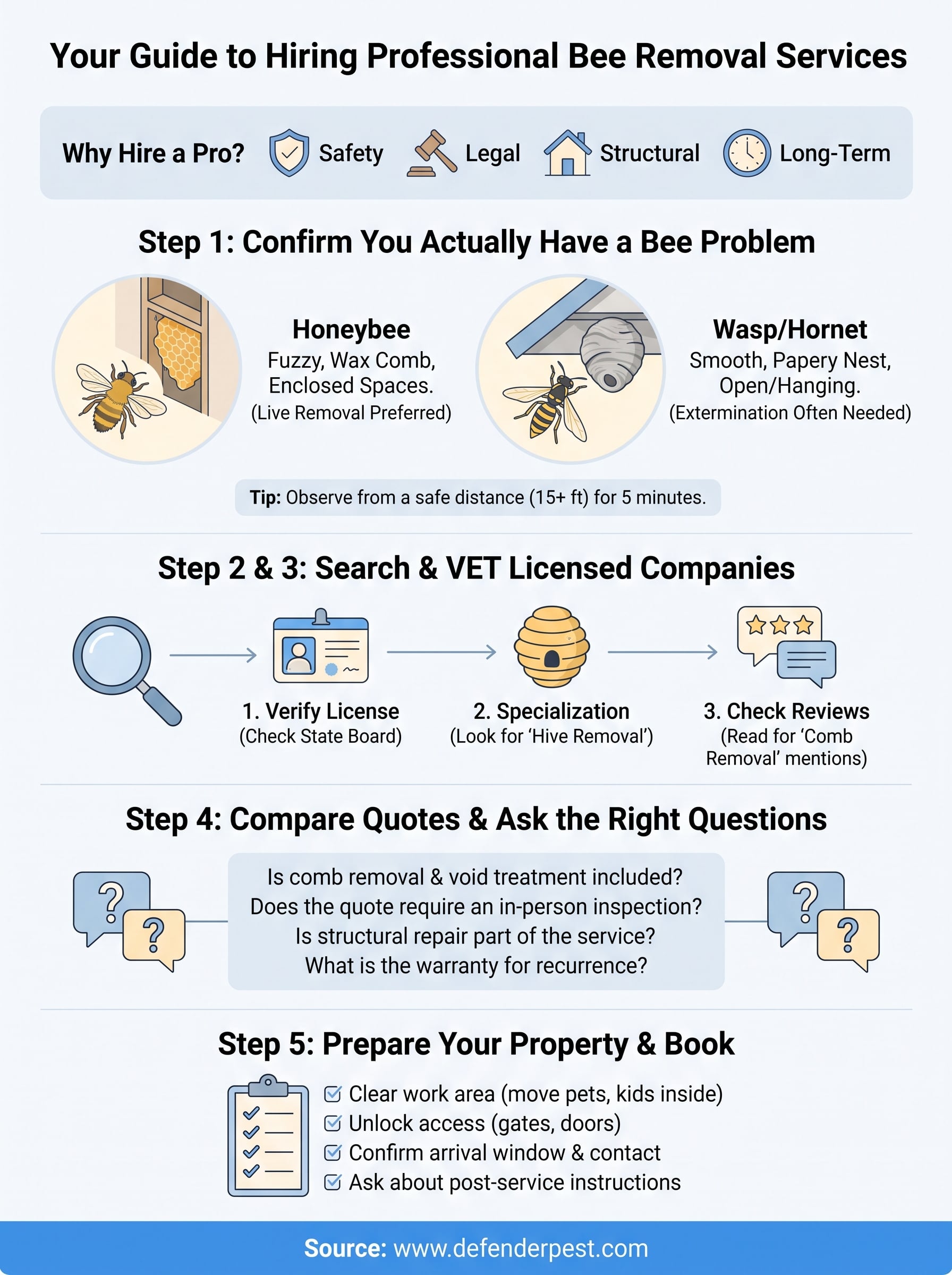
Before you call anyone, spend five minutes watching the insects from a safe distance, at least 15 feet away. Identifying the species correctly changes everything about how the job gets handled, and it's the detail most homeowners skip when they're already nervous about getting stung. Honeybees are fuzzy, golden-brown, and move in a steady, almost lazy pattern in and out of a single entry point. Wasps and yellowjackets are smooth, shiny, and darker, with a more erratic, aggressive flight pattern, especially around trash cans or food.
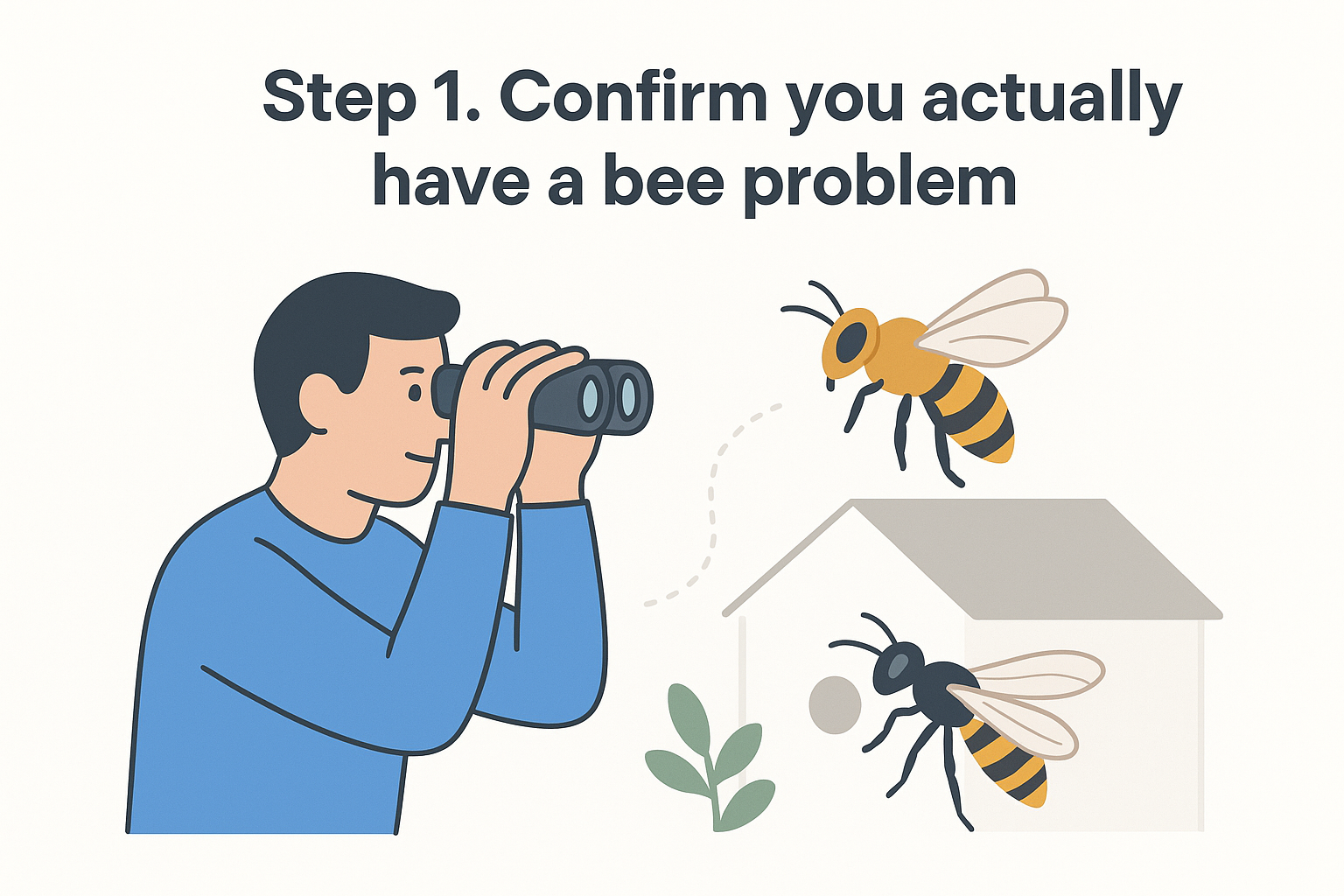
Watching for five minutes from a safe distance tells you more than any spray can will.
Location matters just as much as appearance. Honeybees build wax comb, so you'll usually find them inside a wall void , chimney, attic space, or hollow tree, entering through a small gap or knothole. Wasps often build open, umbrella-shaped nests under eaves or in shrubs, while yellowjackets tend to nest in ground burrows or wall voids near the foundation. If you see a papery gray nest hanging in the open, that's a wasp or hornet, not a honeybee colony, and it calls for different equipment and technique.
Use this quick checklist to narrow it down before you search for pest control for bees near me :
- Body type : Fuzzy and golden (bee) vs. smooth and shiny (wasp/hornet)
- Nest material : Wax comb (bee) vs. papery gray material (wasp/hornet)
- Nest location : Enclosed void, chimney, tree hollow (bee) vs. open umbrella nest or ground burrow (wasp)
- Flight pattern : Steady, direct flights to one entry point (bee) vs. erratic, scattered movement (wasp)
- Population visible : A dozen bees near a small gap in siding often means thousands more inside the wall
Timing also tells you something. A swarm event , a temporary cluster of bees resting on a branch or fence post while scouting for a permanent home, is different from an established colony that's been active for weeks. Swarms are usually calmer and can sometimes be safely relocated by a beekeeper without any structural work. An established hive inside your home is a bigger job, and it won't resolve itself.
If you're still unsure after watching the activity, don't guess. Take a few photos from a distance and send them along when you request a quote. Most local companies, including ours, can identify the species from a clear picture and tell you over the phone whether you're looking at a same-day emergency or something that can wait for a scheduled inspection.
Step 2. Search for local licensed bee removal companies
Once you've confirmed you're dealing with actual bees, start narrowing your search to companies that specialize in live insect removal, not just general pest spraying. Typing pest control for bees near me into Google gives you a map pack of local results, but don't stop at the first three listings. Click through to each company's site and look for a dedicated bee or hive removal page. A business that treats bee work as a core service, rather than an afterthought tucked under "other pests," usually has the equipment and training to do the job right.
Check licensing before anything else
California requires structural pest control operators to hold a license through the Structural Pest Control Board , and that license number should be visible somewhere on the company's website, usually in the footer. If you can't find it, ask directly. A legitimate operator will give you the number without hesitation, and you can verify it yourself through the state board's online license search. Skipping this step is how homeowners end up hiring someone with a truck and a sprayer but no accountability if the job goes wrong.
If a company won't share its license number upfront, that's your answer right there.
Use a short list of search terms that surface the right companies
General searches sometimes return exterminators who only kill bees on contact, which isn't what you want if relocation is possible. Try varying your search to pull up companies built for this specific work:
- "licensed bee removal [your city]"
- "honeybee hive removal near me"
- "bee swarm removal Sacramento"
- "[your city] pest control bees and wasps"
Each phrase tends to surface a slightly different mix of results, and cross-referencing them helps you build a shortlist of three to five companies worth a closer look.
Confirm service area and availability
Before you go further, make sure the company actually covers your zip code and offers a response time that matches your urgency. A hive inside a wall near a bedroom window is a different priority than a swarm resting on a fence post in the backyard. Defender Termite & Pest Management covers Sacramento, Roseville, Folsom, Elk Grove, Vacaville, and the surrounding Northern California counties, and offers 24/7 emergency service for situations that can't wait until Monday. Once you've got a shortlist that checks these boxes, it's time to dig into reviews and credentials before you commit to anyone.
Step 3. Vet reviews, credentials, and experience
Once you've got three to five companies on your shortlist, reviews become your fastest filter. Search each business name plus "bee removal" on Google and Yelp, and skip straight past the star rating to the written detail. A five-star average built on twenty reviews about rat traps tells you nothing about their bee work specifically. Look for reviewers who mention a hive removal, a wall cut-out, or a swarm call, and pay attention to whether the company relocated bees or just sprayed them.
A pile of five-star reviews about rodent work tells you nothing about how they'll handle a hive in your wall.
Experience with structural removal matters more than general pest volume. Bees inside a wall or chimney require cutting into the structure, extracting comb, and sealing the void so honey and wax don't attract secondary pests. Ask how many hive removals, not just spray treatments, the company handles in a typical month. A technician who's done dozens of cut-outs will talk through the process specifically, mentioning comb removal and void treatment, while someone with less experience tends to stay vague about what happens after the bees are gone.
Verify credentials directly
Don't take a website's word for licensing. Cross-check every company against the state database before you schedule anything:
- License number : Confirm it's active through the Structural Pest Control Board's license search
- Insurance : Ask for proof of general liability coverage, especially for jobs involving roof or wall access
- Years in business : A company operating since 1999, for example, has weathered enough seasons to have real hive-removal reps under its belt
- Local presence : A physical address or established service area beats a generic call-center number with no local roots
Ask about technician training specifically
Licensing covers the business, but the technician showing up at your door is who actually handles the hive. Ask whether staff receive species-specific training for bees versus wasps and hornets, and whether they carry the protective gear and extraction tools a wall cut-out requires. A company that treats bee removal as a specialty, rather than folding it into general pest control, usually answers these questions without hesitation. If you get vague responses or pushback on basic questions about credentials, cross that company off your list and move to the next one. The vetting process takes an extra twenty minutes, but it's the difference between a clean removal and a repeat call six months later.
Step 4. Compare quotes and ask the right questions
With your shortlist vetted, request quotes from at least three companies before deciding. Pricing for bee removal near me varies widely depending on hive location, accessibility, and whether the job requires cutting into structure. A swarm on a fence post might run $150 to $300, while a hive inside a wall or chimney, requiring cut-out, comb removal, and repair, can run $400 to $1,200 or more. Anyone quoting a flat rate without seeing the location first is guessing, and that guess usually turns into a change order once the crew arrives.
A quote given without seeing the hive location first is a guess, not a price.
Ask these questions before you book
Use this list on every call so you're comparing apples to apples across companies:
- Is the estimate based on photos, or does it require an in-person inspection first?
- Does the price include comb removal and void treatment, or just the initial spray?
- What happens if the hive turns out to be larger than expected once the wall is opened?
- Is structural repair included, or will I need to hire someone separately for the wood damage?
- What's the warranty or guarantee if bees return to the same spot within a set window?
- How soon can a technician get here, and is there an emergency rate for after-hours calls?
A company confident in its process will answer each of these without hedging. If someone dodges the comb removal question or won't commit to a warranty period, that's worth noting before you sign anything.
Watch for lowball quotes
The cheapest number on your list is rarely the best deal once you factor in what's excluded. A quote that's noticeably lower than the others often means the company plans to spray and leave, skipping comb removal entirely. That leaves rotting wax and honey behind drywall, which draws ants, roaches, and even a second bee colony within a year. Ask directly what's excluded from the low bid, since the answer usually explains the gap.
Structural damage from a long-standing hive is another line item worth asking about upfront. Defender Termite & Pest Management handles both the removal and any resulting wood repair under one roof, since we've done construction-grade structural work since 1999 alongside pest and termite services. That combination matters here, because a company that only removes bees but can't repair the wall they cut open leaves you juggling two contractors and two invoices for one problem.
Step 5. Prepare your property and book the service
Once you've picked a company, a little prep work on your end makes the appointment faster and safer for everyone involved. Keep kids and pets indoors starting the night before, and if the hive sits near a walkway or door you use daily, switch to an alternate route until the technician arrives. Clearing the work area around the entry point, patio furniture, garden hoses, potted plants, gives the crew room to set up ladders and extraction gear without extra back-and-forth.

Confirm access before the day of service
Unlock gates, move vehicles away from driveways the crew needs, and mention any dogs on the property when you book. If the hive is inside an attic or wall cavity, point out which side of the house it's on when you schedule, since some technicians bring different equipment depending on whether they're accessing from inside or outside. A quick walk-through with the technician when they arrive, even five minutes, catches details a phone estimate might have missed.
A few minutes of prep on your end turns a two-hour job into a one-hour job.
What to ask when you finalize the booking
Before you hang up the phone or close out the online form, confirm these details so there's no confusion on service day:
- Arrival window : Get a specific time range, not just "sometime Tuesday"
- Point of contact : Know who to call if the crew runs late or needs to reschedule
- Payment terms : Confirm whether payment is due on completion or requires a deposit
- Post-service instructions : Ask how long to keep the area clear after treatment, especially if relocation rather than extermination is involved
- Follow-up plan : Confirm whether a second visit is included if activity continues after the first treatment
Requesting a quote online
Most established companies, including Defender Termite & Pest Management, let you submit photos and a description through an online quote request instead of waiting on hold. That's often the fastest path from "I think I have a hive" to a scheduled technician, especially if you snap a few clear pictures of the entry point and any visible activity. Submitting details ahead of time also means the crew shows up with the right equipment instead of guessing based on a vague phone description, which cuts down on delays once they're on-site.
Getting professional help for your bee problem
Finding the right help doesn't have to feel overwhelming once you know what to look for. Confirm the species first, verify licensing and insurance before anyone steps onto your property, and read reviews that actually mention hive work rather than general pest jobs. Compare quotes with the same list of questions on every call, and prep your yard so the technician can work quickly and safely. Skipping any one of these steps is usually how homeowners end up with a repeat infestation or a wall full of rotting comb six months later.
Getting this right the first time saves you money, protects a beneficial insect population, and keeps everyone on the property safe from stings. If you're in the Sacramento area and need someone who handles the removal and the structural repair that often comes with it, request a quote from Defender Termite & Pest Management and get a technician on the way.