6 Tips To Choose Wasp Nest Removal Near Me: Costs & Pros
You spotted a wasp nest tucked under your eave or buried in a shrub, and now you're searching wasp nest removal near me hoping someone qualified can deal with it fast. That's the right call. Wasps are aggressive when they feel threatened, and a DIY approach with a garden hose or a can of spray often ends with multiple stings and an angrier colony . The safest move is hiring a professional who knows how to handle the job without putting you or your family at risk.
But not every pest control company operates the same way. Pricing, response times, and treatment methods vary widely, and picking the wrong provider can mean paying too much for a half-finished job, or worse, a nest that comes back. You need to know what separates a reliable exterminator from one that's just going through the motions. At Defender Termite & Pest Management, we've been helping Sacramento-area homeowners deal with exactly these situations since 1999 , so we know what quality service looks like from the inside.
This guide breaks down six practical tips for choosing the right wasp nest removal service, what you should expect to pay, and how to spot a trustworthy pro before you commit. Whether you're dealing with paper wasps under a deck or yellowjackets in your yard, these pointers will help you make a confident decision and get the problem handled safely.
1. Start with a local pro like Defender Termite & Pest Management
When you search wasp nest removal near me , the results will include national chains, solo operators, and local companies with deep community roots. A local pro gives you something the big franchises rarely offer: fast response and genuine accountability . Local companies depend on their reputation in the area, which means they have a stronger incentive to do the job right the first time rather than rush to the next call.
Why local response time matters for stinging pests
A wasp nest grows quickly. What starts as a small cluster in spring can become a colony of several hundred workers by midsummer. Delays in scheduling treatment give the colony more time to expand, which raises the risk for anyone near the nest. Local providers can typically reach your property faster than a national call center can even dispatch a technician, and that speed directly reduces your exposure time and the size of the problem you're paying to fix.
The longer a wasp nest sits untreated, the larger and more defensive the colony becomes, which increases both the risk of stings and the difficulty of removal.
What you get when a company handles both pest control and wood repair
Some wasps, particularly paper wasps and yellowjackets , nest inside wall voids, soffits, or wooden structures where they can cause secondary damage over time. A pest control company that also offers structural wood repair can address both the infestation and any damage left behind in a single service relationship. Defender Termite & Pest Management provides exactly that combination, which means you don't have to coordinate between two separate contractors after the nest is gone.
Working with one provider for both the pest treatment and any structural repair also keeps your documentation clean and consistent, which matters if you're managing a home sale or filing an insurance claim related to property damage.
When 24/7 availability changes the risk and the price
Wasp problems don't wait for a Monday morning appointment window. A nest discovered at dusk near a child's play area or a main entryway is an immediate hazard, and you need a provider who can actually respond. Companies that offer 24/7 emergency service give you the option to act the same day, which can prevent a situation from becoming a genuine medical emergency for someone with a venom allergy.
Emergency visits typically carry a higher service fee than a standard scheduled call, but weigh that cost against the real risk of waiting. Ask any provider upfront what their after-hours rate looks like so the number doesn't catch you off guard when you call.
2. Confirm licensing, insurance, and safety practices
Licensing and insurance aren't just formalities. Any technician treating stinging insects on your property should carry a valid state pest control license and general liability insurance. In California, pest control operators must hold credentials through the California Department of Pesticide Regulation , and you have every right to ask for proof before any work begins.
What to verify before anyone steps on your property
Request the company's license number and certificate of insurance upfront. You can verify California pest control licenses through the state's online verification portal . A reliable provider hands over these documents without hesitation.
- License type : Confirm they're licensed for structural pest control, not just general landscaping work
- Liability insurance : Make sure coverage extends to accidental property damage during treatment
- Worker's comp : Ask whether technicians are covered in case of injury on your property
What safety gear and procedures a qualified team should use
A properly equipped technician arrives with full protective gear , including a bee suit, gloves, and a respirator when applying pesticides. They should treat the nest during low-activity hours when fewer wasps are flying, and they should secure the surrounding area before any treatment starts.
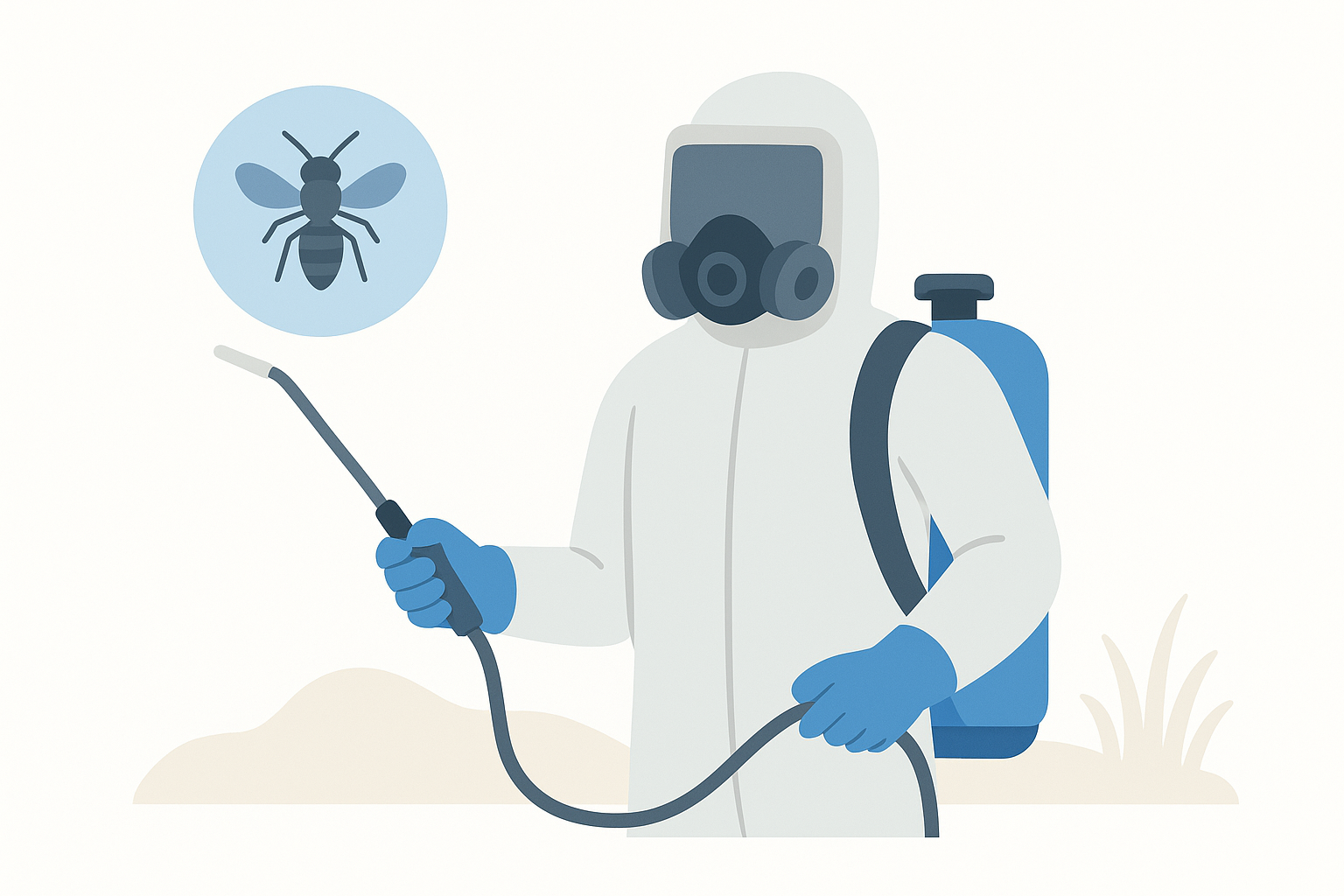
Skipping proper gear or area prep usually signals an operator who prioritizes speed over safety . That puts you, your family, and your pets at real risk during the job.
A licensed and insured technician won't hesitate to show their credentials before starting any wasp nest removal near me service.
Red flags that signal a risky or unqualified operator
Walk away from any company that quotes a price without seeing the nest , demands cash only, or refuses to share licensing details. If they can't produce a written estimate with a clear scope of work , keep looking.
Watch for these specific warning signs before hiring:
- No verifiable license number when asked directly
- Pressure to pay in full before any work begins
- Vague or verbal-only promises about follow-up visits
3. Make sure they identify the wasp type and nest location
Before any treatment starts, a qualified technician should tell you exactly what species you're dealing with and where the nest is physically located . Skipping this step leads to misapplied treatments that don't fully eliminate the colony, or worse, drive wasps deeper into a wall or structure where they become much harder to reach.
Common nest types and where pros usually find them
Different wasp species build distinctly different nests in different locations. Paper wasps construct open, umbrella-shaped combs and typically hang them under eaves, deck railings, and window frames. Yellowjackets often build underground or inside wall voids, while bald-faced hornets create large papery gray nests in trees or dense shrubs.
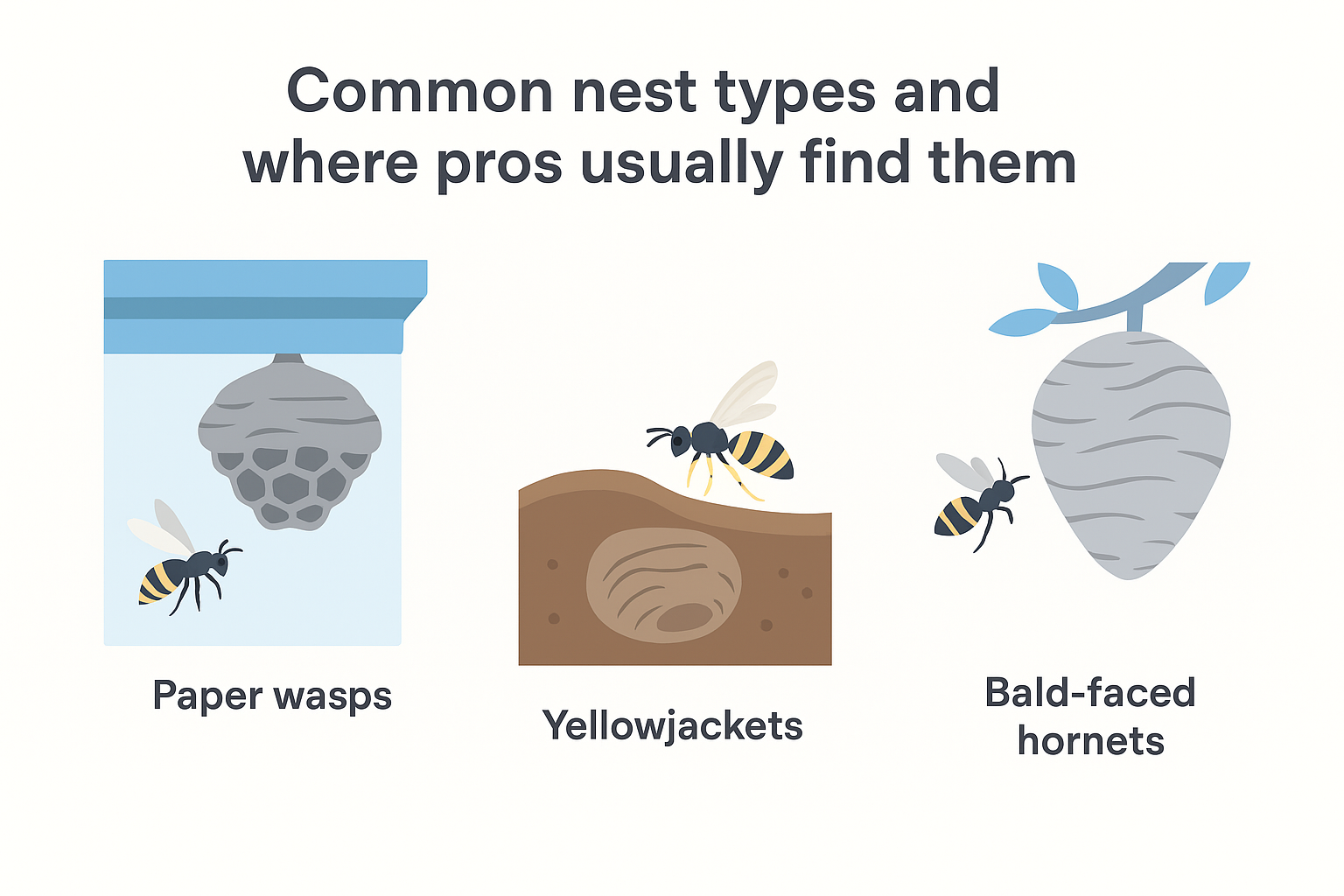
Finding hidden nests requires hands-on experience, since colonies inside attics or below ground are rarely visible from the yard. A thorough inspection covers entry points and structural gaps , along with any area showing elevated wasp traffic around your home's exterior.
Why species ID changes the treatment plan and the risk
Treatment approaches differ significantly by species. Yellowjackets nesting in a wall void require a different application method than paper wasps hanging under a soffit, and using the wrong product in the wrong location can scatter the colony instead of eliminating it.
Species identification is one of the first things a reliable wasp nest removal near me service should confirm before recommending any treatment.
Correctly identifying the species also tells the technician how aggressive the colony is likely to be during treatment, which directly affects the safety protocols the team needs on-site .
What to ask if you suspect a nest in a wall, attic, or underground
Hidden nests need more specialized tools and techniques. Ask the technician whether they use inspection cameras or thermal imaging to locate nests inside structures before applying any product. Also confirm that their plan addresses full colony elimination , not just sealing an entry point, which can trap wasps inside and force them to chew new exit holes through your drywall or siding.
4. Compare what each quote includes, not just the price
When you get multiple quotes for wasp nest removal near me , the lowest number isn't always the best deal. A quote that leaves out follow-up visits or doesn't account for a hidden nest location can cost you more in the long run. Always ask what's actually covered in the price before you agree to anything.
Typical wasp nest removal cost ranges and what drives them
Most professional wasp nest removal jobs run between $100 and $500 , depending on nest size, species, and location. A visible paper wasp nest under an eave sits at the lower end, while a yellowjacket colony inside a wall void or an underground nest pushes the cost higher because it requires more labor and specialized products. Accessibility, urgency, and your geographic area also affect the final number.
A single price quote without a clear breakdown of services tells you very little about what you're actually paying for.
Line items you should see in a clear estimate
A trustworthy estimate breaks the job down clearly instead of handing you a single number with no explanation. Look for these specific line items before agreeing to any service:
- Inspection fee : Some companies charge for the initial site visit; others fold it into the total
- Treatment cost : The product type and volume used should be itemized separately
- Labor : Time on-site, especially for hard-to-reach or hidden nests
- Nest removal or sealing : Confirm whether physical removal is included or an add-on charge
- Follow-up visits : Ask whether a return trip is covered if the colony isn't fully eliminated
Questions to ask about follow-up visits and re-treatments
Not every nest clears in a single treatment, especially underground colonies or wall-void nests where reaching every chamber is difficult. Ask each provider directly whether a re-treatment is included at no extra charge if wasps remain active within a set window, typically seven to fourteen days. A company that backs its work with a clear written guarantee signals that it stands behind the quality of the job.
5. Ask about the removal method and timing
Understanding how a technician plans to handle your nest reveals a lot about their competence and professionalism. Treatment method and timing are two factors that directly affect how safely and completely the job gets done, so ask about both before you book anything.
How pros remove or neutralize nests without escalating aggression
A qualified technician approaches the nest with a clear plan that minimizes disturbance to the colony until the insecticide treatment is fully applied . For exposed nests, they typically use a fast-acting dust or aerosol product directed into the nest opening, which knocks down workers quickly before they can swarm. For hidden nests inside walls or underground, they inject product through a drilled access point rather than opening up walls unnecessarily, which limits both structural damage and wasp agitation.
Asking about the specific treatment method is one of the most useful questions you can put to any wasp nest removal near me service before booking.
Best times of day for service and why it matters
Professionals schedule most wasp treatments at dawn or dusk , when the majority of the colony is inside the nest and foragers are not actively flying. Treating mid-day leaves a large portion of the worker population out of reach, which means stragglers return to a treated nest and scatter rather than die in place. Confirm that your technician plans to arrive during a low-activity window so the treatment reaches as many colony members as possible in one visit.
What you should do before, during, and after the appointment
Before the technician arrives, keep children and pets indoors and clear the area around the nest so the team has unobstructed access to work safely. During the treatment, stay inside and away from windows near the nest. After the job is done, wait the full clearance period your technician specifies before returning to the area, and watch for returning wasps over the following seven to ten days.
6. Choose a provider that prevents the nest from coming back
Removing a wasp nest solves today's problem, but it doesn't guarantee wasps won't rebuild in the same spot next season . A quality provider finishes the job with a clear conversation about what steps will keep colonies from returning, so you're not calling for wasp nest removal near me again in six months.
Exclusion and repair steps that reduce repeat nesting
After the colony is eliminated, a thorough technician inspects the exterior of your home for gaps, cracks, and damaged wood that give wasps an easy entry point for future nesting. Sealing soffits, patching rotted fascia boards, and caulking around window frames and utility penetrations removes the sheltered cavities that paper wasps and yellowjackets actively seek out when building new nests each spring.
Sealing entry points after treatment is one of the most effective steps a provider can take to stop wasps from returning to the same location.
Yard and exterior changes that remove attractants
Some yard conditions make your property consistently attractive to nesting wasps , and your technician should point those out clearly. Uncovered garbage bins, open compost piles, and standing water near outdoor eating areas draw foraging workers looking for protein and sugars. Moving bins away from the structure, keeping lids sealed, and trimming dense shrubs away from the foundation cuts down on the number of wasps that spend time around your home in the first place.
What a simple prevention schedule looks like in Northern California
In the Sacramento region, wasp activity typically picks up between April and October , with new queens emerging in early spring to begin colony construction. Scheduling a preventative perimeter treatment in late March or early April gives you a protective barrier before nesting starts. Pair that with a mid-season check in July and you cover the window when colonies grow fastest and become most aggressive.
Next Steps
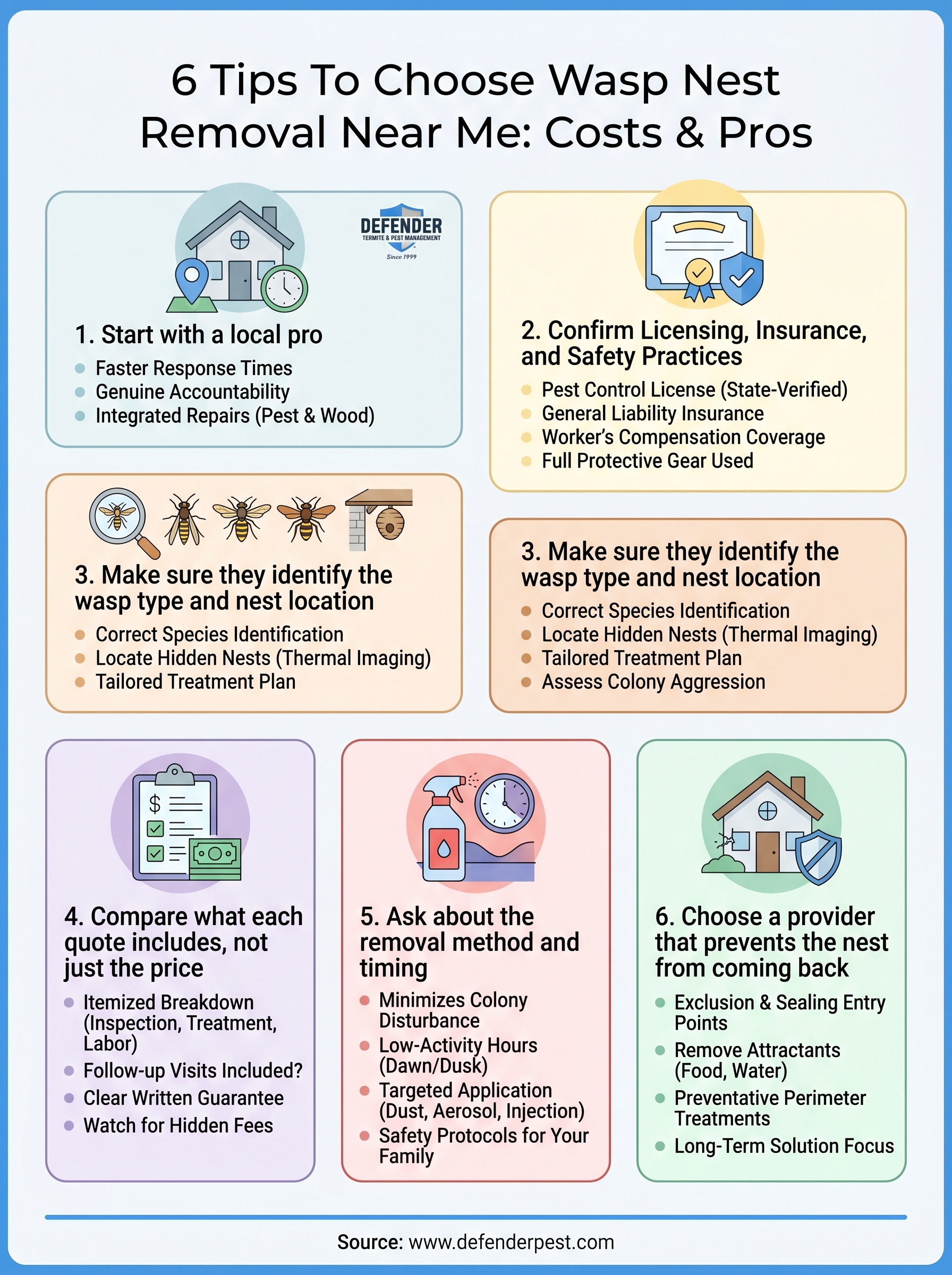
You now have a clear framework for choosing the right wasp nest removal near me service without overpaying or settling for a provider who won't stand behind the work. Verifying credentials, getting itemized quotes, and asking about prevention are the steps that separate a one-time fix from a long-term solution. Every tip in this guide points toward the same outcome: a safe, complete removal handled by someone who knows what they're doing.
If you're in the Sacramento area and need help now, Defender Termite & Pest Management has been handling exactly these situations since 1999. The team offers licensed inspections, targeted treatments, and structural wood repair under one roof, so you're not juggling multiple contractors after the colony is gone. Reach out today to request a quote, get your property assessed, and put a clear plan in place before the problem grows any larger.