Termite Control Cost: Average Prices, Factors, And Quotes
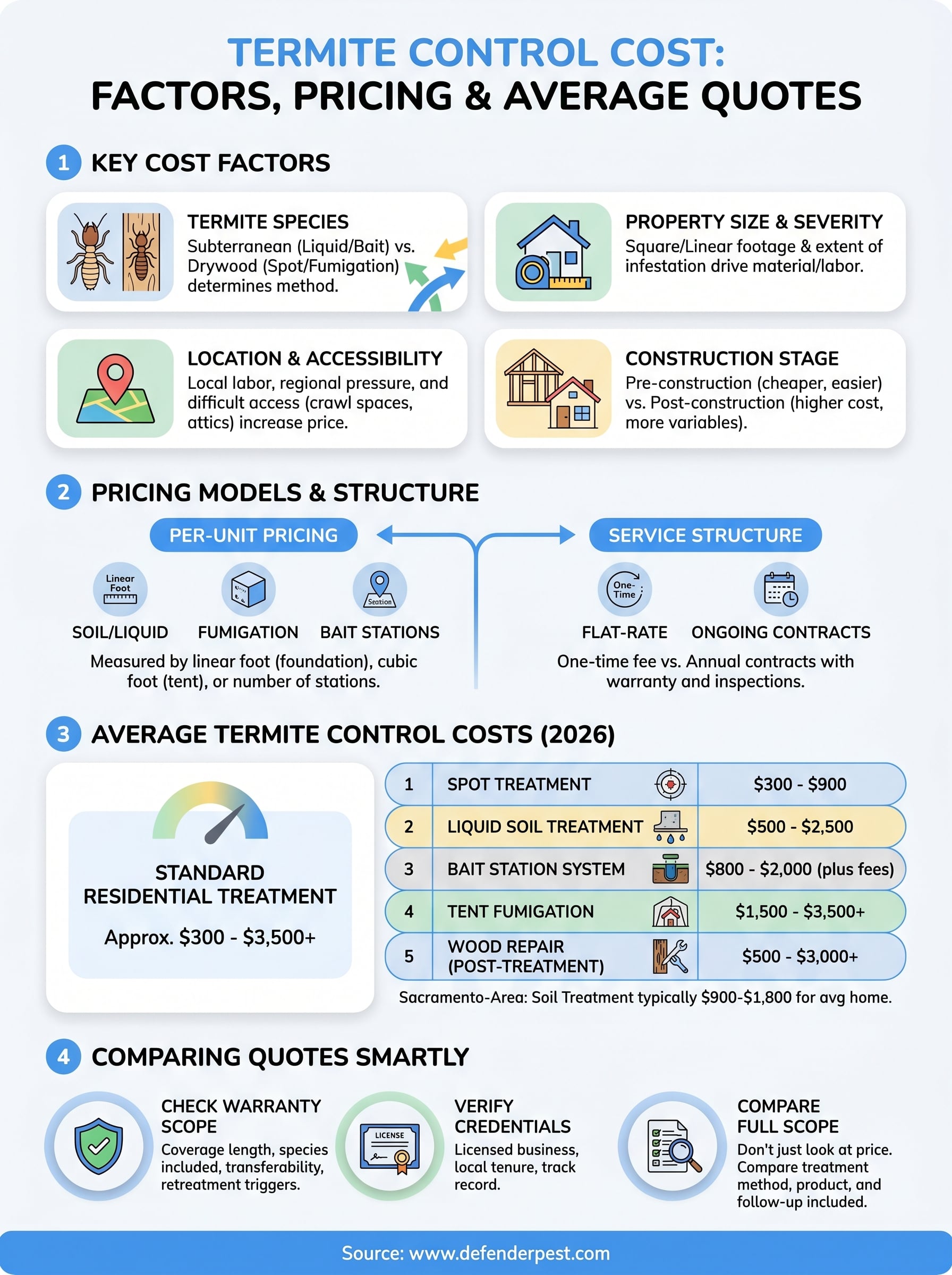
When you discover termites in your home, or suspect they might be there, the first question is almost always about money. How much does treatment actually run? Is the quote you got reasonable, or are you overpaying? Understanding termite control cost starts with knowing what drives the price: the type of treatment, the size of your property, the severity of the infestation, and whether you're dealing with pre-construction or post-construction work .
At Defender Termite & Pest Management, we've been handling termite problems across the Greater Sacramento area since 1999. Over that time, we've seen just about every pricing scenario out there, from straightforward spot treatments to full-structure fumigations with extensive wood repair afterward. That hands-on experience gives us a clear picture of what homeowners should expect to pay, and more importantly, what they should be getting for that investment.
This article breaks down average termite treatment prices, explains the factors that shift those numbers up or down, and gives you the benchmarks you need to evaluate any quote with confidence. Whether you're budgeting for a preventative plan or responding to an active infestation, you'll walk away with real numbers and practical context to make an informed decision.
Why termite control costs vary so much
Termite control cost doesn't follow a simple formula. Two houses on the same street can receive wildly different quotes because termite treatment pricing depends on a combination of factors specific to your property, your pest problem, and the method required to solve it. Before you assume a quote is high or low, you need to understand what's actually driving that number .
The species of termite matters
Not all termites are the same, and the species infesting your home has a direct effect on which treatments work and what they cost. Subterranean termites - the most destructive species in California - live underground and enter structures through soil contact or mud tubes. Treating them typically requires a liquid termiticide applied to the soil around and beneath the foundation, or a bait station system that eliminates the colony over time. Drywood termites, by contrast, live entirely inside the wood they eat. Getting rid of them usually means localized spot treatments or whole-structure fumigation, which is one of the most expensive options available.
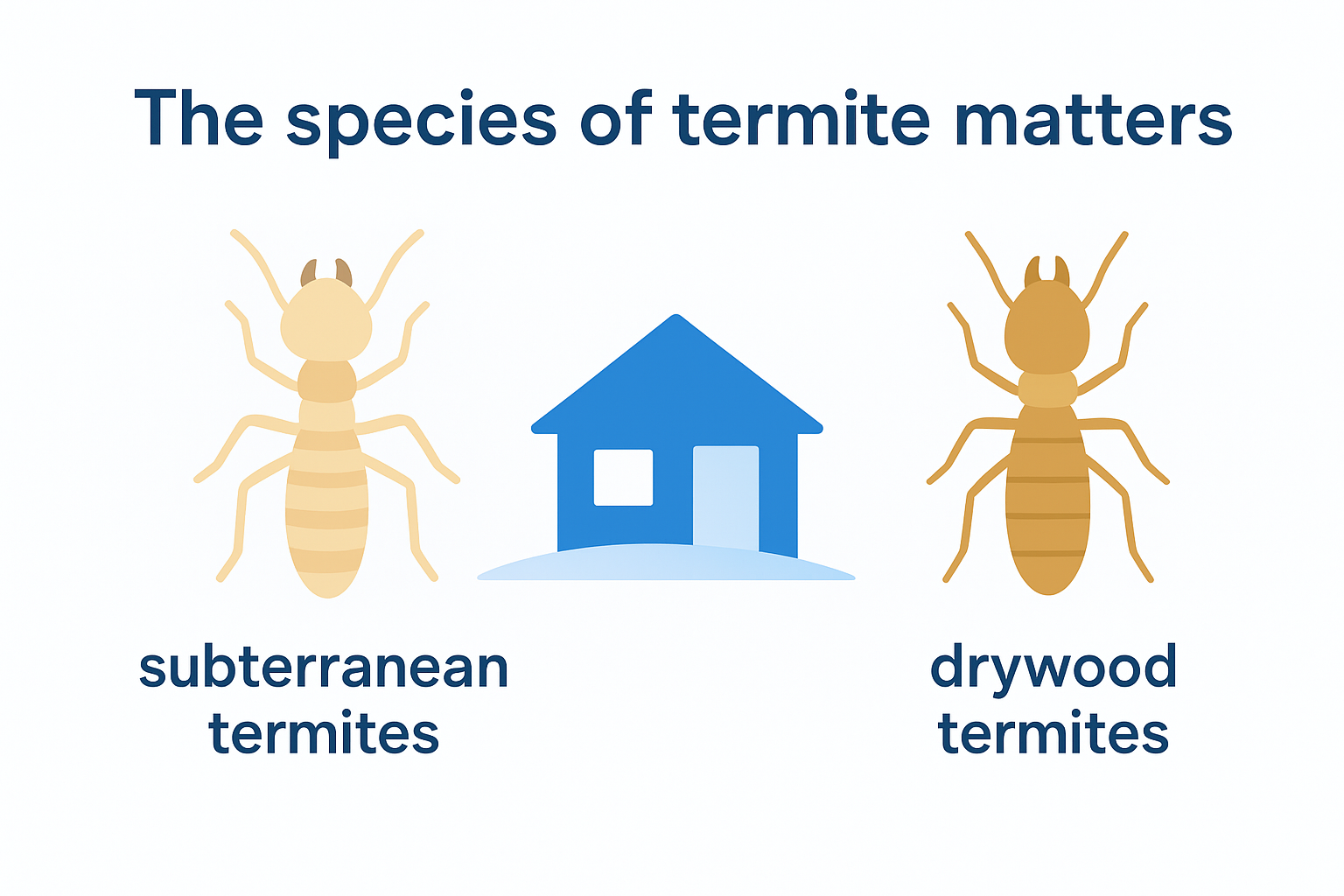
The treatment method is often the single biggest driver of your total termite control cost, and the species is what determines which method you actually need.
The size of your property and the extent of the infestation
Square footage is a primary pricing variable for almost every treatment type. Soil treatments are priced by the linear footage of your foundation. Fumigation is priced by the cubic footage of the structure being tented. Bait station programs factor in the perimeter of your lot. The larger your home or building, the more product and labor the job requires, and that shows up directly in the final number.
The severity of the infestation adds another layer to the total. A small, localized colony discovered early might be treatable with a targeted spot application. But if termites have been active in your home for years, they may have spread through multiple structural members, requiring broader treatment coverage and possibly wood repair work after the infestation is eliminated. Catching the problem early consistently leads to lower treatment costs.
Where your property is located and how accessible it is
Your geographic location affects pricing through local labor costs, licensing requirements, and regional pest pressure . In Northern California, subterranean termite activity is extremely common, which means local companies stay well-stocked with the equipment and materials to handle jobs efficiently. That said, urban areas near Sacramento tend to see different pricing than rural properties in surrounding counties, partly because of travel time and partly because of local market competition.
Accessibility of the infested areas also changes what a job costs. If the affected wood sits in a tight crawl space , behind finished walls, or in an attic with limited entry points, the technician needs more time to complete the treatment properly. Difficult access means more labor hours, and that adds to your bill in ways that don't always show up in a per-square-foot estimate .
How termite companies price treatment
Termite companies use a few standard pricing models, and knowing which one applies to your job makes it much easier to compare quotes side by side. Most companies pick their pricing structure based on the treatment method , not the type of pest, so the same infestation might be priced differently depending on which contractor you call and what approach they recommend.
Per-linear-foot and per-square-foot pricing
Soil treatments and perimeter applications are almost always priced by the linear foot, meaning the company measures the total length of your foundation and charges accordingly. Fumigation jobs, on the other hand, use cubic footage because the tent has to enclose the entire structure and hold gas at a lethal concentration throughout. Understanding which unit applies to your quote tells you whether a number is genuinely comparable to another company's bid or whether you're looking at two entirely different scopes.
If one quote uses linear footage and another uses square footage for the same job, ask both companies to clarify exactly what their number covers before you make any decisions.
Here's a quick breakdown of common pricing units by treatment type:
| Treatment Type | Typical Pricing Unit |
|---|---|
| Soil/liquid termiticide | Per linear foot of foundation |
| Tent fumigation | Per cubic foot of structure |
| Bait station installation | Per station or per perimeter foot |
| Spot/localized treatment | Flat rate per affected area |
| Wood repair (post-treatment) | Per linear or square foot of damaged wood |
Flat-rate vs. ongoing service contracts
Some companies charge a single flat fee for a one-time treatment, which covers the inspection, the application, and a short warranty period. Others offer annual service contracts that include a baseline treatment, periodic inspections, and retreatment guarantees if termites return during the coverage period. Both models are legitimate, but they serve different needs.
Your total termite control cost over time can actually be lower with a contract if your property sits in a high-activity area, since retreatment under warranty costs you nothing extra. For lower-risk properties or newer construction, a one-time treatment with a solid warranty often makes more financial sense.
Average termite control costs in 2026
Real numbers make it much easier to evaluate what you're being quoted. Termite control cost in 2026 generally falls somewhere between $300 and $3,500 for a standard residential treatment, with the wide range reflecting the differences in treatment type, property size, and infestation severity covered in the previous section. Understanding where your job sits within that range helps you spot whether a quote is reasonable before you sign anything.
Typical price ranges by treatment type
Treatment method is the fastest way to narrow down what you should expect to pay. Localized spot treatments sit at the lower end of the cost range, typically running between $300 and $900 , and work best when termite activity is caught early and confined to a small area. Liquid soil treatments for subterranean termites generally land between $500 and $2,500 , depending on the linear footage of your foundation. Full-structure fumigation, the most thorough option for severe or widespread drywood termite infestations, usually runs $1,500 to $3,500 or more for an average-sized home.
Bait station programs often carry a lower upfront cost but include annual monitoring fees, so factor in the multi-year total when comparing them to one-time treatments.
| Treatment Type | Typical Cost Range |
|---|---|
| Spot/localized treatment | $300 - $900 |
| Liquid soil treatment | $500 - $2,500 |
| Bait station installation | $800 - $2,000 |
| Tent fumigation | $1,500 - $3,500+ |
| Wood repair (post-treatment) | $500 - $3,000+ |
What Sacramento-area homeowners typically pay
Northern California properties face high subterranean termite pressure , which means liquid soil treatment s are the most common service type in the Greater Sacramento region. For an average single-family home with a perimeter between 150 and 200 linear feet, you can expect to pay roughly $900 to $1,800 for a soil treatment, including the warranty.
Fumigation costs in this region tend to run on the higher end of national averages due to licensing requirements and the specialized equipment needed to tent a structure properly. If a Sacramento-area company quotes you significantly below the ranges above, ask specifically what the warranty covers and whether a follow-up inspection is included.
Pre-construction vs post-construction termite costs
The stage at which termite treatment happens - during construction or after a building is already standing - creates one of the biggest cost differences in the industry. Pre-construction treatments are applied before concrete is poured or framing is enclosed, giving technicians open, unobstructed access to the soil and wood. Post-construction treatments work around finished walls, flooring, and landscaping, which adds both time and complexity to the job.
Pre-construction treatment: what you pay and why it's cheaper
Pre-construction soil treatment is applied directly to the bare soil beneath and around a foundation before the slab is poured. Because there are no obstacles, the application goes quickly, and the product bonds with the soil before any structure sits on top of it. This makes it one of the most cost-effective forms of termite prevention available.
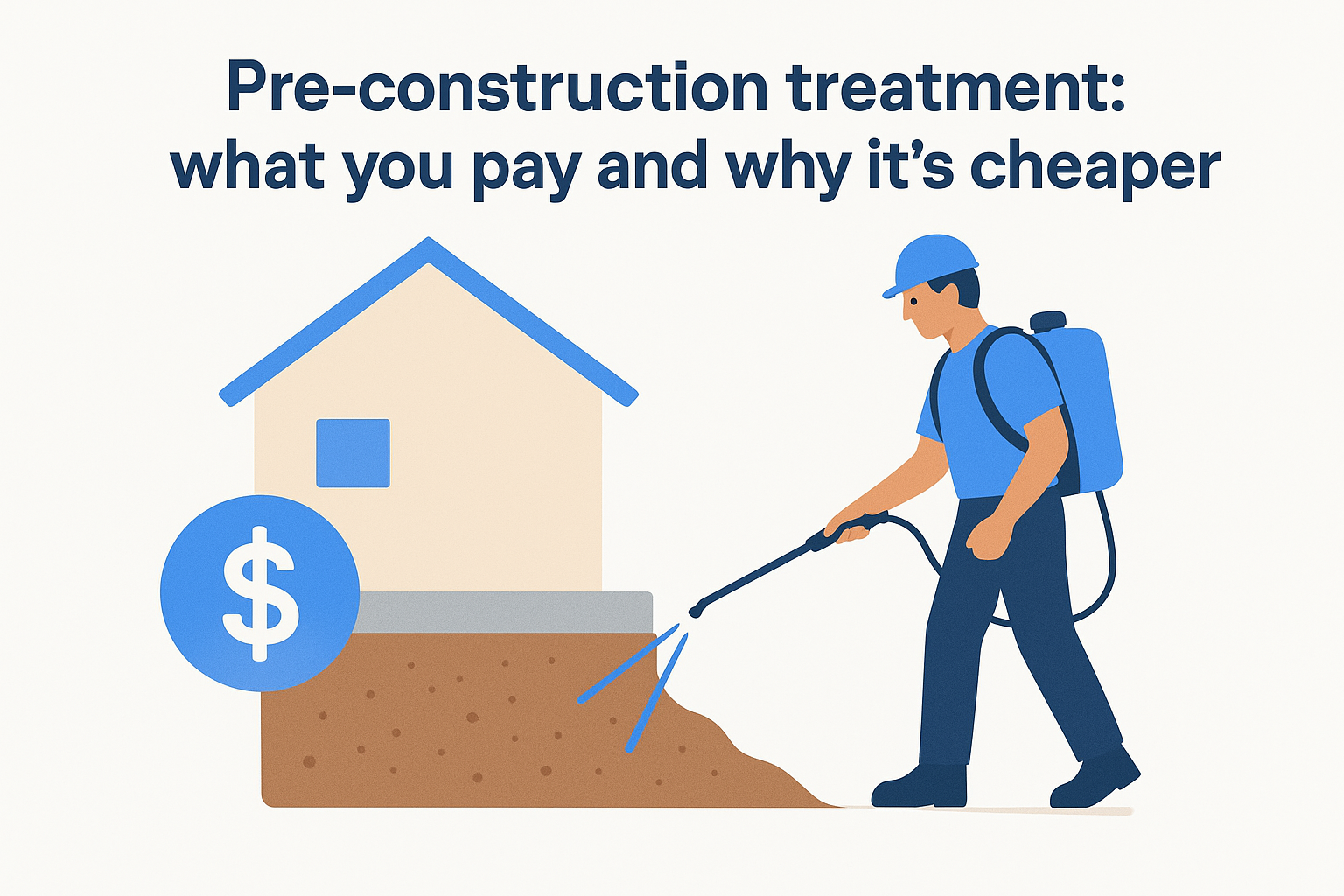
Pre-construction treatment is typically a one-time, low-cost application that provides lasting protection - often priced between $0.10 and $0.25 per square foot of the foundation area, making it one of the best investments a builder or new homeowner can make.
Builders commonly include this treatment in the overall construction budget, so buyers of new construction homes may not see it listed as a separate line item. If you're building a home and your contractor hasn't mentioned pre-construction termite treatment, ask specifically whether it's included in the scope.
Post-construction treatment: higher costs, more variables
Post-construction termite control cost is almost always higher than pre-construction work, and the gap can be significant. Treating an existing structure requires drilling through concrete, accessing crawl spaces, and working around finished surfaces and landscaping that weren't there during the build. That added labor pushes prices up considerably.
The total cost for post-construction treatment also depends on whether active termites are present or whether the treatment is purely preventative. Preventative treatments on an established home typically run between $500 and $1,500. If you're treating an active infestation with structural damage involved, the final bill including wood repair can run well past $3,000. Scheduling a professional inspection before choosing a treatment method ensures you're not paying for more than your situation actually requires.
How to compare quotes and pick the right service
Getting multiple quotes is the right move, but only if you know what to look for inside each one. Termite control cost comparisons fall apart when homeowners focus on the bottom-line number without checking what that number actually includes. A cheaper quote might exclude retreatment guarantees, follow-up inspections, or wood damage assessment - all of which add real cost if you need them later.
Check what the warranty actually covers
The warranty is often the most important variable separating quotes that look similar on paper. A strong warranty should specify the length of coverage, the termite species it applies to, and what triggers a free retreatment. Some companies offer one-year warranties as standard, while others provide multi-year coverage that includes annual inspections at no additional charge. Read the language carefully, not just the headline number on the quote sheet.
Ask each company specifically whether the warranty transfers if you sell your home. A transferable termite warranty adds real value during a property sale, and it's a detail many homeowners overlook until they're already in escrow and a buyer is asking for documentation.
Look at the company's credentials and track record
Before you sign anything, verify that the company holds a current pest control license in California. The California Department of Pesticide Regulation maintains a public license lookup tool for registered pest control businesses operating in the state. Local tenure also matters: a company that has operated in the Sacramento area for years understands how local termite populations behave and which treatment methods hold up over time.
A low quote from an unlicensed or inexperienced contractor can cost you far more than the price difference if the treatment fails and you're left without any warranty coverage.
Compare the scope, not just the price
Request that each contractor put the full treatment scope in writing, including the product used, the coverage area, and any follow-up visits included. When you compare two quotes at the same price point, the one with a broader scope, a stronger warranty, and a clearly documented treatment method is almost always the stronger value. Price is one input in the decision, not the only one.
What to do next
Now that you have a clear picture of termite control cost and the factors that shape it, the next step is getting an accurate assessment of your specific property. No pricing guide replaces a hands-on inspection, because the real numbers for your home depend on your foundation size, the species present, and how far any infestation has spread. Skipping the inspection and guessing at treatment costs almost always leads to either overpaying for a method you don't need or underpaying for one that won't solve the problem.
At Defender Termite & Pest Management, we've been protecting homes across the Greater Sacramento area since 1999. Our team handles everything from initial inspections and soil treatments to structural wood repair after an infestation is cleared. You get one company managing the full job, with no need to coordinate between a pest contractor and a separate repair crew. Request a termite inspection and quote and get a real number based on your actual situation.