Rodent Control Service: How to Hire One and What to Expect
The right rodent control service inspects your whole property, removes the rats or mice, seals every entry point, and cleans up the damage, all under a written warranty. To hire one, confirm what you are dealing with, vet a few licensed local companies, compare quotes line by line, and prepare the house before the first visit. Skipping the sealing step is the most common reason rodents come back.
The hard part is that quotes rarely look alike. One company offers three trap visits, another sells an exclusion package, and a third pushes bait stations. Meanwhile you hear scratching in the attic at night and want it solved. Trapping alone rarely ends an infestation, because mice fit through a gap about a quarter inch wide and rats need roughly half an inch.
This guide walks you through four steps, from confirming the problem to keeping rodents out afterward. Defender Termite & Pest Management has served Sacramento since 1999 as a family-owned company, and we handle rodent jobs in homes and businesses across the area. You will learn what the service includes, what drives the price, and how to check a rat exclusion service near you before you sign.
What a rodent control service includes
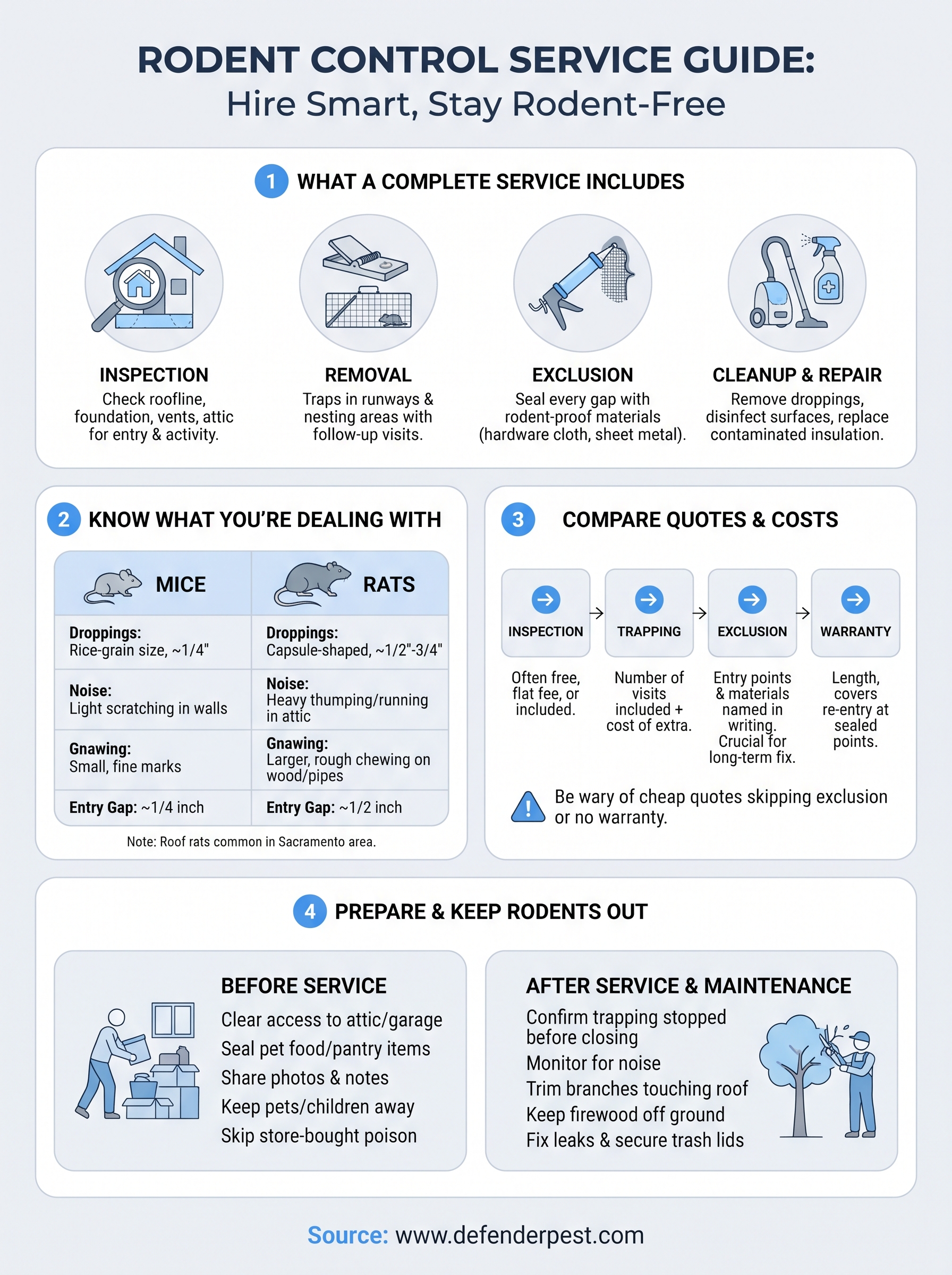
A complete rodent control service has four parts: inspection, removal, exclusion, and cleanup or repair. A company that offers only one of them treats the symptom and leaves the cause in place.
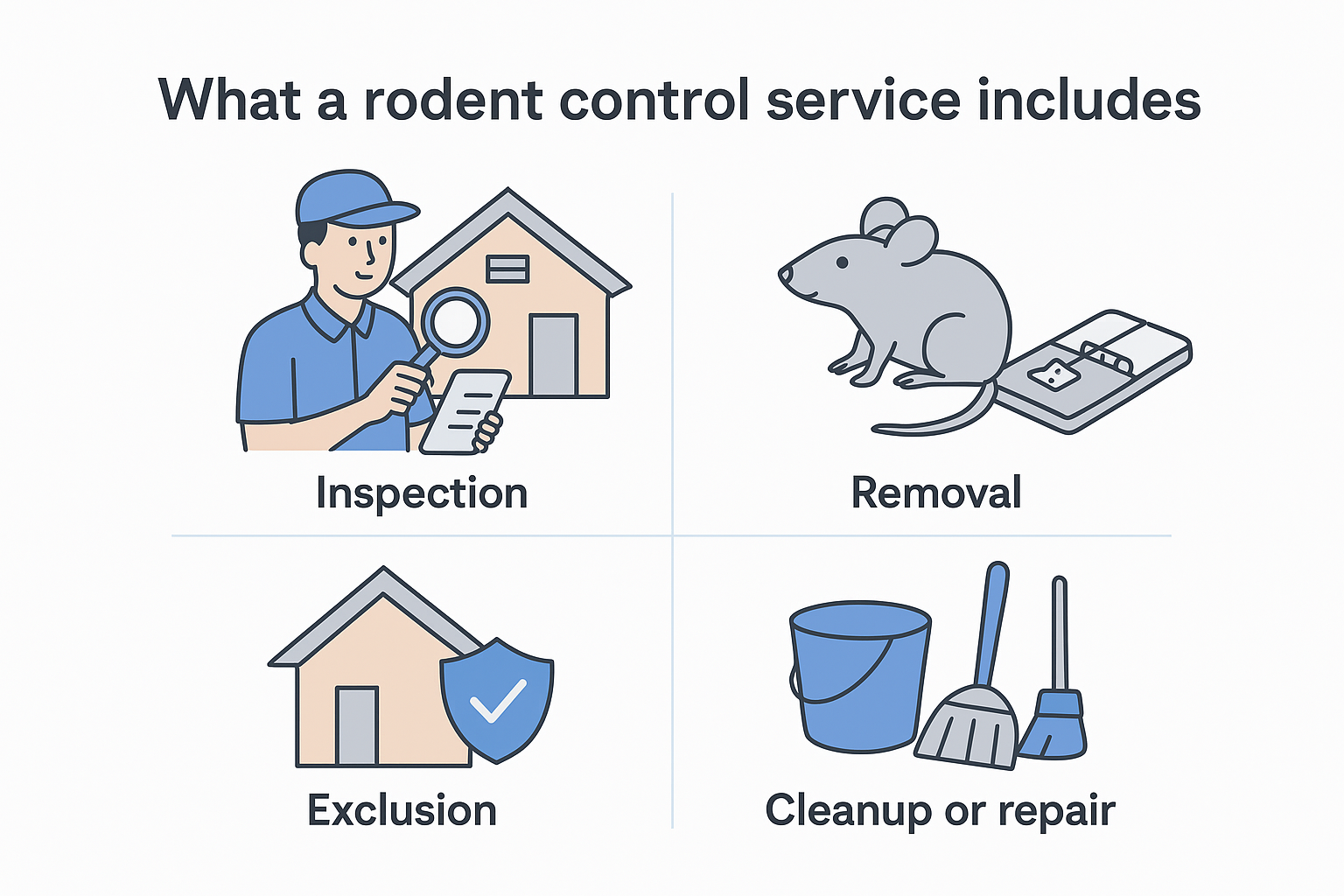
The four parts of a complete job
Each part has a different job, and a good quote names all four.
- Inspection: The technician checks the roofline, foundation, vents, utility penetrations, garage door seals, and attic for entry points and activity.
- Removal: Traps go along runways and nesting areas, with follow-up visits to check and reset them.
- Exclusion: Every gap is sealed with materials rodents cannot chew through, such as hardware cloth, sheet metal, copper mesh, or concrete. Foam and caulk alone get gnawed open.
- Cleanup and repair: Droppings are removed, surfaces are disinfected, and contaminated attic insulation is replaced.
Our own rodent control covers all four for mice and rats, including insulation removal, disinfection and reinstallation, and it carries a 100% satisfaction guarantee.
Removal ends today's rodents, and exclusion decides whether tomorrow's arrive.
Is hiring a professional worth it?
For one mouse in a kitchen, a few snap traps from a hardware store are often enough. Hire a professional when you hear noises in walls or the attic, find droppings in more than one room, see a rat, or the problem returns after you trapped.
Rats usually get in at roof edges, eaves, and vents, so the work involves ladders and heights. Professionals also know the rules around poison. California restricts some anticoagulant rodenticides to protect wildlife, so ask any provider what they use.
Step 1. Confirm what you are dealing with
Identify whether you have mice or rats before you call, because the entry points, traps, and cost differ. A few minutes of looking gives you better answers on the phone.
Read the signs
Check droppings, noise, and gnaw marks, then compare them with this table.
| Sign | Mice | Rats |
|---|---|---|
| Droppings | Rice-grain size, about 1/4 inch, scattered | Capsule-shaped, about 1/2 to 3/4 inch, often in clusters |
| Noise | Light scratching inside walls | Heavier thumping or running in the attic, mostly at night |
| Gnawing | Small, fine marks | Larger, rough chewing on wood, wiring, and pipes |
| Entry gap | About 1/4 inch | About 1/2 inch |
In the Sacramento area, roof rats are common. They travel along fences, power lines, and tree branches and settle in attics, so overhead noise at night is a strong clue.
Document before you act
Take photos of droppings, gnaw marks, and any greasy rub marks along walls. Note where and when you hear noise. Do not seal holes yourself yet, since that can trap animals inside and send them chewing into living space.
Wear gloves and a mask near droppings, and wet them down with disinfectant before wiping. Never sweep or vacuum dry droppings, because that puts dust in the air.
Photos and notes turn a vague phone call into an accurate quote.
Step 2. Vet local providers
Shortlist two or three licensed companies near you, then test each one with specific questions. Proximity matters because trapping and exclusion need return visits, and a company across the region is slower to come back.
Check license, insurance, and local roots
California licenses structural pest control companies through the Structural Pest Control Board, and its website lets you look up a license before you hire. Ask for proof of liability insurance too, since the work happens on your roof and in your attic. Defender is licensed and insured, and any provider you consider should show the same without hesitation.
Look for a real local address and direct phone line rather than a call center. Read recent reviews for rodent jobs specifically, not general spraying, and see whether the company returned when rodents came back.
Ask these questions on the call
- Do you inspect the full exterior, roofline, and attic before quoting?
- How many entry points do you expect to seal, and which materials do you use?
- Do you rely on traps, or on poison?
- How many follow-up visits are included?
- What does the warranty cover, and for how long?
- Can you handle cleanup and insulation, or do I need another company?
Be wary of a firm exclusion price by phone with no inspection, a poison-only plan , or no written warranty.
A provider who will not describe the exclusion work in writing is selling visits, not a fix.
Step 3. Compare quotes and costs
Rodent control prices vary with the size and height of your home, the number of entry points, the trapping visits needed, and the cleanup involved. Because those factors are unknown until someone inspects, trustworthy companies quote after an inspection . You can request one online or by phone.

Compare the same line items
Ask each company to break the quote into these items so you can compare them fairly.
| Line item | What to look for |
|---|---|
| Inspection | Free, flat fee, or folded into the job |
| Trapping | Visits included, and the cost of extra visits |
| Exclusion | Entry points and materials named in writing |
| Cleanup | Droppings removal and disinfection, priced separately from insulation work |
| Warranty | Length, and whether it covers re-entry at sealed points |
Here is a worked example. Quote A is a flat fee for three trap visits. Quote B covers inspection, trapping, and sealing a written list of 12 entry points with a one-year warranty. Quote A costs less today, but if even one of those gaps stays open, you pay again. Compare Quote B against other full-service quotes.
Does home insurance cover it?
Usually not. Standard homeowners policies commonly treat rodent damage as a maintenance issue and exclude it, so read your policy or ask your agent before assuming coverage. That makes the warranty and the quality of exclusion more important, because you will likely pay for any repeat damage yourself.
The cheapest quote is rarely the cheapest outcome if the entry points stay open.
Step 4. Prepare for service and keep rodents out
Preparation speeds up the job, and what you do afterward decides whether the fix lasts. Both take little effort.
Before the technician arrives
Make the inspection quick and complete.
- Clear access to the attic hatch, garage, and areas under sinks.
- Put pet food and pantry items in sealed containers .
- Keep pets and children away from trap areas.
- Share your notes and photos from Step 1.
- Skip store-bought poison, since it can send rodents to die inside walls and complicates the technician's work.
After exclusion, follow up and maintain
Schedule the follow-up visit and confirm trapping has stopped catching before you consider the job closed. Listen for noise at night for a couple of weeks, and report it right away so the warranty can apply.
Then remove what drew rodents in. Trim branches that touch the roof, keep firewood off the ground and away from walls, fix leaking pipes and outdoor faucets, and keep trash lids tight. If contaminated insulation was found, replacing it removes the odor and the contamination that attract new rodents.
Good exclusion plus a clean, dry exterior leaves rodents nothing to come back to.
Hire for the fix, not the visit
A good rodent control service inspects, removes, seals, and cleans up, and it puts the scope and warranty in writing. Confirm whether you have mice or rats, verify the license, compare quotes by line item, and prepare your home. That sequence is what separates a one-time fix from a repeating problem.
If you have signs of rodents in the Sacramento area, request a quote from Defender Termite & Pest Management or call our pest control line at (916) 389-2847. We offer 24/7 emergency service for urgent situations, and we will inspect first so you know exactly what the job involves.