Diatomaceous Earth Rodent Control: Does It Really Work?
You've probably seen the advice online: sprinkle some diatomaceous earth around your baseboards and watch the mice disappear. It sounds cheap, natural, and easy, which is exactly why so many Sacramento homeowners try it before calling a professional. But diatomaceous earth rodent control doesn't work the way most articles claim, and using it wrong can leave you with a bigger infestation and a mess of white powder for nothing.
Here's the direct answer: diatomaceous earth can injure rodents through abrasive contact with their skin and respiratory tract, but it is slow, inconsistent, and nowhere near as reliable as trapping or professional baiting. Mice and rats are smart enough to avoid heavy powder deposits, and food-grade DE loses effectiveness fast in the humid, damp spots where rodents love to nest.
In this article, we break down what diatomaceous earth actually does to mice and rats, where it might help as a supplemental tool , and why our technicians at Defender Termite and Pest Management rarely recommend it as a standalone fix. You'll get straight talk from a company that's handled rodent problems across the Sacramento area since 1999, not marketing fluff.
Why homeowners consider diatomaceous earth for rodents
The appeal of a cheap, natural fix
Homeowners search for diatomaceous earth for mice because it promises a chemical-free way to deal with an infestation without hiring anyone or setting a single spring trap. Food-grade DE is cheap, sold at almost every hardware store in Sacramento, and marketed as safe to use around kids and pets. For a family already stressed about droppings in the pantry, the idea of sprinkling a natural powder instead of laying down poison bait feels like a low-risk first move. Compare that to the effort of sealing entry points or calling a technician, and it's easy to see why DE becomes the default starting point.
How the powder is actually supposed to work
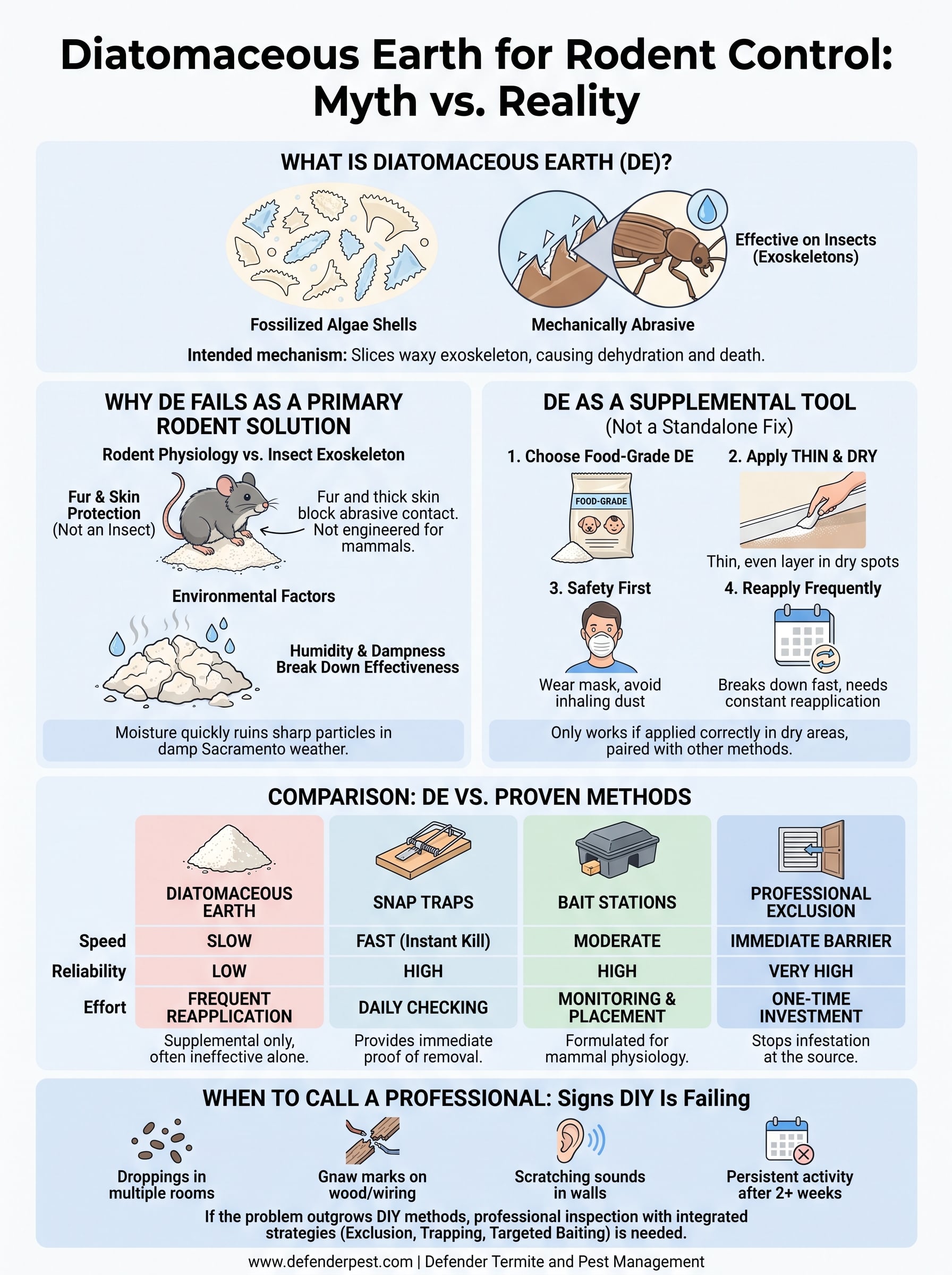
Diatomaceous earth is made from fossilized algae with microscopically sharp edges. On insects, those edges slice through the waxy exoskeleton, and the powder absorbs lipids from the insect's body until it dehydrates and dies. That mechanism works reasonably well on cockroaches, ants, and bed bugs, which is why pest control companies do use DE for certain insect infestations .
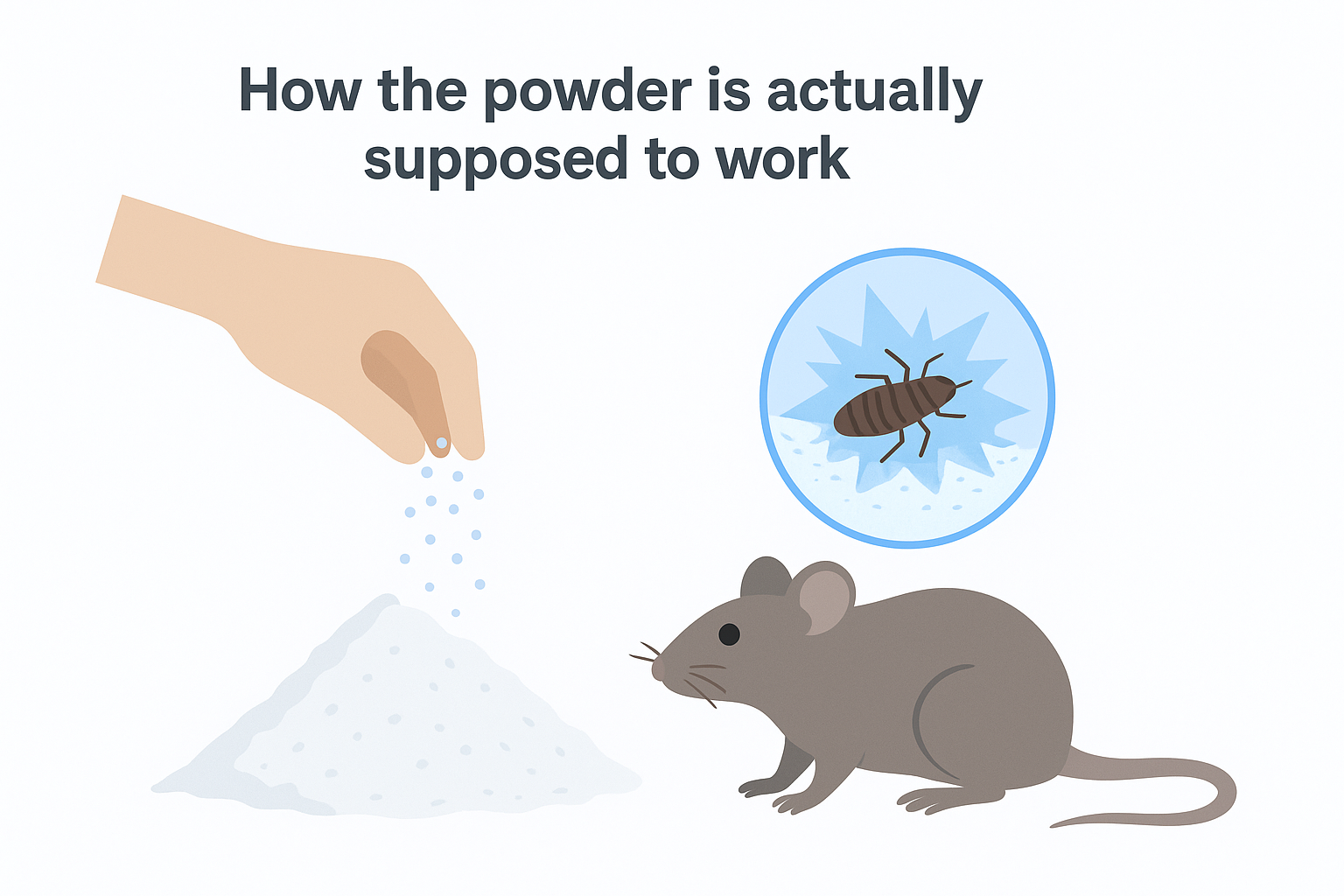
Diatomaceous earth was engineered to injure creatures with exoskeletons, not mammals covered in fur and thick skin.
Mice and rats aren't insects. Their fur and paw pads offer real protection that a cockroach's shell doesn't provide against the same abrasive powder.
What draws people to try it anyway
A few specific reasons keep coming up when Sacramento homeowners explain why they reached for DE before anything else:
- No chemical odor or residue left on countertops and floors
- Pet safety concerns after hearing rodenticide can harm dogs and cats
- Prior success using it on ants or spiders elsewhere in the house
- Low cost compared to an exterminator visit or bulk trap purchase
- Availability at nearly any local hardware or garden store
Those reasons are understandable, but they don't answer whether DE actually solves a rodent problem, which is where the real evidence gets more complicated.
How to use diatomaceous earth for rodent control
Choosing the right product and location
Food-grade diatomaceous earth is the only type safe enough to use inside a home with pets or kids around, so skip the pool-grade version sold for filters. Apply a thin, dry layer along baseboards, behind appliances, and near suspected entry points rather than piling it on thick. Rodents avoid walking through deep powder, which defeats the purpose before it even gets a chance to work.
A basic application routine
Most pest professionals who still use DE as a supplemental measure follow a similar pattern:
- Vacuum the area first to remove existing dust and debris
- Dust a light, even layer using a bulb duster or old flour sifter
- Focus on dry, low-traffic zones like wall voids and crawl space edges
- Reapply every few days since humidity and airflow break down the powder fast
- Pair it with sealed entry points, not as a substitute for exclusion work
Diatomaceous earth only has a chance of working when it's applied thin, dry, and directly in a rodent's travel path.
Rodents will simply reroute around a visible pile, so placement matters more than quantity.
Safety precautions worth knowing
Breathing in DE dust irritates human lungs just as it does a rodent's respiratory system, so wear a mask during application and keep children away until the dust settles. Keeping powder dry is also critical, since moisture ruins its effectiveness , turning sharp particles into clumped, harmless dust within days in Sacramento's damp winter months.
Diatomaceous earth vs. other rodent control methods
Comparing DE against snap traps, bait stations, and professional exclusion work makes the gap obvious. Snap traps kill on contact and let you confirm results immediately, while DE might take days to cause any harm, if it works at all. Bait stations use rodenticides formulated specifically for mammal physiology, targeting a rat's clotting factors or nervous system rather than relying on skin abrasion that fur already blocks. Exclusion work, sealing gaps and vents, stops the problem at the source instead of hoping a mouse walks through powder on its way to your pantry.
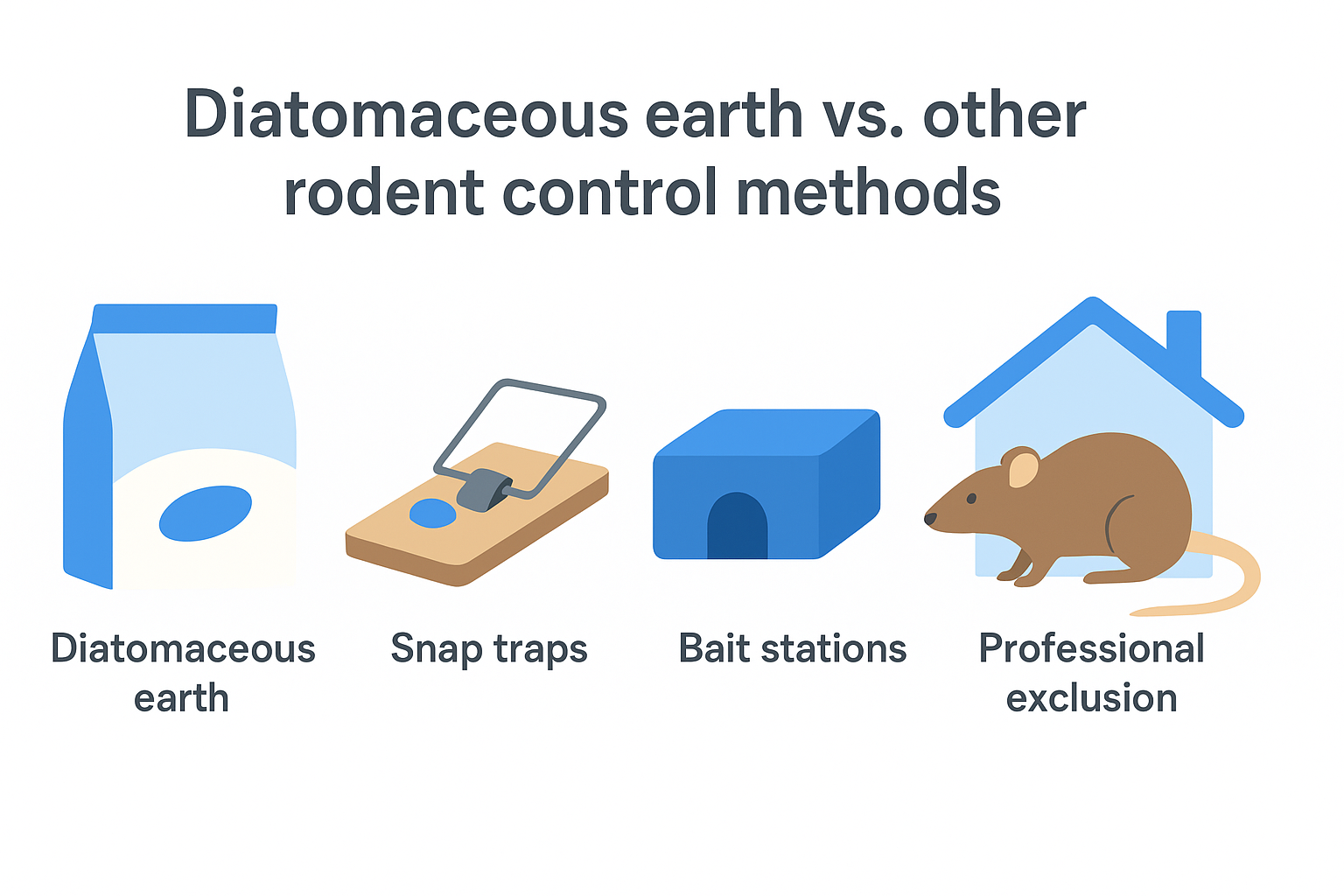
A snap trap gives you proof of a dead rodent; diatomaceous earth mostly gives you proof you tried something.
Sacramento's climate adds another wrinkle. Humidity from winter rains and irrigation-heavy yards breaks DE down within days, according to pest management research cited by the EPA's guidance on rodent control, which favors integrated approaches over single powders. Trapping and sealing don't degrade in wet weather the way DE does.
| Method | Speed | Reliability | Effort |
|---|---|---|---|
| Diatomaceous earth | Slow | Low | Frequent reapplication |
| Snap traps | Fast | High | Daily checking |
| Bait stations | Moderate | High | Placement and monitoring |
| Professional exclusion | Immediate barrier | Very high | One-time labor investment |
Defender's technicians combine trapping, exclusion, and targeted baiting because rodent control effectiveness depends on removing access, not just discomfort. DE rarely earns a spot as anything beyond a minor supplement in that mix.
When to call a professional for rodent control
Signs the problem has outgrown DIY methods
Repeated sightings after weeks of trying diatomaceous earth or store-bought traps usually mean the infestation size has outpaced what a single homeowner can manage alone. Gnaw marks on wiring, droppings scattered across multiple rooms, and scratching sounds inside walls at night all point to an established colony rather than a stray mouse that wandered in once. Rats especially breed fast, and a rodent control approach that worked on three mice rarely scales to a nest of twenty.
What a professional visit actually solves
Watching for these signs helps you decide when it's time to stop experimenting:
- Droppings found in more than one room of the house
- Gnaw damage on wood, wiring, or stored food packaging
- Scratching or scurrying sounds inside walls or the attic
- A strong ammonia odor near suspected nesting areas
- No drop in activity after two weeks of trapping or DE use
If you're still seeing droppings after two weeks of DIY effort, the infestation is bigger than the tools you're using.
Defender's technicians start with a full property inspection , identifying entry points, nesting locations, and the species involved before choosing a mix of exclusion, trapping, and targeted baiting. That combination handles active rodents and stops new ones from moving in, something a bag of powder was never built to do.
Weighing your rodent control options
Diatomaceous earth isn't a scam, but it's not a solution either. It's a mild, slow-acting tool that works best as backup support, not the main plan for diatomaceous earth rodent control . If you're dealing with a mouse or two and want to try it alongside sealed entry points and traps, go ahead. Just don't expect powder alone to clear an active infestation, especially once Sacramento's humid months roll in and break down its effectiveness within days.
Once droppings spread across multiple rooms or you hear scratching in the walls, DIY methods stop being worth the wasted time. Real rodent control means combining exclusion, trapping, and targeted baiting, the same approach our technicians have used across Sacramento since 1999. If you're past the powder-and-hope stage, get a free inspection from Defender Termite and Pest Management and let someone who does this daily handle it right.