What Do Bed Bugs Look Like? Pictures, Size, And Early Signs
You found a small bug on your mattress or woke up with a line of itchy red welts, and now you're asking yourself, what do bed bugs look like ? That question matters more than most people realize. Misidentifying the pest (or missing it entirely) means the infestation keeps growing, and bed bugs reproduce fast , a single female can lay hundreds of eggs in her lifetime.
This guide breaks down the physical characteristics of bed bugs at every life stage, from translucent nymphs smaller than a sesame seed to fully grown, rust-colored adults. You'll see what to look for on your sheets, furniture, and baseboards , along with the early warning signs that separate a bed bug problem from other common household pests. We also cover lookalike insects that are frequently confused with bed bugs so you can tell the difference quickly.
At Defender Termite & Pest Management, we've been helping Sacramento-area homeowners and businesses identify and eliminate pest infestations since 1999 . Bed bug calls are some of the most urgent we receive, and the outcome almost always depends on how early the problem is caught. If anything in this article looks familiar, our team offers 24/7 emergency pest services and can inspect your property the same day.
Quick bed bug ID checklist
Before diving into life stages and lookalikes, it helps to have a fast-reference description you can check against what you're seeing right now. Bed bugs are parasitic insects that feed exclusively on blood , and their bodies change depending on when they last fed. That said, most adults share a consistent set of physical traits that make them identifiable once you know what to look for.
Size and shape
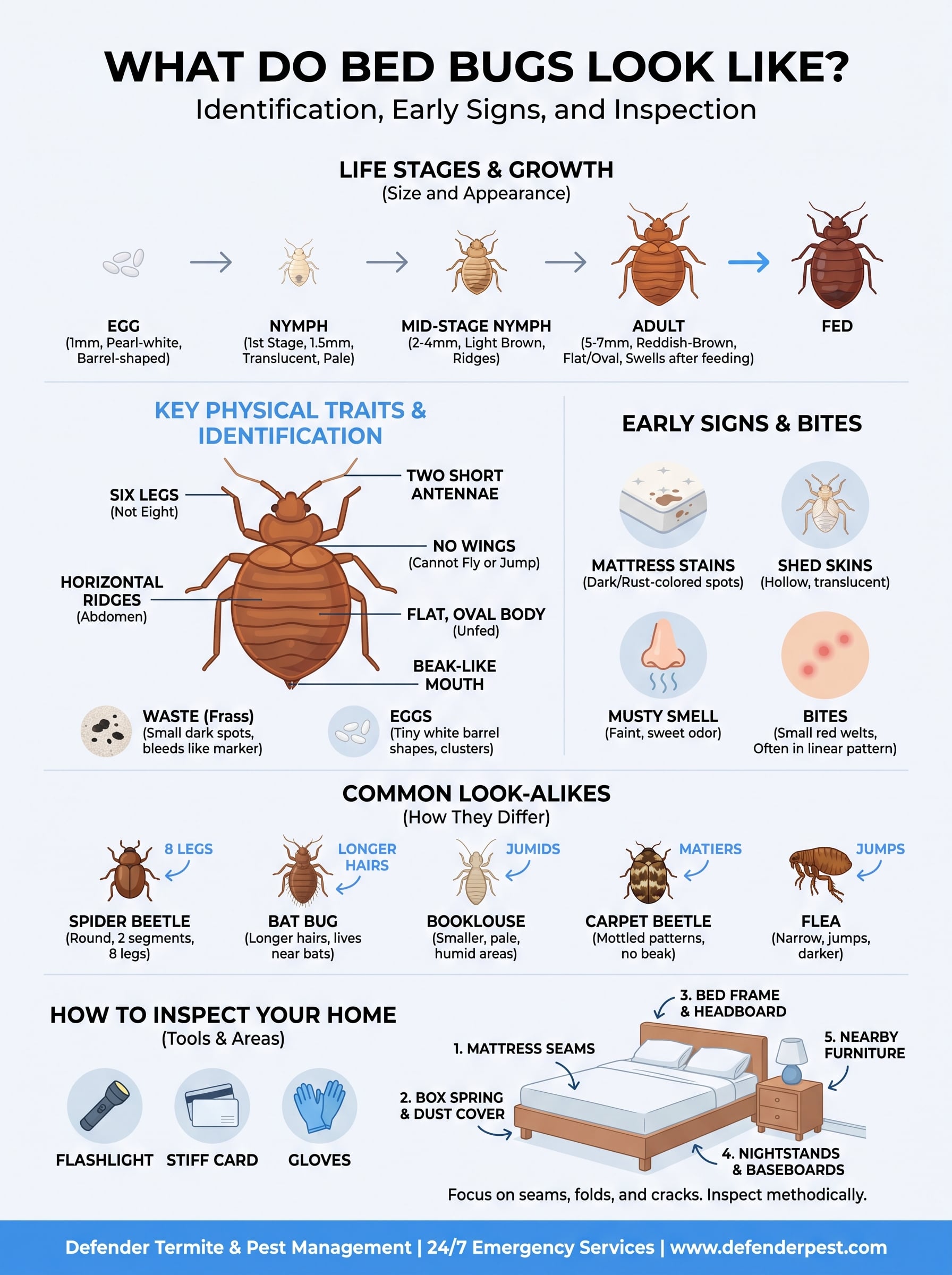
Adult bed bugs are roughly the size of an apple seed , measuring about 5 to 7 millimeters in length. That's small enough to hide inside a mattress seam or behind a picture frame, but large enough to spot with the naked eye if you're looking in the right places. Their body shape is flat and oval when they haven't fed recently , which lets them squeeze into incredibly thin gaps like cracks in a bed frame or folds in a box spring.
After feeding, their shape changes noticeably. A bed bug that has recently fed swells into a more elongated, balloon-like form and turns a deeper red or dark brown. If you crush one and see a dark red smear, that's blood it consumed from a host, usually you.
Color
Unfed adult bed bugs are reddish-brown with a translucent quality around the edges of their abdomen. Nymphs (juvenile bed bugs) start out nearly colorless or pale yellow and become more visible after their first blood meal. Color is one of the fastest ways to distinguish a bed bug from common lookalike insects, which we cover later in this guide.
A pale, nearly invisible nymph is often the first stage of an infestation, and it's the stage most people miss entirely.
Key physical traits to check
Knowing what do bed bugs look like comes down to a handful of specific features. Use this list to compare what you've found:
- Six legs , not eight (spiders and mites have eight)
- Two short antennae extending from the head
- Horizontal ridges across the abdomen, visible under a magnifying glass
- No wings (bed bugs cannot fly or jump)
- A small, flat head with a narrow, beak-like mouthpart used for piercing skin
- Rust-colored or dark streaks on the body if recently fed
None of these traits alone confirms an identification, but seeing three or more together puts you in strong bed bug territory.
What bed bug waste and eggs look like
Finding an actual bug is only one way to confirm an infestation. Bed bug waste , also called frass, shows up as small dark spots about the size of a period at the end of a sentence. These spots bleed into fabric like a marker would, and you'll typically find clusters of them along mattress seams, on box spring fabric, or on nearby walls and baseboards.
Eggs are another major sign. Bed bug eggs are tiny, about 1 millimeter long , pearl-white, and barrel-shaped. They're usually laid in batches and glued to surfaces inside cracks, behind headboards, or inside furniture joints. A female can lay one to five eggs per day, so a small cluster of eggs can become a serious infestation within weeks if left untreated.
Where to look first
Even with a solid description in hand, bed bugs are good at staying hidden. Focus your initial inspection on the mattress seams, the box spring, and the area directly around your bed frame . Pull back the sheets and use a flashlight. Check behind the headboard and any nightstands within arm's reach of the bed. Bed bugs rarely travel far from their food source, which is you while you sleep.
What bed bugs look like at each stage
Bed bugs go through six life stages : one egg stage and five nymph stages before reaching adulthood. Understanding what do bed bugs look like at each stage is critical because the early stages are nearly invisible without a flashlight and a sharp eye. Most infestations go undetected for weeks or months because people only recognize the adult form and miss the younger stages entirely.
Eggs and first-stage nymphs
Bed bug eggs are pearl-white and about 1 millimeter long , roughly the size of a pinhead. They have a slightly barrel shape and a pale sheen that makes them look almost like tiny grains of uncooked rice. Female bed bugs glue them to rough surfaces inside cracks, along mattress seams, and in furniture joints, which makes them difficult to dislodge and easy to overlook.
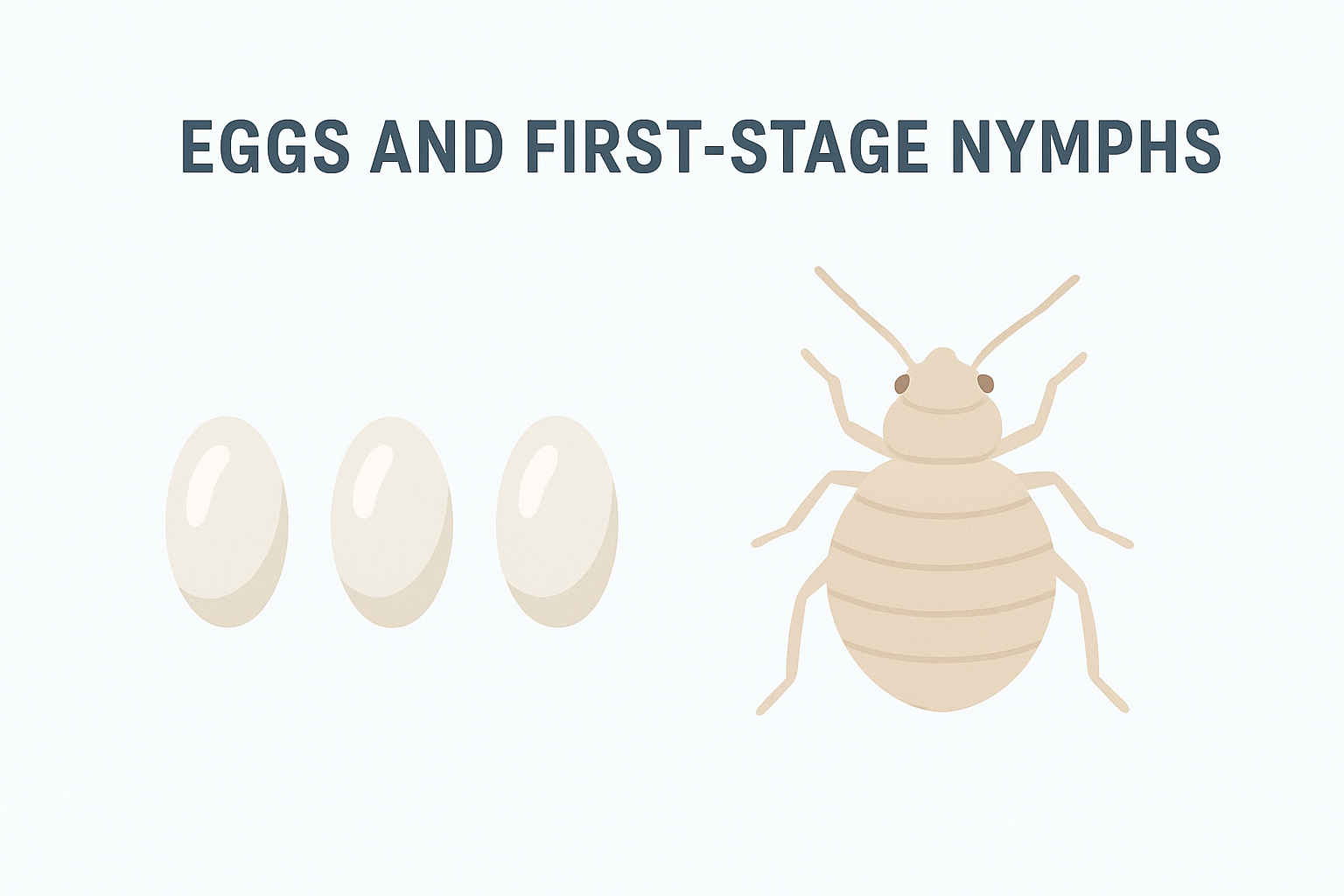
First-stage nymphs that hatch from these eggs are translucent and nearly colorless until they take their first blood meal. After feeding, they turn a brighter yellow or light red. Their small size, roughly 1.5 millimeters, means they can hide inside the stitching of a mattress seam without any visible bulge.
If you spot tiny white specks clustered near a seam or crack, treat them as bed bug eggs until a professional confirms otherwise.
Mid-stage nymphs (instars 2 through 4)
As nymphs progress through their second, third, and fourth molts, they grow steadily from about 2 to 4 millimeters. Their coloring shifts from pale yellow to a light brown as their exoskeleton hardens after each molt. You'll also notice the horizontal ridges across the abdomen becoming more defined, which is one of the clearest visual markers at this stage.
Mid-stage nymphs still require a blood meal to advance to the next stage. This feeding dependency is why infestations tend to stay close to sleeping areas.
Fifth-stage nymphs and adults
Fifth-stage nymphs measure around 4.5 millimeters and are nearly indistinguishable from adults in shape and color. Both display a reddish-brown tone with a flat, oval body when unfed. The main difference is size. Adults reach 5 to 7 millimeters and show slightly more defined wing pads (though bed bugs never develop functional wings). An adult that has recently fed looks swollen and darker, almost mahogany in color.
Early signs of bed bugs in your home
Most people find out they have bed bugs not by spotting an actual insect , but by noticing something else first. The signs they leave behind are often easier to find than the bugs themselves, especially in the early stages of an infestation when populations are still small. Knowing what to look for gives you a real advantage in catching this problem before it spreads through multiple rooms.
Stains and spots on your bedding
The most common early sign is small dark or rust-colored stains on your mattress, sheets, or pillowcase . These come from two sources: crushed bed bugs that got caught between your body and the mattress while you slept, and fecal deposits the bugs leave after feeding. Fecal spots are about the size of a pencil dot and bleed into fabric rather than sitting on top of it, similar to how a felt-tip marker bleeds into cloth. You'll typically find them clustered along seams, in corners of fitted sheets, and on the mattress surface near the edges.
If you see dark spots that smear when you drag a damp cloth across them, that's a strong indicator of bed bug activity rather than ordinary dirt.
Shed skins and a musty smell
As bed bugs progress through their five nymph stages, they shed their exoskeleton each time they molt . These shed skins are hollow, translucent, and roughly shaped like the bug itself, which gives you a useful clue about what do bed bugs look like at different life stages. Finding multiple shed skins in the same area tells you the infestation has been active long enough for bugs to mature, which means you likely have a larger population than you can see .
A less obvious sign is odor. Bed bugs release pheromones that produce a faint, sweet, musty smell , sometimes described as similar to coriander or damp towels. You won't notice this scent in a minor infestation, but in a heavily infested room, the smell becomes distinct enough that many pest professionals use it as a diagnostic indicator. If your bedroom has an unusual odor you can't trace to another source, combined with any of the visual signs above, treat it as a reason to inspect thoroughly rather than something to dismiss .
Bed bug bites and common look-alikes
Bed bug bites are one of the most unreliable ways to confirm an infestation on their own. Not everyone reacts to bed bug bites , and those who do can take anywhere from a few hours to several days to show any visible response. By the time marks appear on your skin , the population inside your mattress may already be large enough to have spread to other furniture.
What bed bug bites look like
Bites typically appear as small, red, raised welts that itch intensely and can persist for several days. They usually show up in a linear or clustered pattern on skin that was exposed while you slept, including your arms, neck, shoulders, and legs. That grouped arrangement is a meaningful clue, since random scattered bites point more toward mosquitoes or fleas. Some people develop a flat, blotchy rash instead of raised bumps, and a small percentage show no skin reaction at all. Because of that variability, bites alone should never serve as your only evidence of a bed bug problem.
If your bites appear in a straight line of three or four marks, that's a pattern pest professionals call "breakfast, lunch, and dinner," and it's strongly associated with bed bug feeding behavior.
Insects commonly mistaken for bed bugs
Understanding what do bed bugs look like is easier when you compare them directly to the insects people most often misidentify them as. Shape, leg count, and movement are the fastest ways to separate bed bugs from common lookalikes.
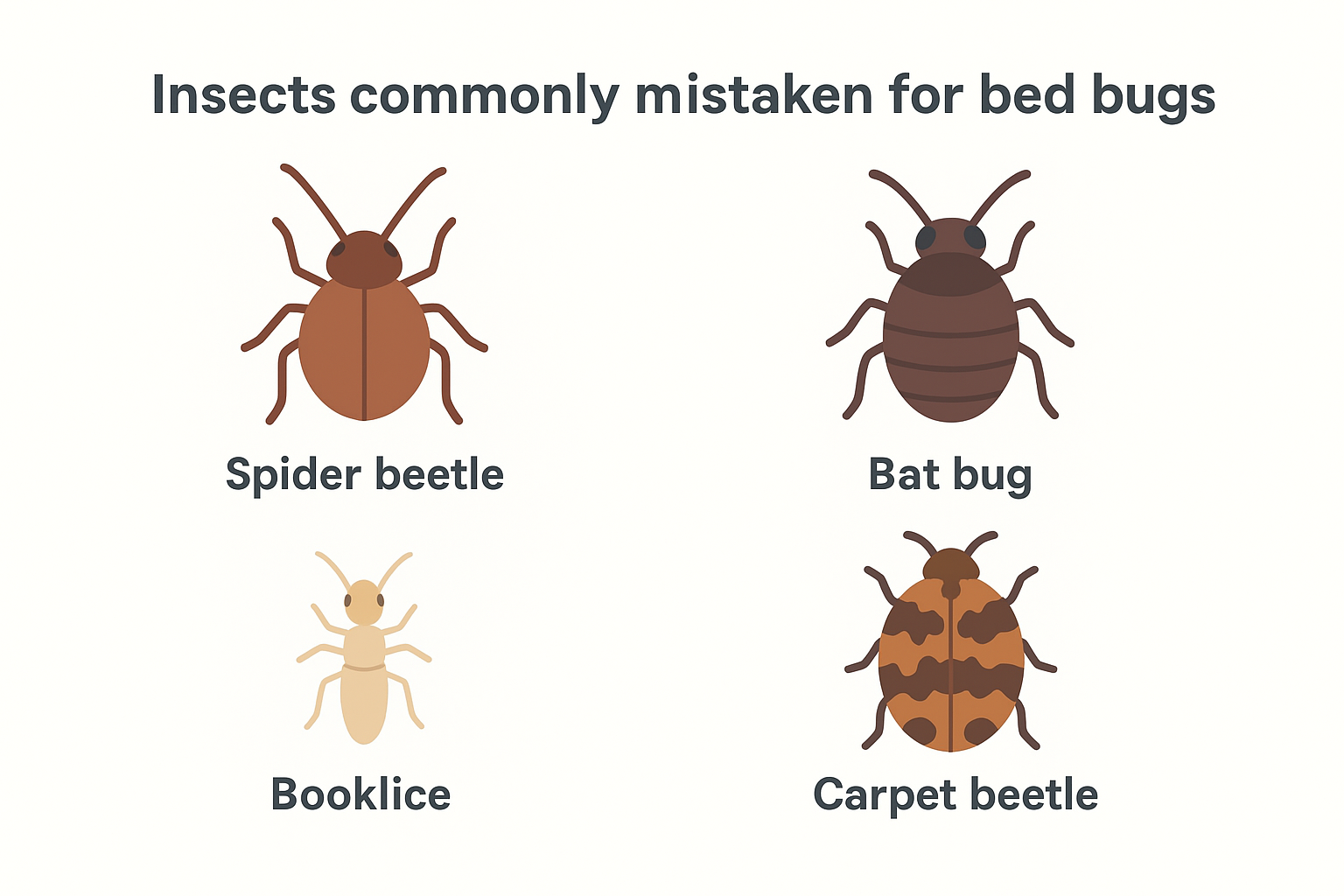
- Spider beetles : Round and reddish-brown, similar in size to a bed bug, but they have two body segments and eight legs with no horizontal ridges on the abdomen.
- Bat bugs : Nearly identical to bed bugs in shape and color, but the hairs on their thorax are noticeably longer . Bat bugs live near roosting bats, not in bedding.
- Booklice : Much smaller and pale, typically found near paper or mold in humid areas. They do not bite humans and pose no health risk .
- Carpet beetles : Oval and similar in size, but they display mottled brown, white, or black patterning and lack the beak-like mouthpart bed bugs use to pierce skin.
- Fleas : Narrower, darker, and capable of jumping . If the bug you found leaps, it is not a bed bug.
Checking body segments, leg count, and how the insect moves gives you a reliable way to rule out these lookalikes before scheduling a professional inspection.
How to inspect your bed and bedroom
Knowing what do bed bugs look like means nothing if you don't know where to search. Bed bugs are deliberate hiders , and a quick visual scan of your mattress top will rarely reveal an active infestation. A thorough inspection takes about 20 to 30 minutes and requires you to work methodically through each hiding spot before drawing any conclusions.
What you need before you start
Gather these items before you begin:
- Bright flashlight : essential for seeing inside dark seams and crevices
- Stiff card or old credit card : drag it along seams to dislodge hiding bugs or eggs
- Magnifying glass : optional, but helpful for spotting eggs and first-stage nymphs
- Latex gloves : keep contamination minimal and protect your hands during handling
Having all four items ready before you start helps you work without stopping partway through. Disturbing bugs without documenting what you find first can cause them to scatter to harder-to-reach locations, which makes a follow-up professional inspection more difficult.
Never vacuum the area before you inspect, since vacuuming can push bugs into new rooms before you understand how widespread the infestation actually is.
A room-by-room inspection order
Start with the mattress itself and work outward from there. Pull off all bedding and seal it in a bag to examine separately. Inspect every seam of the mattress on all four sides, pressing the fabric flat to check inside the folds. Move to the box spring and pull back the dust cover on the underside, since this fabric lining is one of the most common hiding spots in any bedroom.
After the mattress and box spring, check the bed frame and headboard thoroughly , including every joint, screw hole, and visible crack. Bed bugs cluster inside these gaps, especially in wooden frames with natural grain splits that create ideal harborage spaces. Then check your nightstands, both inside the drawers and along the back panel where it presses against the wall.
Work across the rest of the room in a consistent pattern so you don't skip sections . Inspect baseboards, the space behind picture frames, electrical outlet covers, and the seams of any upholstered furniture within a few feet of the bed. Bed bugs rarely travel far from where you sleep, but they will spread to nearby seating if the mattress population grows crowded. If you find even a single adult or a cluster of eggs, stop and contact a pest professional immediately rather than attempting treatment on your own.
If you think you have bed bugs
Knowing what do bed bugs look like puts you ahead of most people who discover an infestation too late. Spotting a single bug, a cluster of eggs, or dark fecal stains on your mattress is enough reason to act immediately. Waiting even a week gives the population more time to spread into furniture, baseboards, and neighboring rooms.
Your next step should be a professional inspection rather than a store-bought spray . Over-the-counter treatments rarely penetrate the hiding spots where bed bugs actually live, and incorrect application can cause bugs to scatter deeper into your home. At Defender Termite & Pest Management, we've helped Sacramento-area homeowners and businesses eliminate bed bug problems since 1999. Our team is available 24/7 for emergency inspections and can confirm an infestation the same day you call. Request a pest inspection from our Sacramento team and get answers before the problem gets worse.