National Wildlife Control Operators Association: What It Is And Does
If you have spotted the initials NWCOA on a technician's truck or a certificate on the wall of a wildlife company, you probably want to know what it actually means. The National Wildlife Control Operators Association is the main professional body for wildlife control operators in the United States, and it sets the bar for training, ethics, and business standards in an industry that otherwise has very little oversight. Understanding what this group does helps you tell a serious operator from someone who just bought a live trap and a truck magnet.
This article breaks down exactly what the NWCOA is, how membership works , and what its certification programs cover, from basic wildlife control officer training to advanced credentials in bat and bird management. You will also see how these standards compare to state licensing requirements.
We put this together because homeowners and property managers in the Sacramento area regularly ask us how to vet a wildlife company before letting anyone onto their roof or into their attic. Knowing what NWCOA credentials actually verify gives you a real way to judge industry qualifications before you sign a contract.
Why the NWCOA matters to homeowners and pros
Wildlife control sits in a strange gap in most states. Pest control operators often need a pesticide license, but trapping a raccoon out of your attic or removing a colony of bats does not always require the same paperwork. That gap is exactly why the National Wildlife Control Operators Association exists. It fills the training void that state agencies leave open, giving technicians a real curriculum on animal behavior, humane handling, and safe exclusion work instead of leaving them to figure it out on the job.
The oversight gap in wildlife work
Many states regulate nuisance wildlife control loosely compared to structural pest control or termite work. A technician might hold a basic state permit to trap and relocate animals, yet have zero formal instruction on things like one-way door exclusion for bats, proper ventilation after a rodent job, or how to avoid injuring a mother raccoon separated from her kits. NWCOA training programs were built specifically to close that gap.
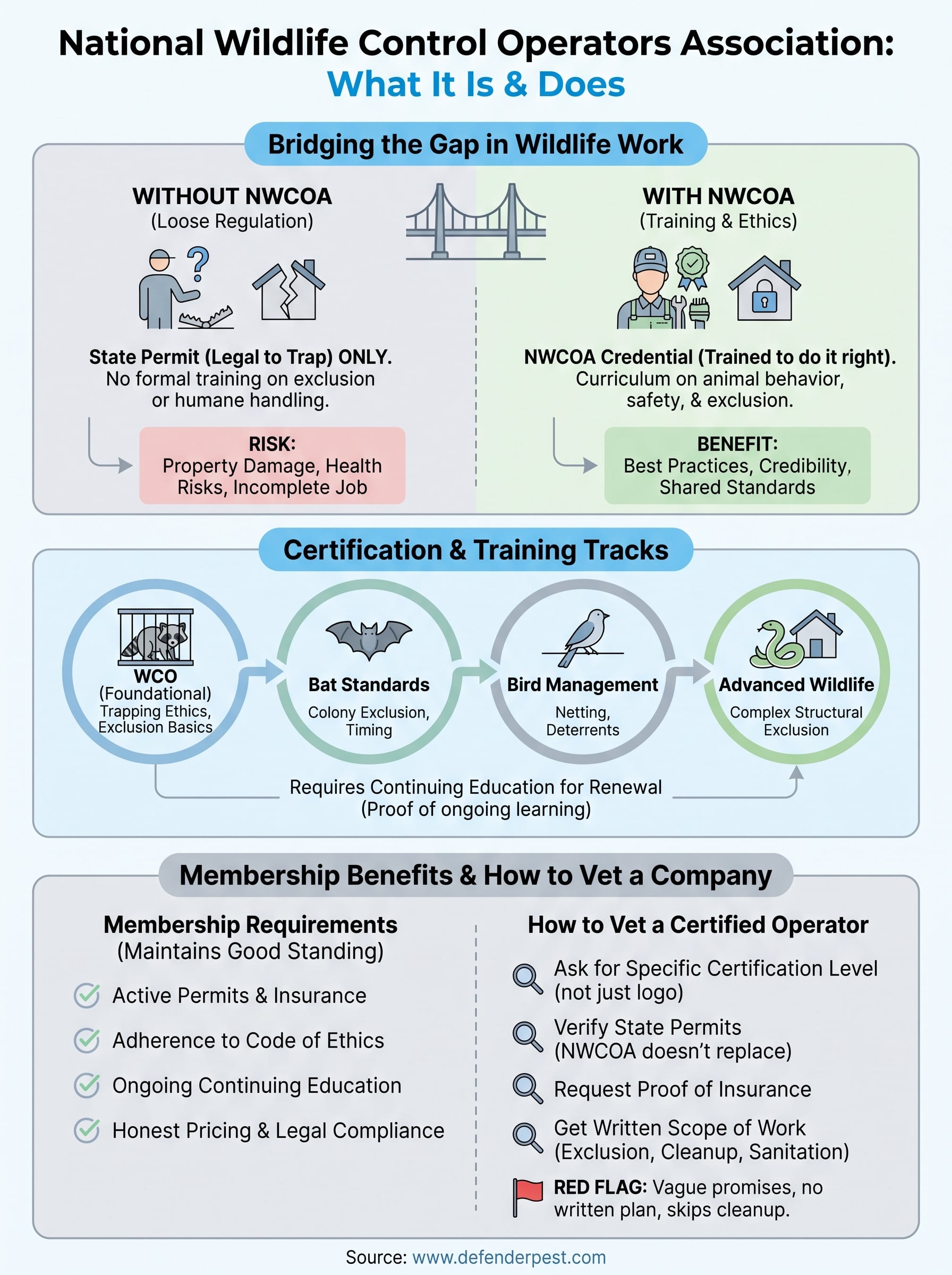
A state permit tells you someone can legally trap an animal; an NWCOA credential tells you they were actually trained to do it right.
What this means for you as a client
For homeowners, this distinction matters more than it seems. You are usually dealing with an active problem, squirrels chewing through a soffit, a skunk under the porch, bats in the eaves, and you need someone who won't just remove the animal but will also handle the cleanup, sanitation, and exclusion correctly the first time. Property damage and health risks from droppings, parasites, and chewed wiring only get worse with a sloppy job.
For pest and wildlife companies, NWCOA affiliation signals something to both customers and industry peers: a documented commitment to best-practice standards rather than the bare minimum required by law. That credibility helps operators win trust with real estate agents, insurance adjusters, and repeat commercial clients who need documentation, not just a phone call promising the problem is solved. It also gives companies a shared reference point for training new technicians instead of building everything from scratch.
How NWCOA certification and training work
Certification through the National Wildlife Control Operators Association works on a tiered system, starting with foundational courses and building toward species-specific expertise. Technicians typically begin with the Wildlife Control Operator (WCO) certification, which covers trapping ethics, exclusion methods, and basic zoonotic disease awareness. From there, operators can pursue advanced credentials in bat management, bird control, or venomous snake handling, depending on what their local market demands.
Course formats and testing
Most coursework blends online modules with hands-on workshops held at regional NWCOA conferences, so technicians learn theory before practicing exclusion techniques on real structures. Exams test knowledge of animal biology, humane trap placement, and legal handling requirements that vary by state, since federal law treats many species differently than individual state wildlife agencies do.
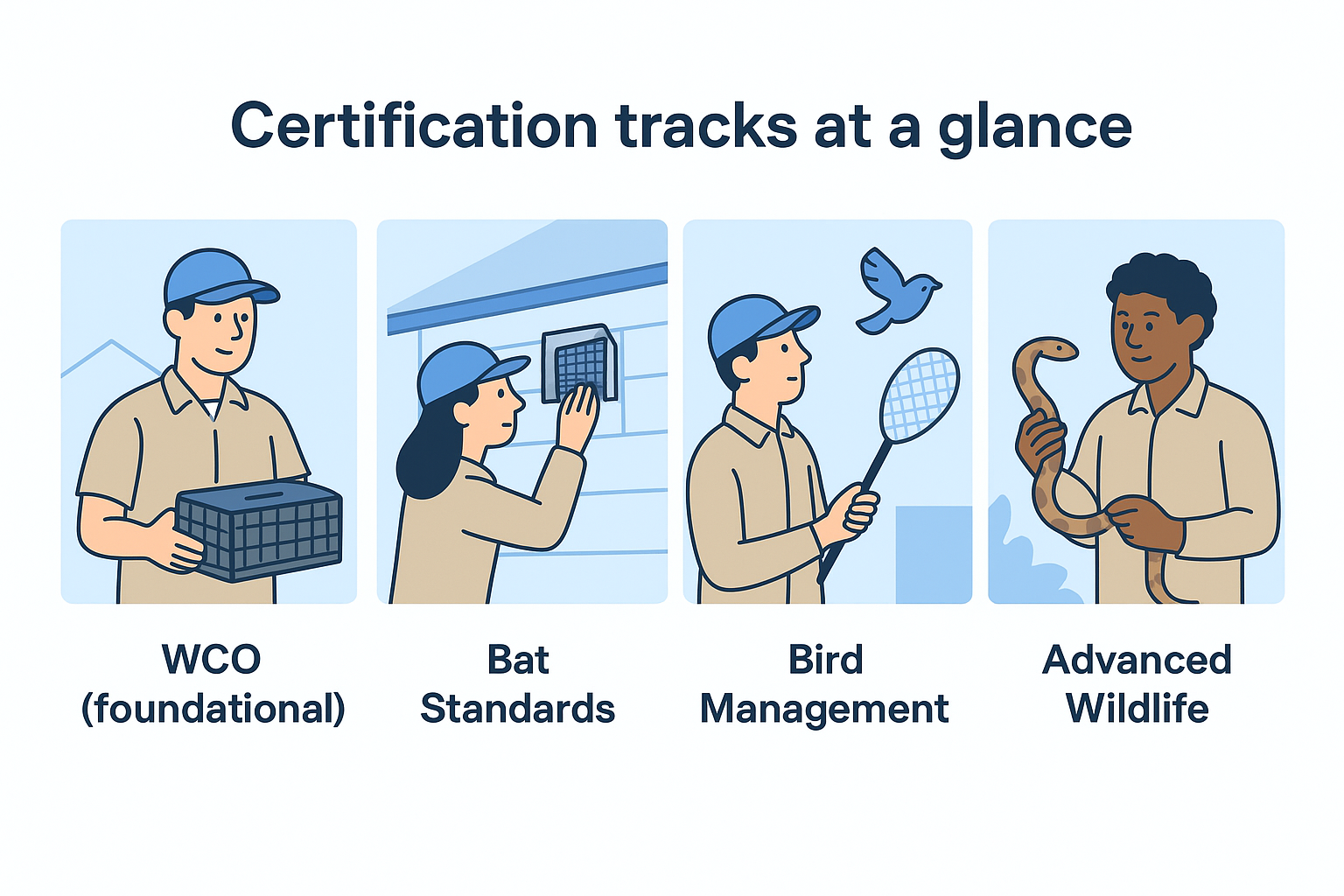
Certification tracks at a glance
| Certification | Focus Area | Typical Audience |
|---|---|---|
| WCO (foundational) | General trapping, exclusion basics | New technicians |
| Bat Standards | Colony exclusion, timing restrictions | Bat removal specialists |
| Bird Management | Netting, deterrents, nest removal | Commercial property teams |
| Advanced Wildlife | Complex structural exclusion | Senior field techs |
Renewal isn't automatic. Operators must complete continuing education hours every few years to keep their certification standards current as techniques and regulations shift.
Certification isn't a one-time badge, it's proof someone keeps learning as wildlife laws and methods change.
Companies that invest in this training pipeline usually treat it as a baseline expectation for staff, not a marketing add-on.
Membership benefits and requirements
Joining the National Wildlife Control Operators Association isn't just paying dues and getting a decal. Applicants sign a code of ethics covering humane treatment, honest pricing, and legal compliance before they're accepted, and the association can revoke membership if a company violates that code. This vetting step matters because it separates operators who treat standards as a real commitment from those chasing a logo for their website.
What members must maintain
Staying in good standing requires more than an initial application. Members need:
- Active state or local trapping/wildlife permits where required
- Proof of liability insurance
- Ongoing continuing education credits tied to certification level
- Adherence to the NWCOA code of ethics and business practices
Lapses in any of these can trigger a review, which keeps the membership list from becoming a static directory of names that stopped caring years ago.
Membership only means something if the organization is willing to remove companies that stop earning it.
Why membership pays off for operators
Benefits flow both ways. Members get access to liability insurance discounts , group purchasing on trapping equipment, legal updates on state and federal wildlife law, and a referral network that sends business to properly credentialed companies. Property managers and homeowners benefit indirectly, since a company motivated to keep its membership active has a financial reason to keep training current and paperwork clean. That accountability loop is exactly what's missing in the unregulated corners of wildlife control, and it's why membership status is worth checking before you hire anyone.
How to find and vet a certified wildlife control operator
Finding a legitimate operator starts with checking whether a company actually holds current standing with the National Wildlife Control Operators Association , not just a logo pasted on their homepage. Ask directly for their member number or certification level, then verify it rather than taking their word for it.
Steps to confirm credentials
Before signing anything, run through this checklist:
- Ask for the technician's specific certification level, not just the company's general membership
- Request proof of state trapping or wildlife permits, since NWCOA credentials don't replace local licensing
- Confirm active liability insurance and ask to see a certificate of insurance
- Check for continuing education records if the work involves bats, birds, or other regulated species
- Get a written scope of work covering exclusion, cleanup, and sanitation, not just removal
A company that hesitates to prove its credentials probably doesn't have much to prove.
Red flags worth walking away from
Watch for vague verbal promises instead of documented plans, technicians who can't explain exclusion timing for bats or nesting seasons for birds, and pricing that skips sanitation or repair work entirely. Legitimate operators explain their process step by step because they were trained to follow one. Sacramento homeowners dealing with attic damage or persistent rodent activity should treat this vetting process the same way they'd vet a termite inspector: check the paperwork first, then the reputation, and only then the price.

Choosing a qualified wildlife control partner
The National Wildlife Control Operators Association exists because state licensing alone doesn't guarantee a technician knows how to exclude bats safely or handle a mother raccoon without hurting her kits. Certification, active membership, and a documented code of ethics give you a real way to separate trained professionals from anyone with a trap and a truck. Vetting these credentials before you sign a contract protects your property, your family, and your wallet from a rushed or careless job.
You don't have to memorize every certification tier to hire smart. Just ask for proof, check the permits, and expect a written scope of work covering exclusion and cleanup, not just removal. If you're in the Sacramento area and dealing with raccoons, bats, or rodents in your attic right now, reach out to Defender Termite & Pest Management for a straightforward inspection and a plan you can actually verify.