How To Get Rid Of Cockroaches In An Apartment Fast
Cockroaches in an apartment hit different than in a house. You share walls, plumbing, and ventilation with neighbors, which means even if you keep your unit spotless, roaches can still show up uninvited. If you're wondering how to get rid of cockroaches in an apartment , you need strategies that account for these shared spaces and limited control over the building around you .
The good news: you can make real progress on your own. With the right combination of sanitation, targeted treatments, and entry point sealing, most apartment dwellers can knock down a cockroach problem significantly. But it helps to understand why apartments are so vulnerable in the first place and what actually works versus what's a waste of time and money. That's exactly what this guide covers .
At Defender Termite & Pest Management, we've been handling cockroach infestations across Sacramento and the surrounding area since 1999 . We've seen what apartment residents deal with firsthand, from German cockroaches taking over kitchens to Oriental roaches creeping up through drains . Below, we'll walk you through the DIY methods, natural options, and prevention steps that work, plus how to tell when it's time to call in professional help.
Why roaches show up in clean apartments
Most people assume cockroaches only infest dirty spaces. That's not how apartments work. In a multi-unit building, your unit shares walls, pipes, and ventilation ducts with every neighboring unit. A roach problem two floors down can become your problem within days. The structure itself acts as a highway system, and cockroaches travel it constantly in search of food, water, and warmth.
In apartment buildings, cockroach movement between units is one of the leading reasons infestations are so hard to control without addressing the whole building.
Shared infrastructure is the real problem
Roaches enter your unit through gaps you'd never think to inspect. Plumbing penetrations under sinks , the space around electrical conduits, and gaps where walls meet flooring are all common entry points. German cockroaches, the most common apartment species, are flat enough to squeeze through a crack as thin as a dime . Once inside, they follow moisture and heat, which is why kitchens and bathrooms get hit hardest.
What actually draws them in
Even a clean apartment offers roaches what they need. A single dripping faucet or condensation on pipes provides enough water to sustain a colony. Pet food left in a bowl overnight, a small grease buildup behind the stove, or crumbs caught under a kitchen appliance are all viable food sources. Roaches can also survive on paper, cardboard, and even soap residue, so "clean" by human standards still means well-stocked by roach standards. Understanding this is essential if you want to know how to get rid of cockroaches in an apartment and keep them out for good.
Step 1. Find where they hide and how they enter
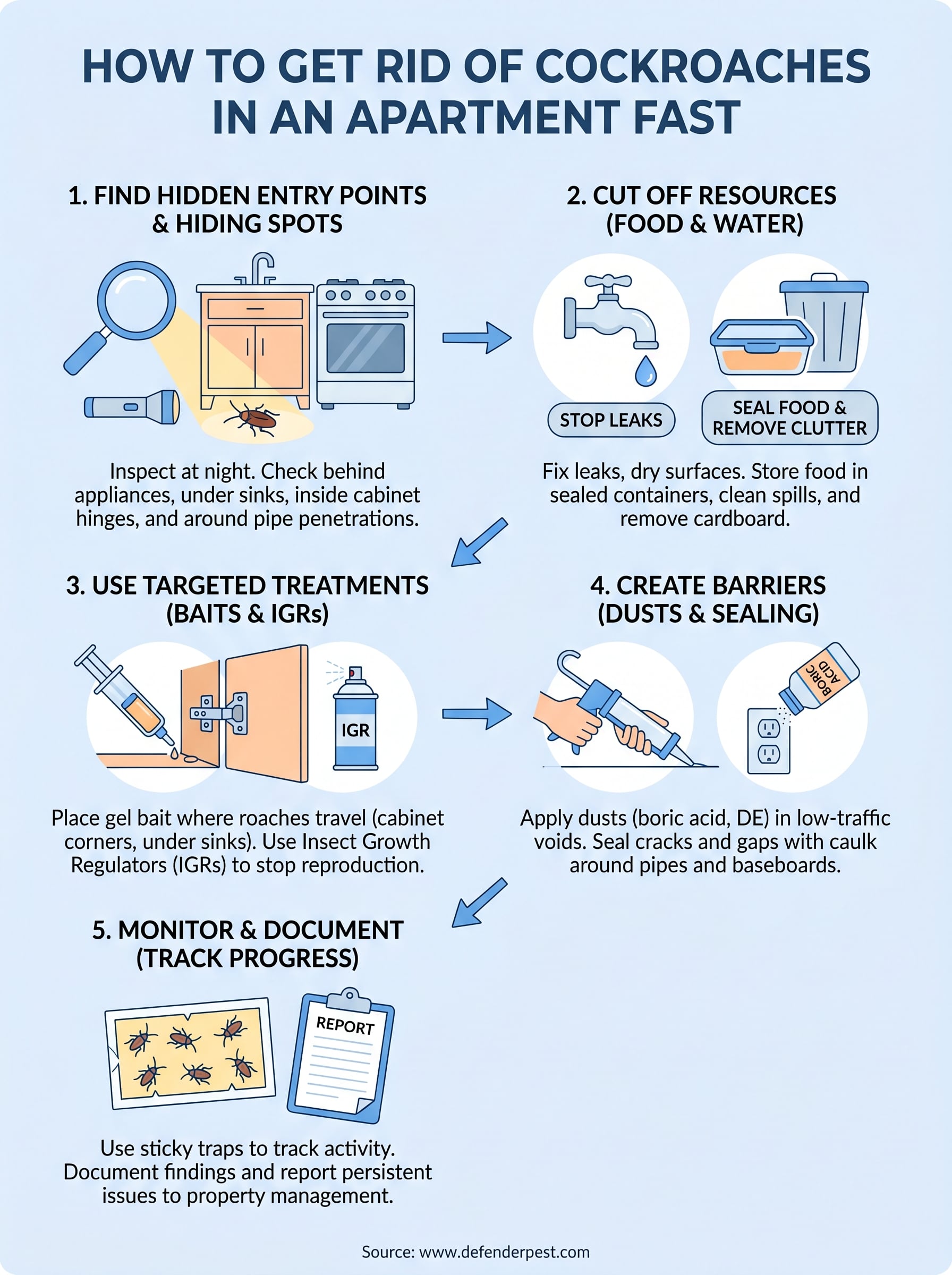
Before you treat anything, you need to know where roaches are living and how they're getting in . Grab a flashlight and inspect at night, when cockroaches are most active. Check behind the refrigerator, under the stove, and inside cabinet hinges first, since these spots stay warm, dark, and close to food residue.
Inspecting at night gives you a far more accurate picture of the infestation size than a daytime check.
Common entry points to inspect
Apartment cockroaches typically enter through gaps in plumbing under sinks , around pipe penetrations in walls, and along the edges where baseboards meet flooring. Check each of these locations closely:
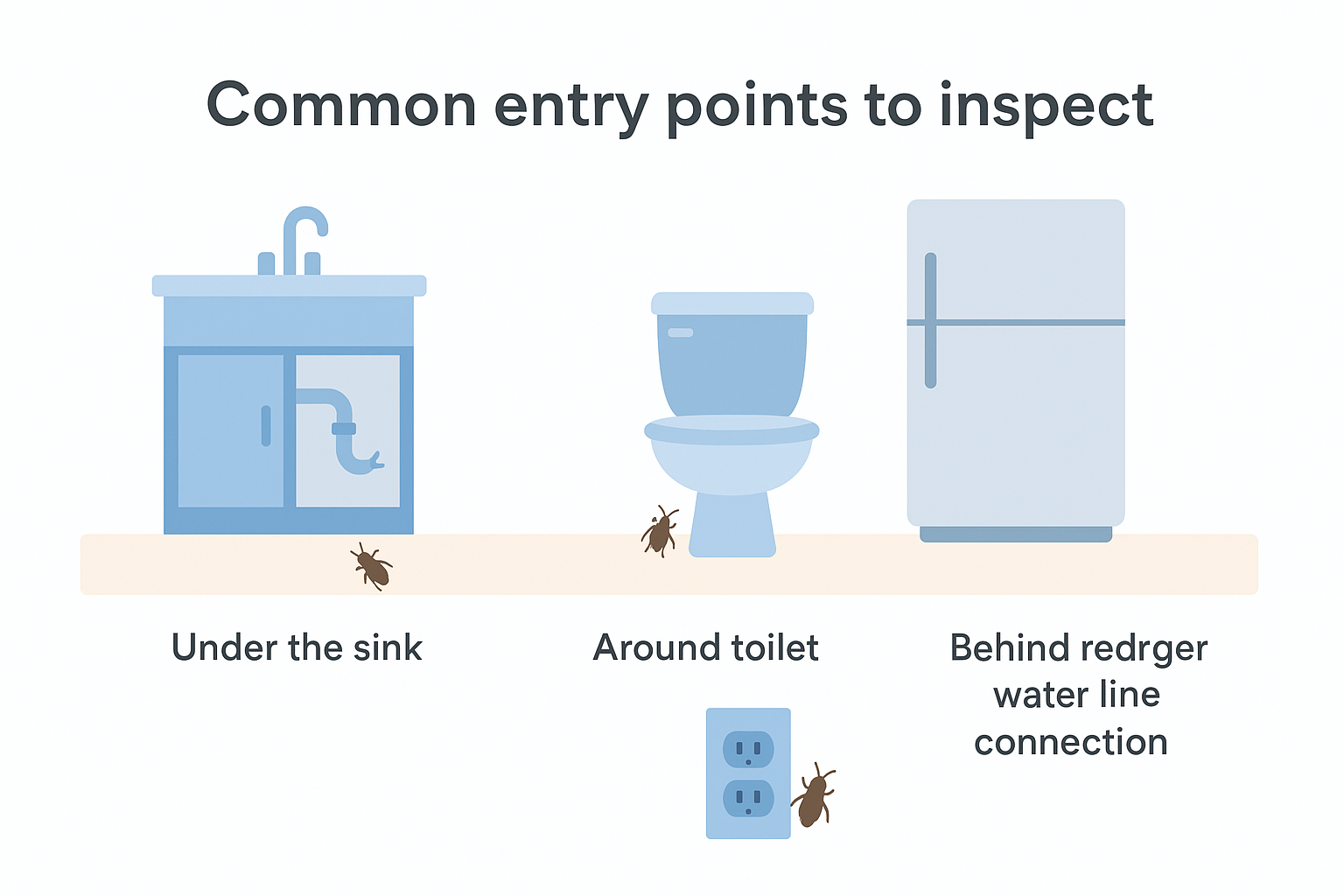
- Under kitchen and bathroom sink cabinets
- Around toilet bases and pipe collars
- Behind the refrigerator's water line connection
- Electrical outlet boxes on shared walls
- The gap between the stove and adjacent counter
Knowing your entry points is the first real step in figuring out how to get rid of cockroaches in an apartment, because treating without sealing those gaps just keeps the cycle going as more roaches move in from neighboring units.
Step 2. Remove food, water, and hiding spots fast
Sanitation is one of the fastest steps to slow a cockroach population. Roaches need food, water, and shelter to survive, and cutting off even one forces them to move or die. Fixing a dripping pipe or wiping grease buildup behind your stove can produce noticeable results fast.
Eliminating moisture sources often does more to reduce cockroach activity than any store-bought spray.
Fix moisture problems first
Cockroaches survive weeks without food but only days without water. Check under kitchen and bathroom sinks for leaks or pipe condensation, and dry those surfaces. Standing water in dish drains left overnight is enough to sustain a small colony.
- Fix any dripping faucets or slow leaks under sinks
- Dry sink basins and dish drains each night
- Check for pipe condensation on cold water lines
Remove food access and clutter
Store dry goods in sealed containers , not original cardboard packaging. Cardboard also serves as a hiding spot, so removing it is part of how to get rid of cockroaches in an apartment. Sweep under appliances weekly and never leave pet food out overnight:
- Wipe stove surfaces after every meal
- Take trash out nightly
- Remove cardboard boxes from under sinks
Step 3. Use baits and IGR the right way
Bait stations and insect growth regulators (IGRs) are two of the most effective tools for apartment cockroach control. Unlike sprays that push roaches deeper into walls, gel bait draws them out to feed and spread the active ingredient back through the colony via contact and consumption.
Gel bait placed in the right spots consistently outperforms aerosol sprays for lasting cockroach control.
Place bait where roaches travel
Put gel bait inside cabinet hinges and along shelf edges , avoiding surfaces cleaned with strong chemicals since those repel roaches away from the bait. Refresh bait every two to three weeks or when it dries out and hardens.
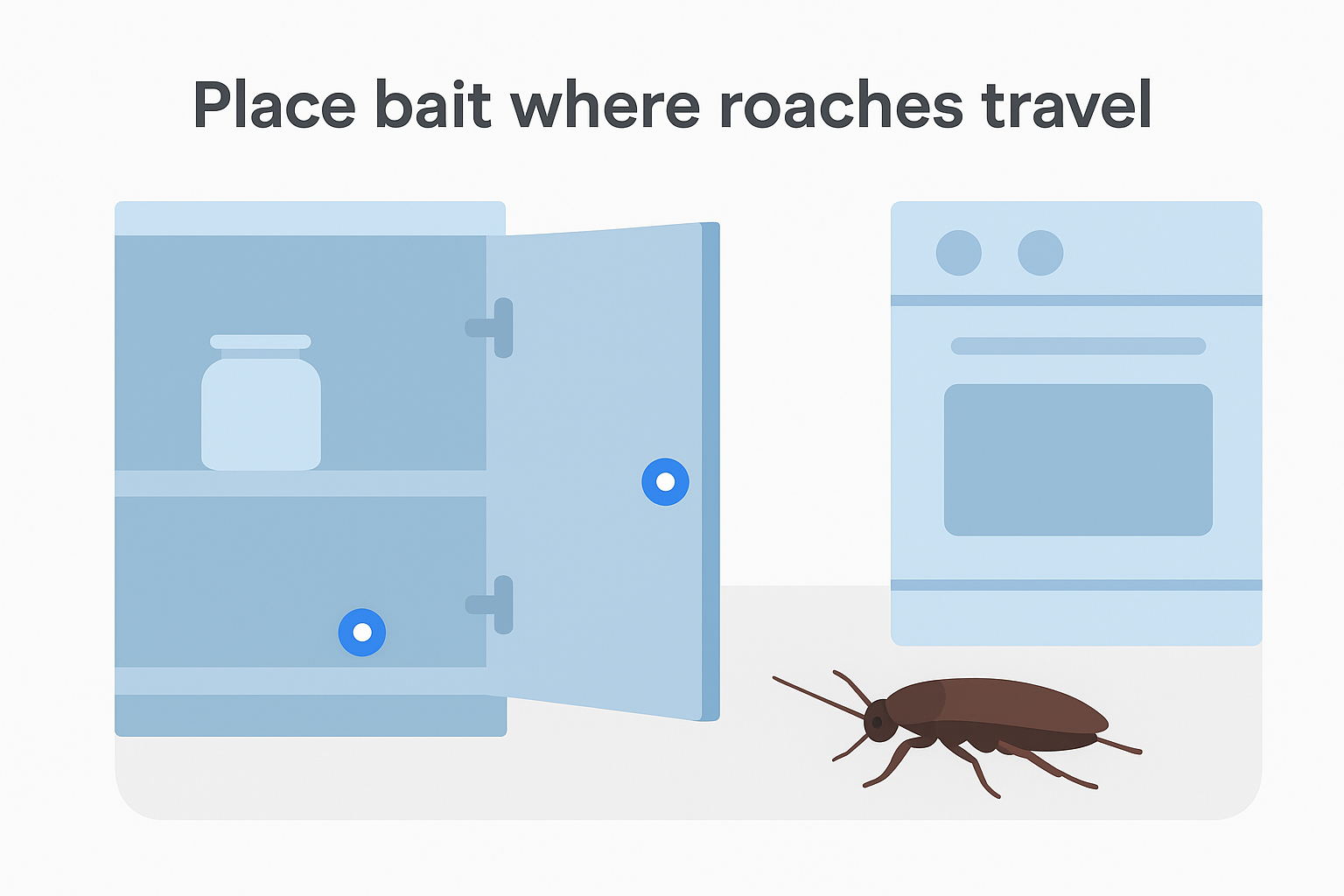
- Inside cabinet hinges and dark corners
- Under sink cabinets near pipe penetrations
- Along the back edge of stove drawers
Add an IGR to stop reproduction
An IGR like hydroprene or pyriproxyfen prevents juvenile roaches from reaching reproductive maturity. Knowing how to get rid of cockroaches in an apartment long-term means stopping the population from rebuilding after adults die, which is exactly what IGRs do when layered on top of gel bait.
- Apply IGR spray in the same zones as your gel bait
- Reapply every 30 to 90 days per product instructions
Step 4. Add dusts and seal cracks
Dusts like boric acid and diatomaceous earth work differently than bait or sprays. They stay active for months when left undisturbed, and cockroaches pick up particles while moving through treated areas. Combined with physical sealing , this step cuts off existing hiding spots and blocks future entry routes from neighboring units.
Boric acid applied in a thin, barely visible layer works better than a heavy application, which roaches will detect and simply walk around.
Apply dust in low-traffic voids
Place boric acid or diatomaceous earth in spots you won't disturb regularly. Wear a mask during application and keep all dust away from food preparation surfaces :
- Inside wall voids accessed through outlet covers
- Beneath cabinet toe kicks
- Along the back edge of appliance gaps
Seal cracks to block roaches between units
Use paintable silicone caulk to close gaps along baseboards and around pipe penetrations. Knowing how to get rid of cockroaches in an apartment long-term depends on physical barriers that stop roaches from neighboring units from moving back in after treatment:
- Baseboards along shared walls
- Pipe collars under kitchen and bathroom sinks
- Gaps where countertops meet the wall
Step 5. Monitor, document, and involve management
After treating your unit, tracking what happens next tells you whether your efforts are working or if the infestation is being fed from neighboring units. Monitoring is not optional when you're figuring out how to get rid of cockroaches in an apartment for good.
Sticky traps give you hard numbers, which carry far more weight with property management than verbal complaints.
Track activity with sticky traps
Place sticky monitoring traps inside cabinet corners, under the sink, and along the back of the stove. Check them every three to five days and note which locations catch the most roaches. If one area spikes repeatedly after treatment, that spot likely connects to a neighboring unit through a wall void or shared pipe.
Document and report to management
Your landlord or property manager is legally responsible for pest control in most states, including California. When you report the issue, bring dated trap counts, photos, and a written record of steps you've already taken. Submit your complaint in writing so there's a paper trail they can't ignore, and request confirmation that neighboring units are being treated as well.
Keep your apartment roach-free
Knowing how to get rid of cockroaches in an apartment is only half the job. Keeping them out requires consistency. Refresh your gel bait every two to three weeks, check your sticky traps on a set schedule, and re-caulk any gaps that open up as the building settles. Cockroaches come back when conditions allow it, so small maintenance habits matter more than any single treatment.
Your best long-term defense combines sanitation, physical barriers, and ongoing monitoring into a routine you actually stick to. If traps keep spiking after several weeks of treatment, the infestation likely runs deeper than one unit, and that calls for building-wide action. When DIY stops being enough, professional treatment gets faster results and reaches wall voids and shared spaces that are difficult to access on your own. The team at Defender Termite & Pest Management has handled cockroach infestations across Sacramento since 1999 and can help you take back your space for good.